What Does It Cost to Remodel a House in South Florida?
Why no honest per-square-foot price exists, and the scope, flood, hurricane-code, tax and contract rules that actually set a South Florida remodel budget.
$5,000contract size that needs a notice of commencement
By Elbaz ConstructionUpdated September 26, 202611 min readSources: Florida Building Code · Florida Statutes · FEMA · EPA · Florida DOR
Whole-house remodel cost
The short answer
?
There is no honest per-square-foot price for remodeling a house in South Florida, and we do not publish one. The same house can cost a small or a large multiple depending on four things: how much of the house the work touches (which decides how much of the current building code comes in), whether the house is in a flood zone (where work costing 50% or more of the structure’s value triggers full flood compliance), the hurricane-rated products the code requires, and what is found behind the walls. Fees, sales tax and design add to that. For scale, a national survey put even a midrange minor kitchen remodel at an average of $28,458 in 2025.
01
Scope level
Replacing finishes, reconfiguring rooms, or reworking more than half the house: each brings in more of the code.
02
Flood zone
At 50% of the structure’s market value, the whole house must meet flood rules for new construction.
03
Hurricane code
Impact-rated windows, doors and roofing are required in Miami-Dade and Broward.
04
Hidden conditions
Age, lead paint, rot and old wiring surface at demolition and change the scope.
Scope and code
The first cost driver: how much of the house the work touches
Florida classifies work on an existing building by what it changes, in the Florida Building Code, Existing Building (8th edition, 2023). The class decides how much of today’s code the project has to meet, and that is where budgets split:
Level 1 (section 602.1) is the removal and replacement, or covering, of existing materials, elements, equipment or fixtures with new ones that serve the same purpose. New cabinets and counters in the same kitchen layout are a typical example.
Level 2 (603.1) is the reconfiguration of space, adding or removing a door or window, reconfiguring or extending a system, or adding equipment, where the work area is up to half of the building area. Moving walls to open a kitchen is Level 2.
Level 3 (604.1) applies “where the work area exceeds 50 percent of the building area”. That is most true whole-house renovations, and it carries the most requirements.
Additions add floor area or height; the new part is built to the code for new construction.
Simplified from sections 602–604 and chapter 5 of the Florida Building Code, Existing Building, 8th edition (2023). The building official classifies the work from your drawings.
The practical lesson: two projects with the same finishes can land in different classes. Keeping the kitchen where it is, or phasing work so the work area stays under half the house, changes what the code asks for. Deciding that deliberately, at the design stage, is cheaper than discovering it at plan review.
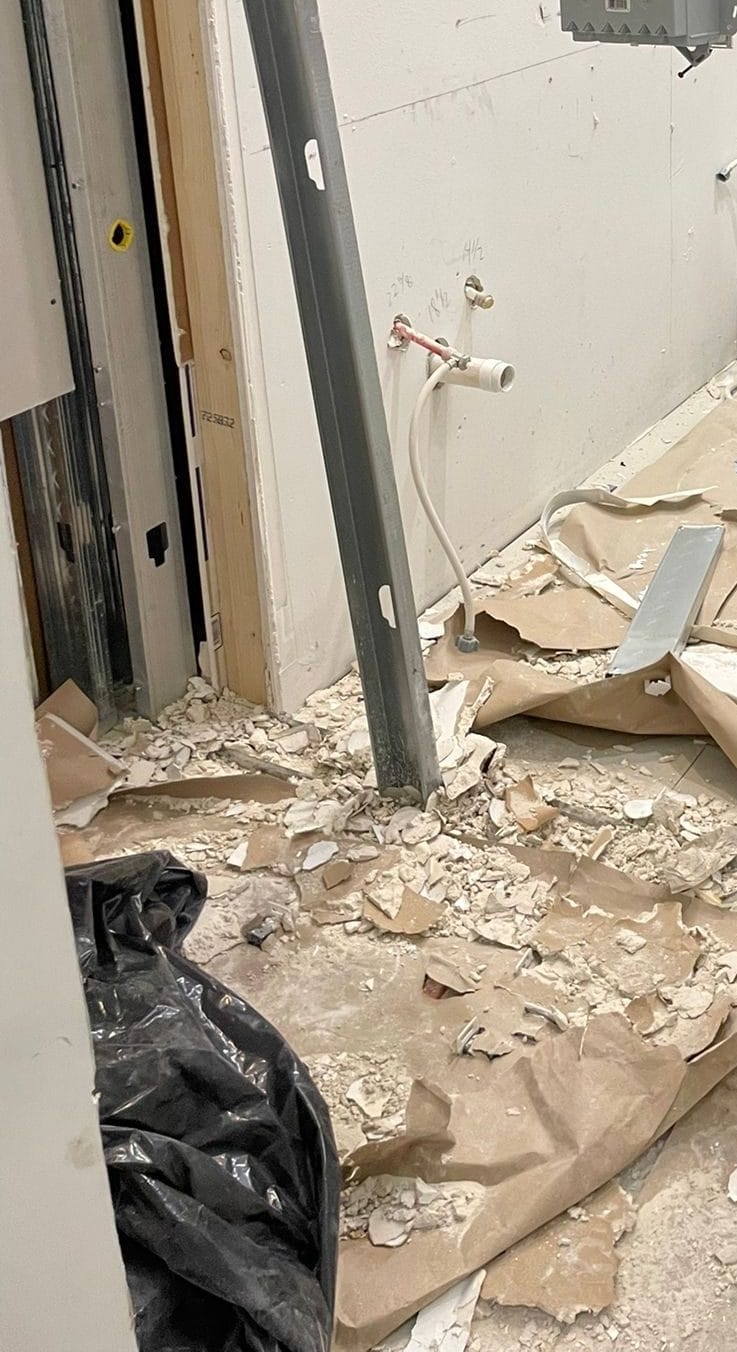
Demolition on an Elbaz Construction remodel: wallboard stripped to expose the supply pipes. Behind the walls is where scope changes.
Flood zones
In a flood zone, the 50% rule can decide the whole budget
If the house is in a Special Flood Hazard Area, federal floodplain rules add a second test that ignores the code level. Any improvement whose cost equals or exceeds 50% of the market value of the structure is a substantial improvement (44 CFR 59.1), and the Existing Building Code then requires the building to meet the flood requirements for new construction (sections 502.2, 503.2 and 701.3). For an older, lower house that can mean elevating it, which changes the project entirely.
Cost of the improvementmaterials, labour, overhead, sales tax÷Market value of the structurethe building only, not the land=≥ 50%substantial improvement: full flood compliance
Counted in the cost
Materials and labour, including owner labour
Demolition and site preparation
Contractor overhead, profit and sales tax
Windows, doors, roofing and finishes
Plumbing, electrical, HVAC and built-in appliances
Left out
Plans, surveys and permit fees
Landscaping, driveways, fences and pools
Detached accessory structures
Plug-in appliances
Minimum work to correct cited code violations
The lists follow FEMA’s substantial improvement desk reference (P-758). Florida also prohibits local governments from adding up improvements over several years to reach the 50% line (section 163.31795, Florida Statutes). Our full guide to the FEMA 50% rule in South Florida explains how the market value is set and how to check your flood zone before the scope is fixed.
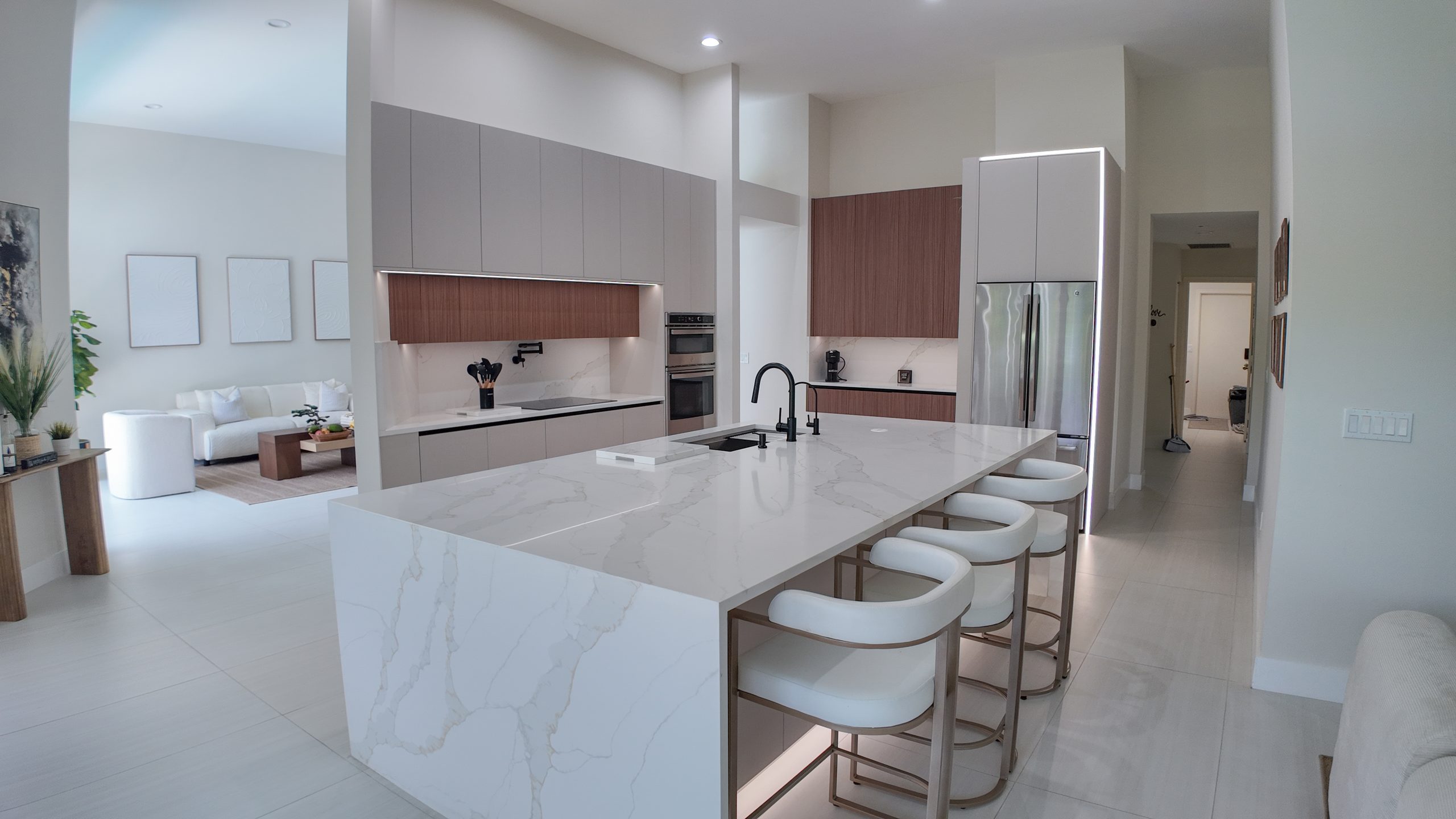
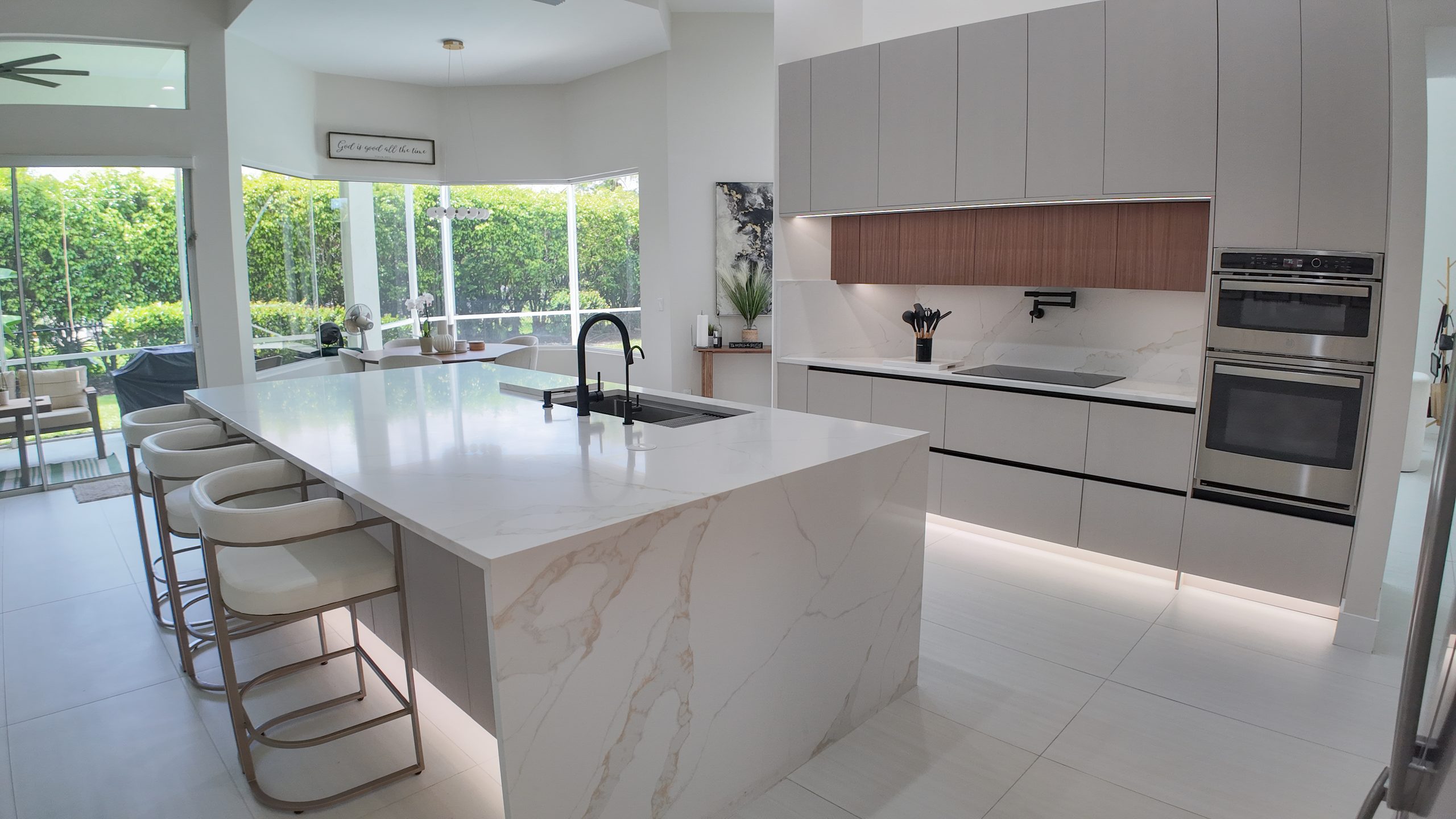
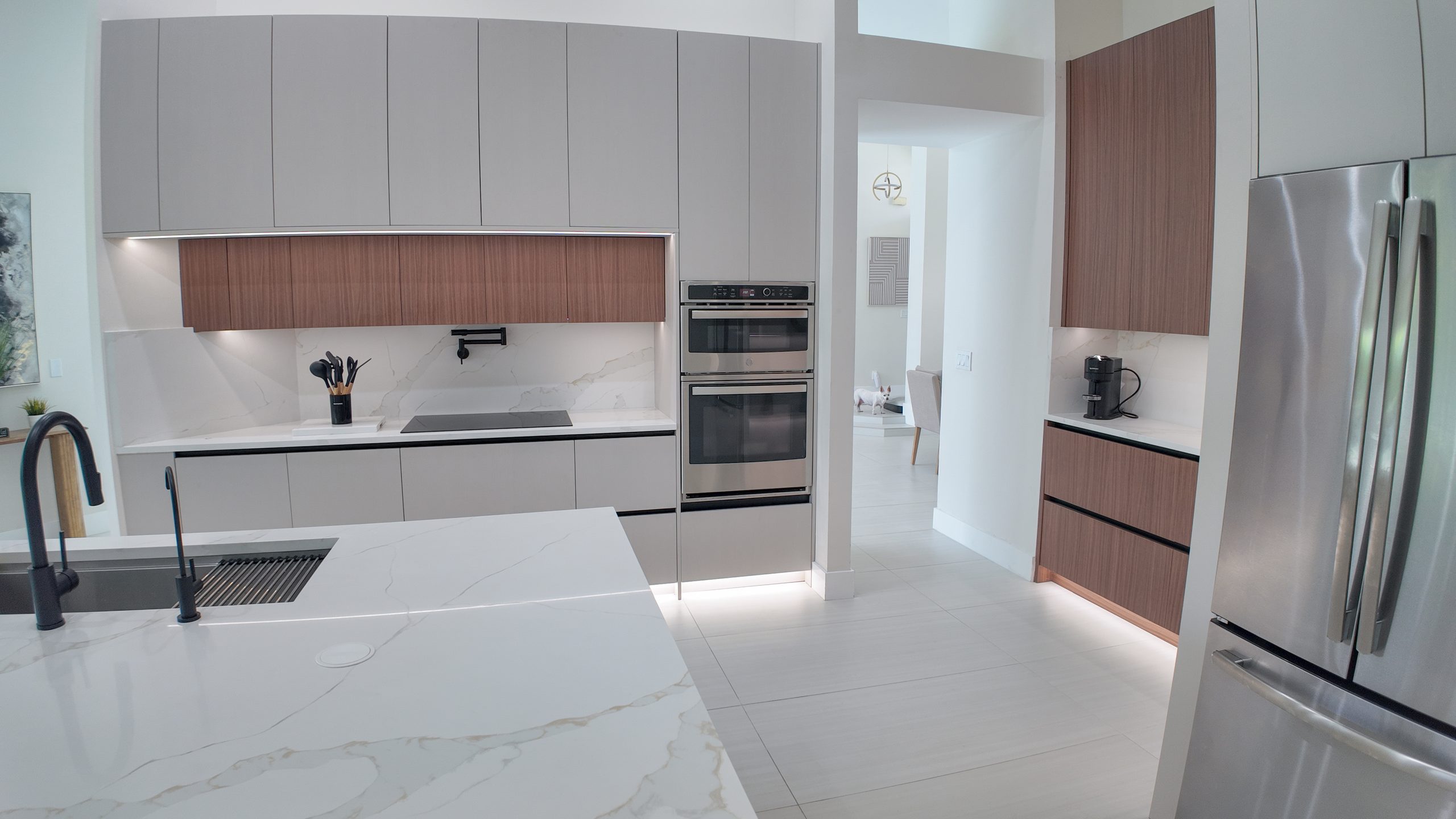
An open kitchen and dining area from an Elbaz Construction remodel: waterfall-edge island, handleless cabinetry and walnut accents.
Windows, doors and roofs
Hurricane code: why openings and roofs cost what they do
The Florida Building Code defines the High-Velocity Hurricane Zone as Broward and Miami-Dade counties. There, exterior walls, the roof, outside doors, skylights and glazing “shall meet impact test criteria or be protected with an external protection device” (section 1626.1), and products need approval: Florida names Miami-Dade’s Product Control Division as an approved evaluation entity (section 553.842). Palm Beach County is outside the HVHZ, so its requirements differ.
For a whole-house budget this means two things. Replacing windows and doors across a house is one of the largest single line items, because every opening needs a tested, approved product and a compliant installation. And the product approvals belong in the permit package, which is why we choose them before we submit. See our hurricane-rated window systems.
Roofs follow their own rule. Under section 553.844(5), Florida Statutes, when 25% or more of a roof is repaired, replaced or recovered, and the roof was built to the 2007 Florida Building Code or later, only the portion being worked on has to meet the current code. For older roofs, that relief does not apply, which is worth knowing before you decide whether the roof belongs in the project.
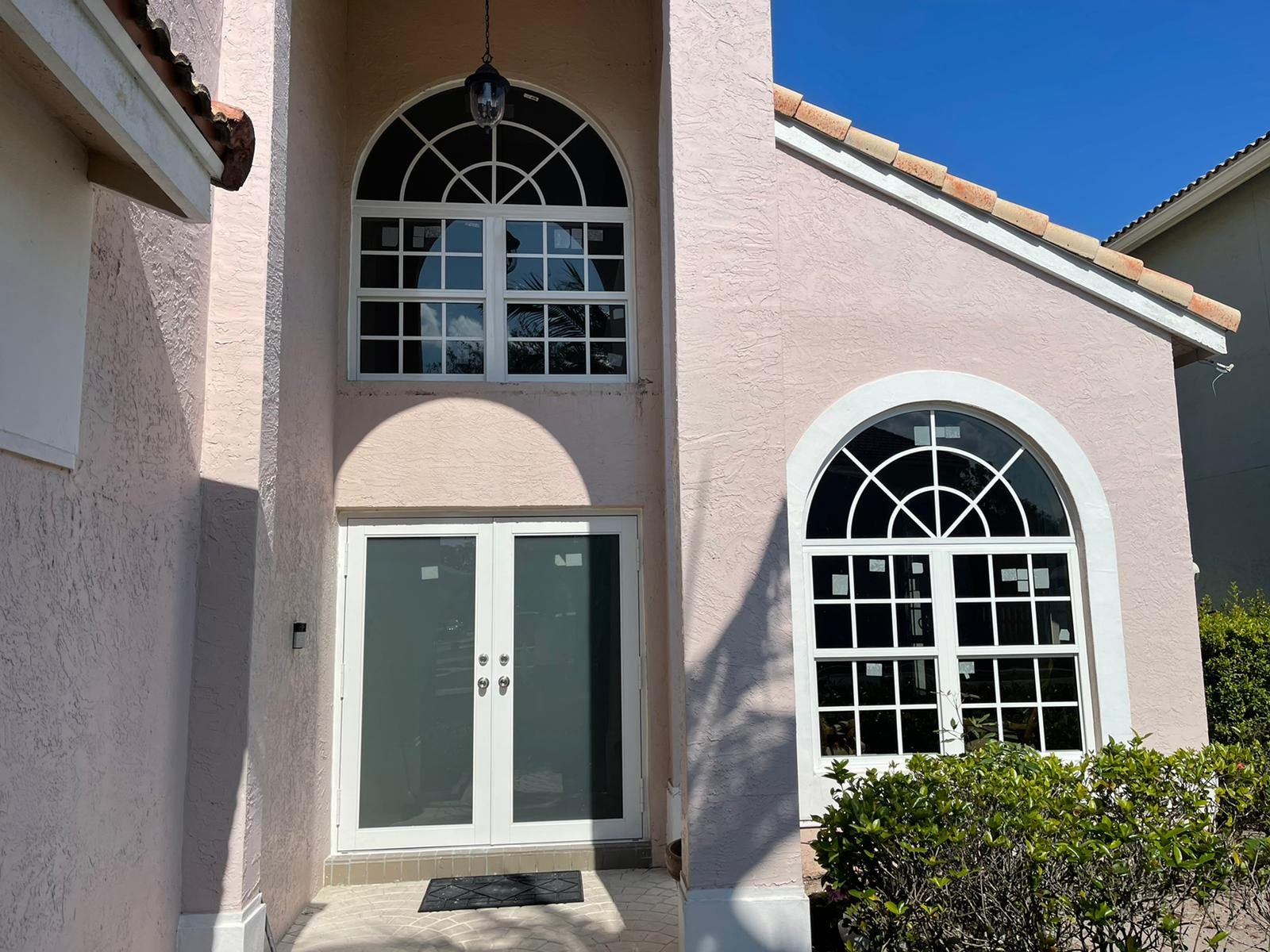
Impact windows and French doors installed by Elbaz Construction, with the product labels still on the glass.
Hidden conditions
Older homes: what the walls and paint can add
The age of the house shapes the budget twice. First, anything hidden: once walls and floors are open, rot, termite damage, earlier leaks or outdated wiring become part of the job, and the repair is work nobody could price in advance. Second, paint. If the house was built before 1978, the EPA’s Renovation, Repair and Painting rule requires the firm to be EPA- or state-certified and to use certified renovators and lead-safe work practices. The minor-repair exception covers only 6 square feet or less of painted surface per room inside, or 20 square feet outside, and never covers window replacement or demolition (40 CFR 745.83). A whole-house remodel of a pre-1978 home will almost always go past those limits.
Neither can be priced honestly from the street. What you can do is agree in the contract how a hidden condition will be documented, priced and approved before work continues, and hold a contingency for it.
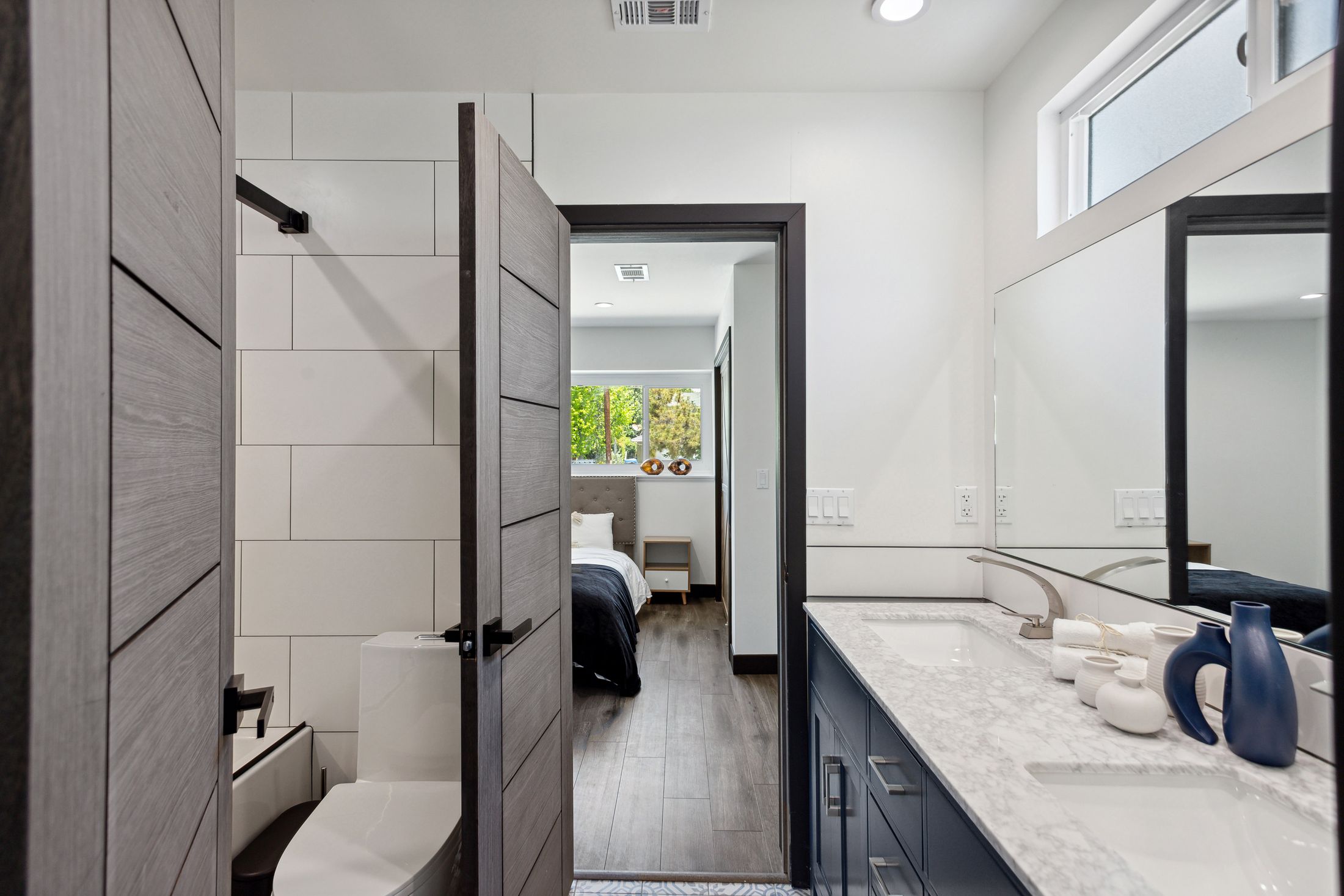
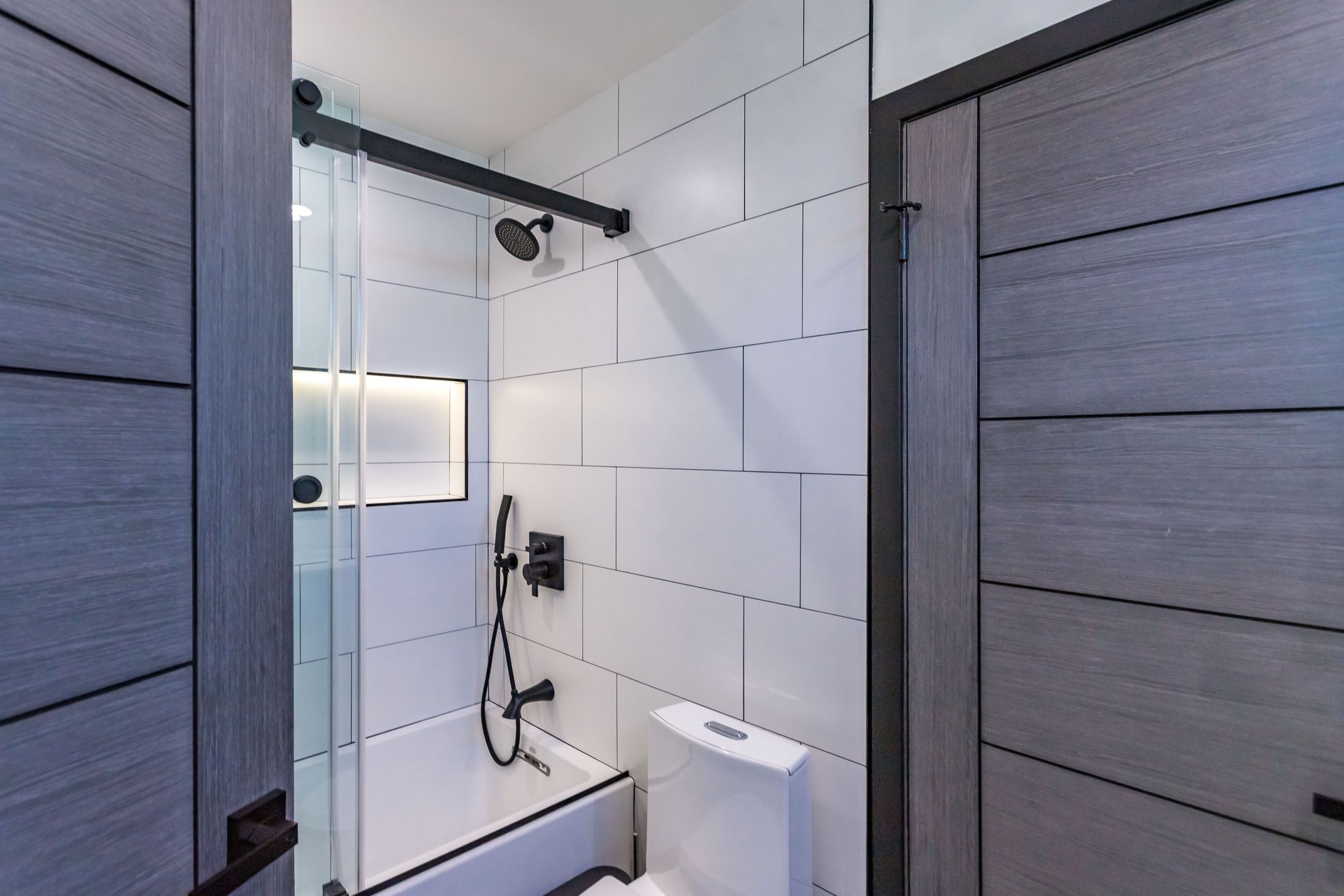
A remodeled bathroom and bedroom by Elbaz Construction: large-format wall tile, a navy double vanity and wood-look flooring.A tiled shower-tub from the same Elbaz Construction project, with matte black fittings, a sliding glass screen and a lit niche.
The rest of the budget
Beyond construction: permits, sales tax and the review clock
Permit fees are set by each building department. As one published example, unincorporated Miami-Dade County charges 50 cents per square foot of the whole structure for alterations to a single-family home, with a minimum of $147 and a maximum of $847.95 before surcharges (Implementing Order 4-63, in force since June 26, 2026; the County adjusts its fees each October 1). Plumbing and electrical permits are separate. Cities in all three counties publish their own schedules, so check the one for your address.
Sales tax is inside the contract price. Florida treats contractors as “the ultimate consumers of materials and supplies they use to perform real property contracts” (Rule 12A-1.051), so the contractor pays tax on materials and it is part of what you pay. The rate is the 6% state rate plus the county surtax, and Palm Beach changed this year:
Sales tax rate on materials in 2026
State 6% plus the county discretionary surtax
Miami-Dade County7%
Broward County7%
Palm Beach County6.5%
Source: Florida Department of Revenue, form DR-15DSS for calendar year 2026. Palm Beach County’s 1% infrastructure surtax was repealed on December 31, 2025, and a 0.5% school surtax began on January 1, 2026.
Time is a cost too. Since July 1, 2026, section 553.792 gives the building department 30 business days to decide a complete application for a home under 7,500 square feet, 60 for larger structures, and 5 for listed permits under $15,000 on an existing single-family home. A complete application is the fastest one, which is the job of our permit expediting team. Design and engineering fees depend on the scope and are quoted separately by the professionals involved.
Contracts and payments
The dollar lines in Florida law that protect your budget
Several Florida rules switch on at fixed contract amounts. Knowing them helps you read a contract and a payment schedule:
Contract amounts where Florida rules change
Residential construction contracts, Florida Statutes 2026
Above this: lien law and the Recovery Fund notice apply$2,500
Above this: notice of commencement before the first inspection$5,000
Below this: owner may ask for a no-permit exemption (cosmetic work only)$7,500
Below this: 5-business-day review for listed permits on an existing single-family home$15,000
Sources: sections 713.02(5), 489.1425, 713.135(1)(e), 553.79 and 553.792(1)(a), Florida Statutes. The $2,500 and $5,000 lines are commonly confused: the notice of commencement is required when the direct contract is greater than $5,000.
ContractRecovery Fund noticeResidential contracts over $2,500 must include the notice about the Florida Homeowners’ Construction Recovery Fund (section 489.1425).
DepositOver 10% starts two clocksIf the first payment is more than 10% of the contract price, the contractor must apply for the permits within 30 days of payment and start work within 90 days after they are issued, unless there is just cause or a written agreement (section 489.126).
Before inspectionNotice of commencementOver $5,000, a recorded notice of commencement must be filed with the building department before the first inspection (section 713.135). It is part of Florida’s construction lien system (chapter 713).
During the workPayments follow progressTie each draw to inspected, completed work, and keep change orders in writing with their price and schedule effect before the work is done.
One more line worth knowing: the state’s My Safe Florida Home program offers matching grants of up to $10,000 ($2 from the state for every $1 from the owner) for hurricane-hardening work on homesteaded houses built before 2008 with an insured value of $700,000 or less, for low- and moderate-income owners. Funding opens and closes, so check its current status before counting on it.
Interactive checklist
Before you set a budget: a checklist
0 of 8 done
Our process
How we build a whole-house budget
We price a whole-home renovation from the house, not from a table: we look at the structure, the flood zone, the roof and openings, and the rooms that change, then set the scope level with you before anything is drawn. On a design-build project, one team carries the design, the permit package and the build, so the drawings the building department reviews are the drawings we price. Kitchens and baths are usually the largest parts of the scope; see our kitchen remodeling and bathroom remodeling pages, and home additions if you need more space.
For an example of the scope a whole-house project can cover, from the exterior and roof to the kitchen, primary suite and outdoor kitchen, see our modern farmhouse whole-home renovation. Send us your plans or photos and we will tell you which scope level and rules apply before we talk about numbers.
Our work
Renovations we have built
Real Elbaz Construction projects. Photos show the work only; none is presented as a particular home or location. Tap a photo to enlarge.
Asher was the best choice I have made. We love the outcome of the ADU . They showed up on time and did a great job, were friendly. No issues at all during the whole process. Very organized team . I would recommend them to everyone I know !
RRobert Bryan
”
Great experience! The team was professional, efficient, and delivered high-quality work on time. They communicated clearly throughout the project and exceeded our expectations. Highly recommend for any construction needs!
AAndrew
”
If you are planning to remodel your kitchen or bathroom or do any other construction project, call Sean from Elbaz Construction . He has a lot of experience and will recommend the best options/ suggestions to your project. He did high quality job !
KKameron Allison
”
Thank you Ashley ! We love the new bathrooms. Good with communication and very clear with explanations . I will definitely use them again in the future
AAndrew Tyupa
”
Asher has a lot of experience . We replaced our windows to energy efficient windows. He got down to business right away and did high quality work. His team is very professional! Thanks again
Jjessica berliner
”
I give them a five star rating not only for their excellent roofing skills and timelines, but also for their competitive pricing and the honesty and professionalism of the team !! We are very pleased with the outcome
ZZachary Gugliotta
Genuine Google reviews of Elbaz Construction, reproduced as written. They describe general work with us, not the specific topic of this article. Read all reviews on Google.
Questions
Quick answers on remodel budgets
Rules vary by address and scope. For your property, call 754-236-0675.
There is no reliable per-square-foot figure, because the cost depends on the scope level under the Florida Building Code, the flood zone, the hurricane-rated products required and the condition of the house. For scale, the 2025 Cost vs Value Report put the national average for a midrange minor kitchen remodel at $28,458. We price each house after seeing it.
Under section 604.1 of the Florida Building Code, Existing Building, Level 3 applies where the work area exceeds 50 percent of the building area. It carries the most requirements of the three alteration levels, and most true whole-house renovations fall into it.
Only if the house is in a Special Flood Hazard Area. There, an improvement costing 50 percent or more of the market value of the structure (not the land) is a substantial improvement, and the house must then meet the flood requirements for new construction. Florida prohibits local governments from adding up improvements over several years to reach that line.
Under section 713.135(1)(e), Florida Statutes, the building department requires a recorded notice of commencement before the first inspection when the direct contract is greater than $5,000. Contracts of $2,500 or less are exempt from most of the lien law.
Section 489.126, Florida Statutes, sets conditions on larger deposits: a contractor who receives more than 10 percent of the contract price as the first payment must apply for the permits within 30 days and start work within 90 days after they are issued, unless there is just cause or a written agreement.
Thanks — that came through.
Your details are with the Elbaz Construction team and we will come back to you,
usually the same or next working day. If it is urgent, call (754) 236-0675.
General information about Florida building code, statutes and published fees as of September 2026, not legal, tax or financial advice. Fees and rates change; your building department, the permits issued and your contract decide how they apply to your project. No figure on this page is an Elbaz Construction price.
Planning a whole-house remodel?
Set the scope before the numbers
We plan whole-house renovations across Miami-Dade, Broward and Palm Beach with the scope level, flood test and permit package settled first.