


Falls before finishes
Where the water goes is set at the substrate, not by the surface on top of it. We establish falls and outfalls first, then choose what the deck is finished in.
10 service categories · 100 service pages · Miami-Dade, Broward & Palm Beach
View all services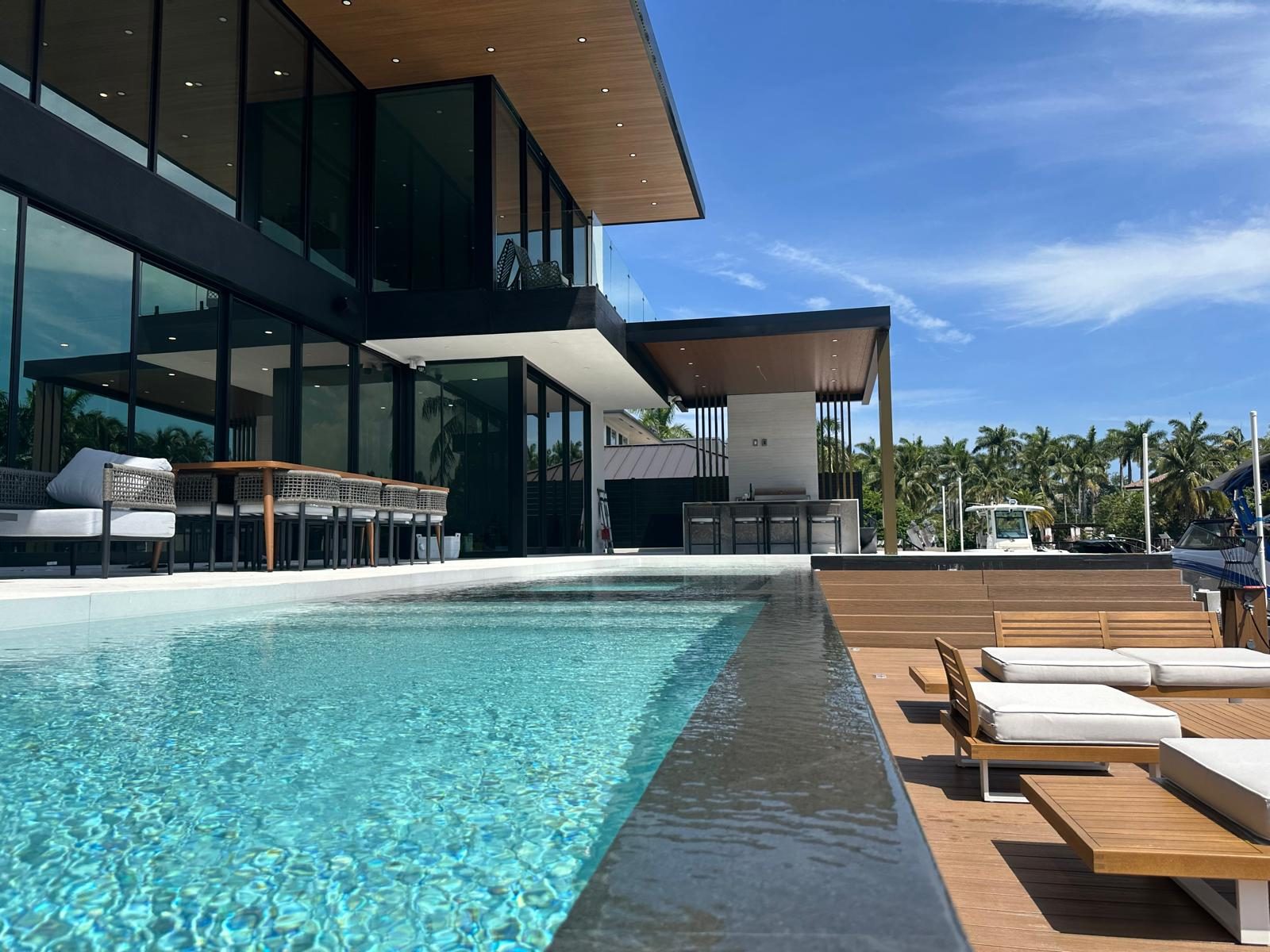
Outdoor and pool deck flooring across Miami-Dade, Broward and Palm Beach — surfaces chosen for grip and temperature, laid to falls that actually move water away from the house.
Miami-Dade · Broward & Palm Beach Counties
ScrollOutdoor & pool deck flooring
A pool deck fails from underneath and from the edges — from where the water goes, from what the slab is sitting on, and from how the surface behaves at 2pm in August.
Three things decide whether an outdoor floor works here. Slip resistance, because the surface is wet for a good part of the year. Surface temperature, because a dark or dense material becomes unwalkable barefoot in direct sun. And drainage, because a deck that falls the wrong way sends water at the house instead of away from it.
Underneath, South Florida soils and the sun move things. Slabs expand, contract and settle, and a rigid surface laid without control joints or without a movement allowance at the perimeter will crack where it likes rather than where you put a joint. Pool decks additionally sit next to a structure that does not move at all, which is exactly why the joint at the coping matters.
The photographs on this page are Elbaz decks and terraces, several of them on canal lots. What they have in common is not a material — travertine, large-format paving and poured concrete all appear — but that the falls, joints and edges were decided before anything was laid.
How we work
Where the water goes is set at the substrate, not by the surface on top of it. We establish falls and outfalls first, then choose what the deck is finished in.
A wet pool surround needs a texture that works barefoot. Polished and dense surfaces photograph well and are the wrong answer within a metre of water.
Colour and density decide whether a deck is usable barefoot in direct sun. This is the single most common regret on a finished pool deck, and it costs nothing to get right at selection.
Control joints, perimeter movement and the joint against the pool coping. Put them in deliberately, or the deck decides where it cracks.
Where the deck meets turf, planting, the coping, the house threshold and any level change. Edges are where outdoor floors come apart.
Bound, unbound, on a slab or on compacted base — the build-up follows the substrate and the loading, not a preference.
Finished decks · 01
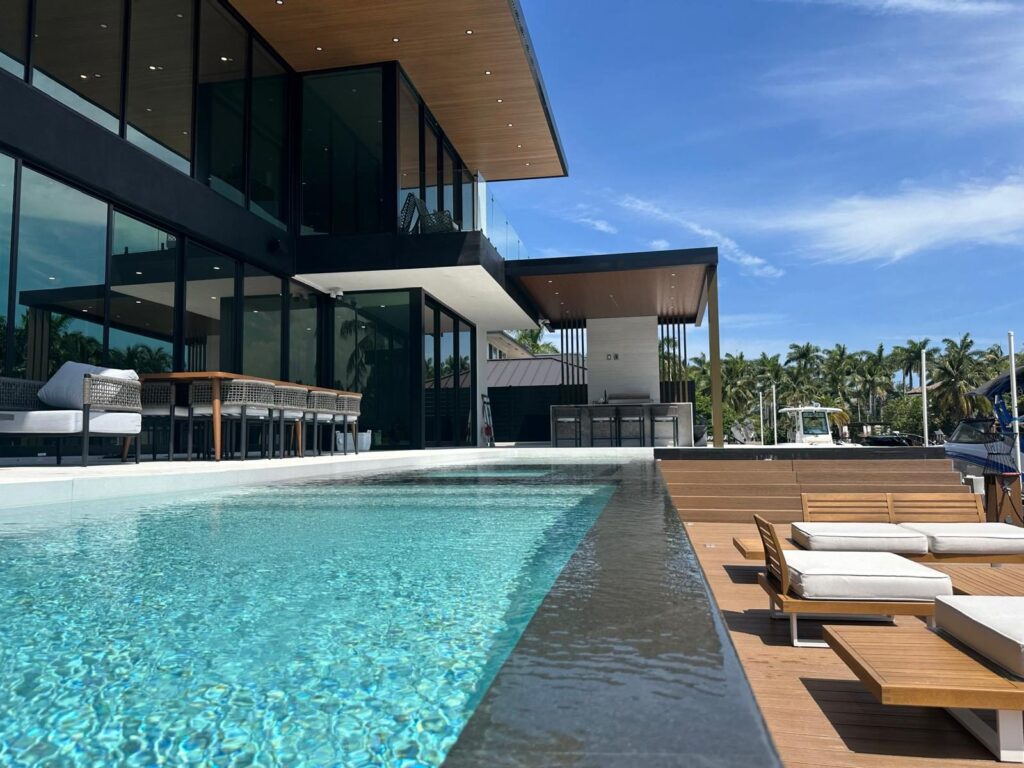
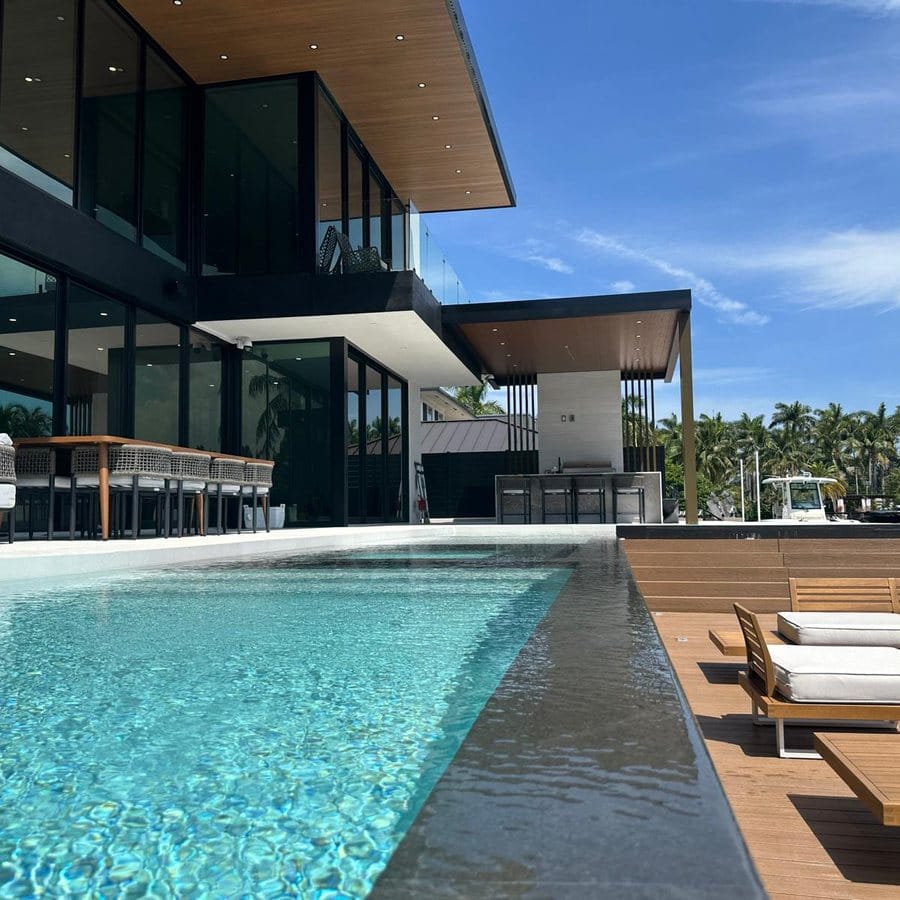
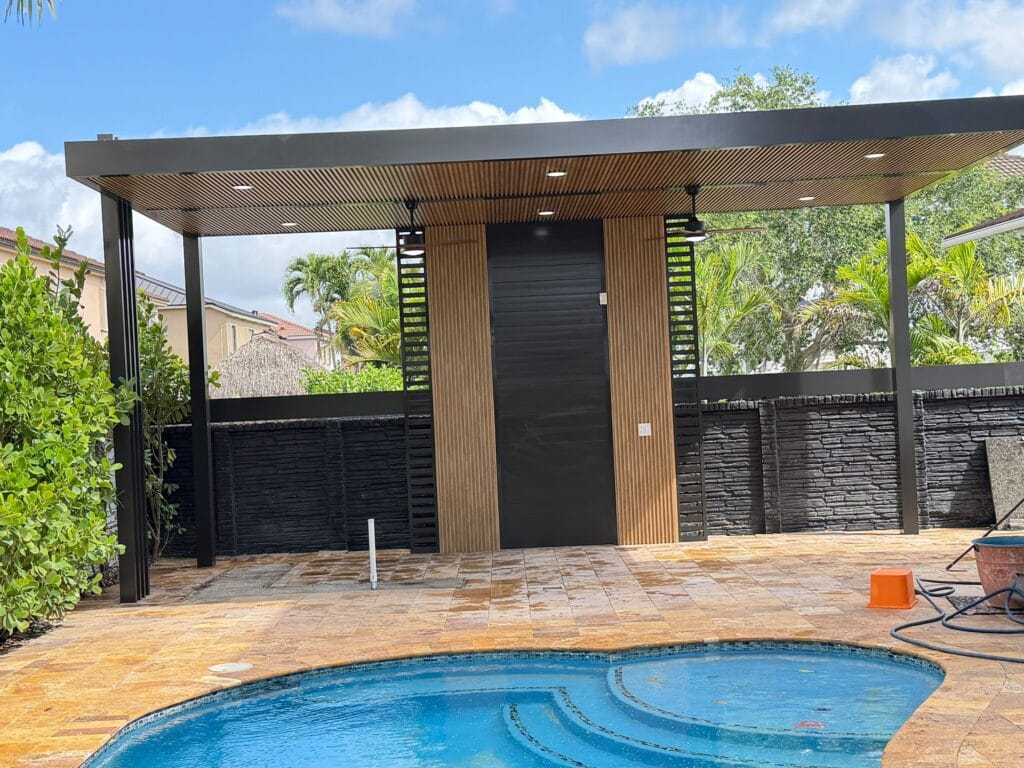
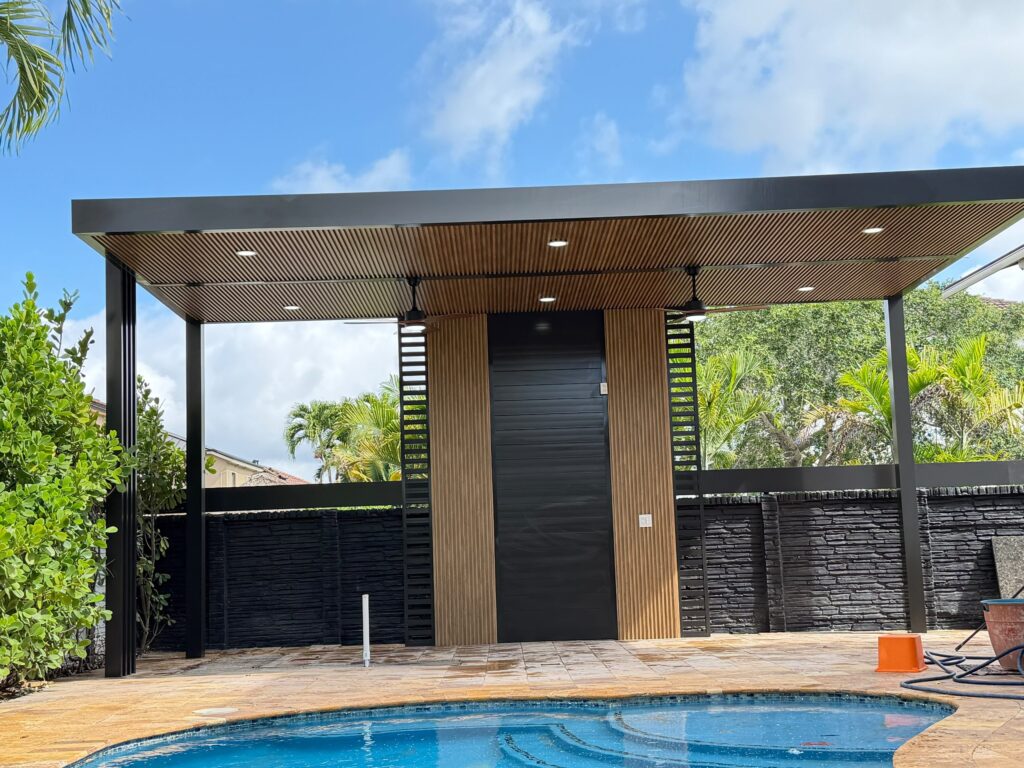
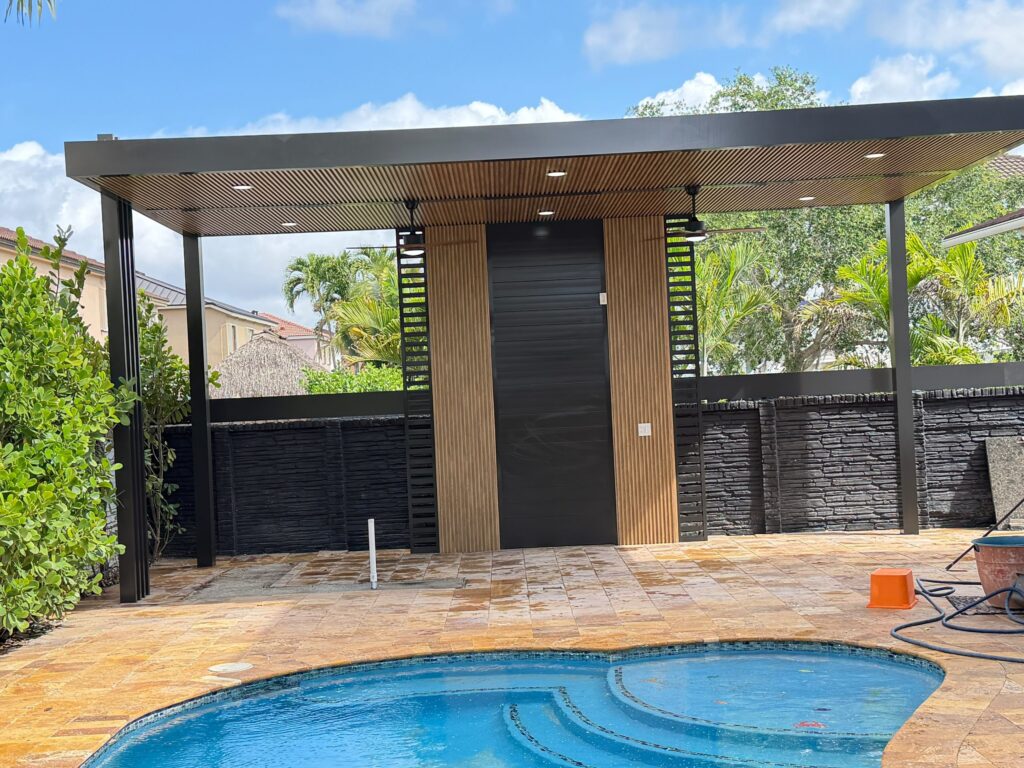
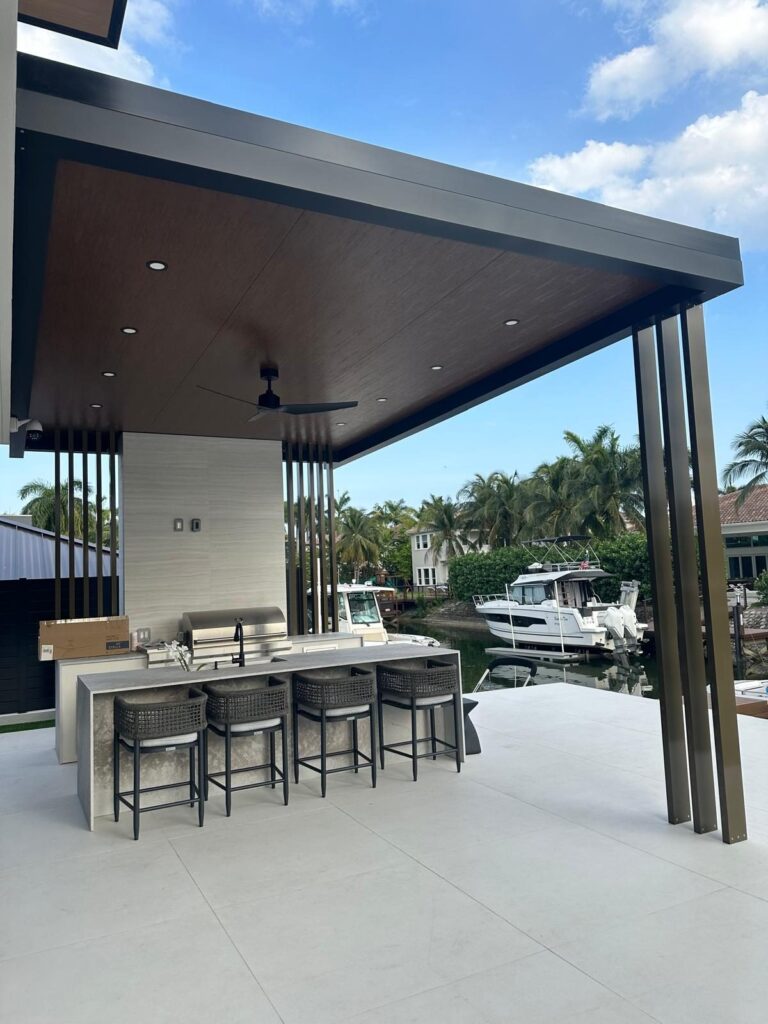
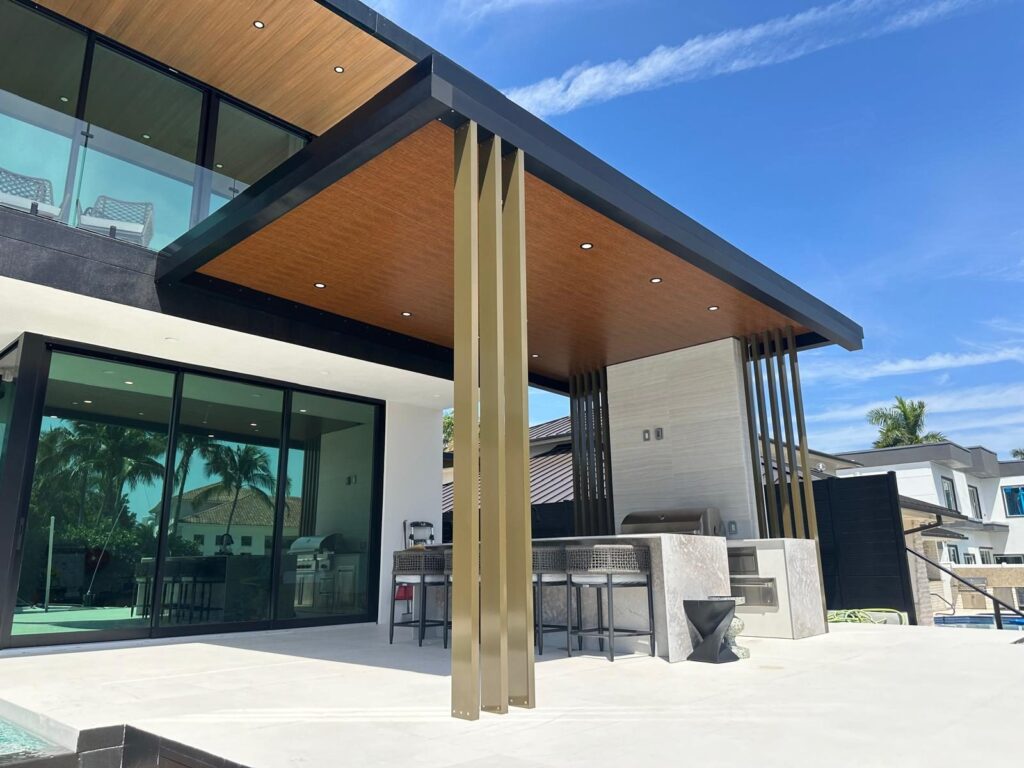
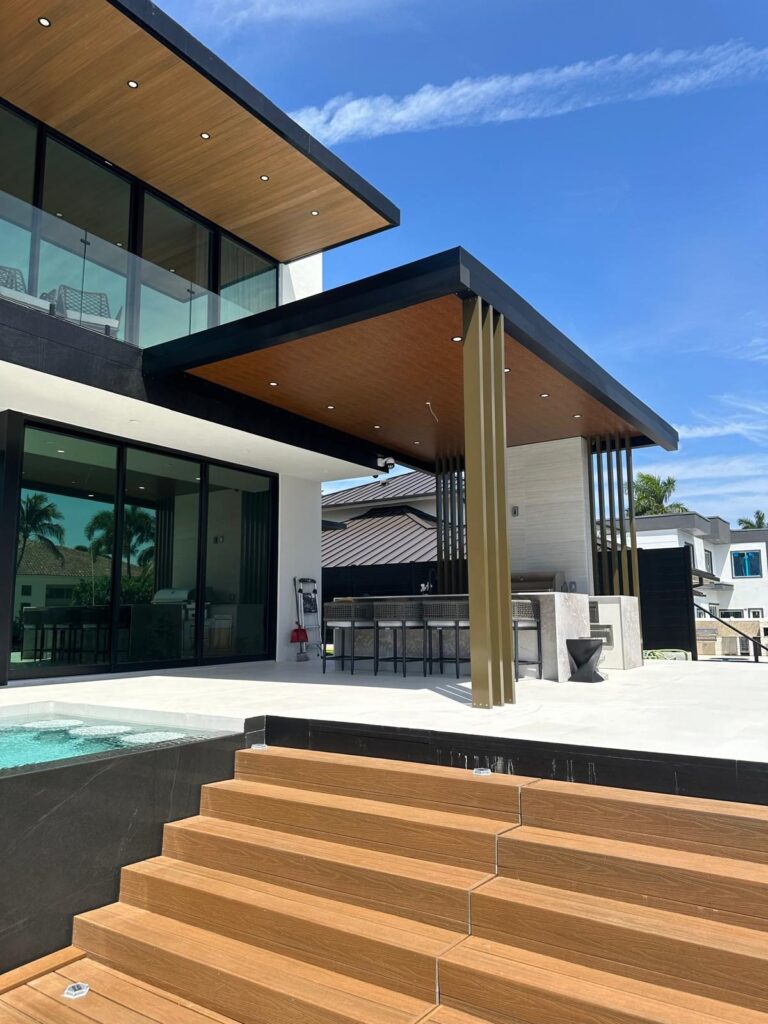
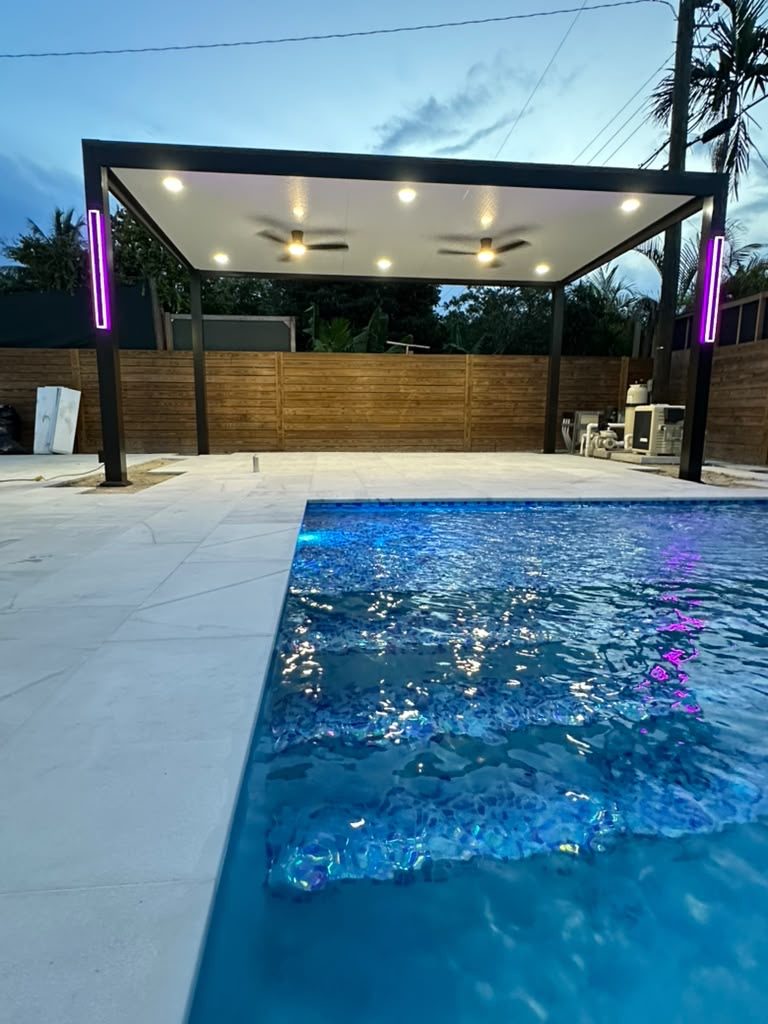
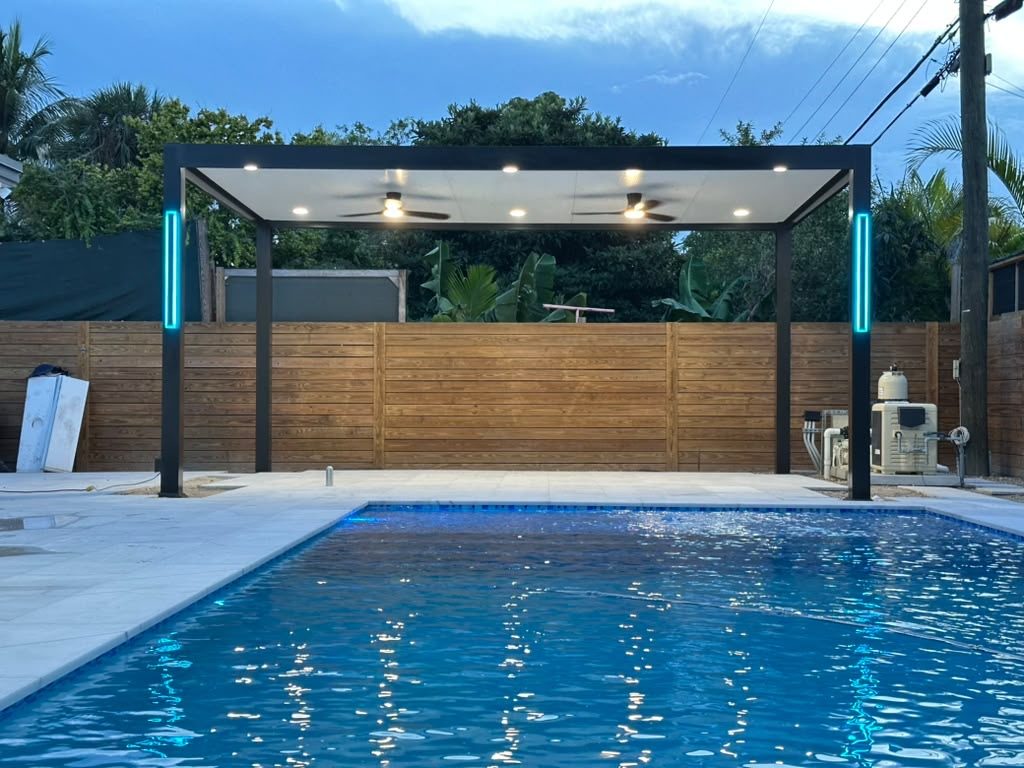
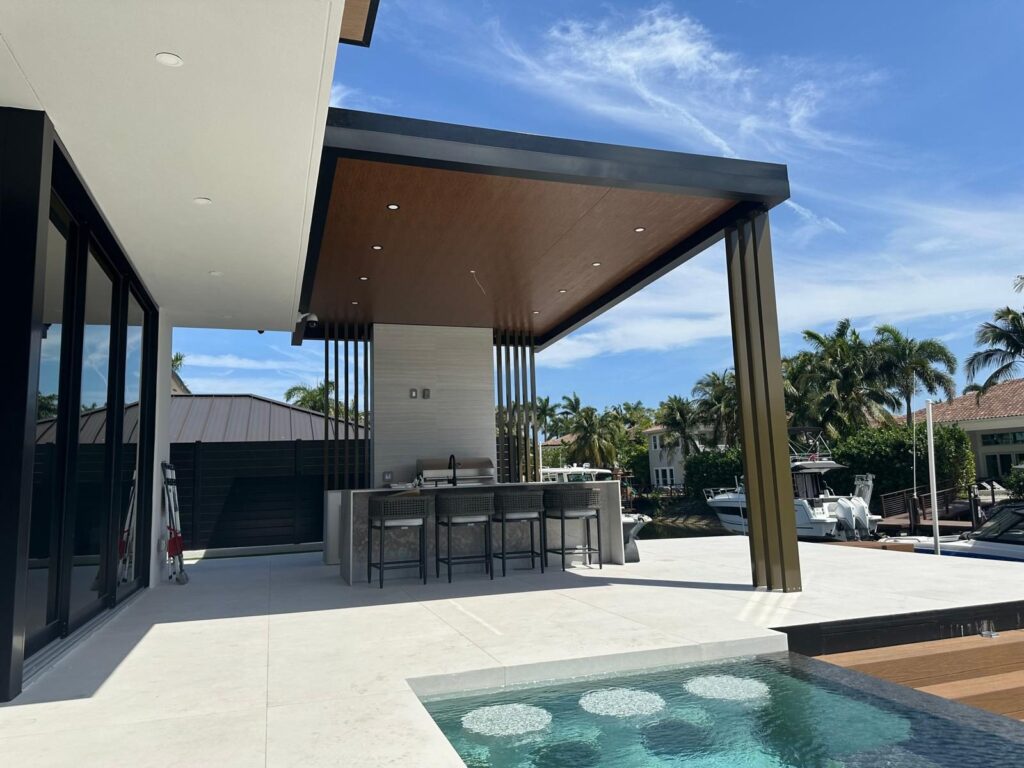
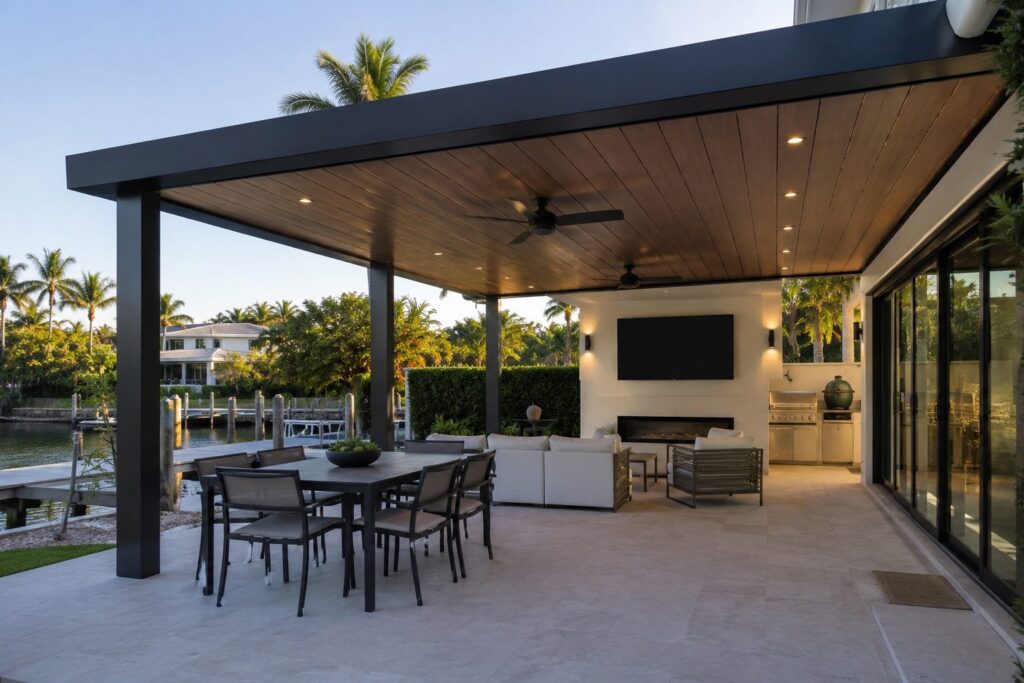
A pool deck running the length of a waterfront lot, in a large-format light surface that stays walkable in full sun.
What the photographs show
Several of the decks above run right to the coping of a pool. That junction is the hardest detail on the job: the pool shell does not move, the deck does, and the joint between them has to absorb the difference for years without opening up.
The waterfront decks have a second problem. On a canal lot the deck often has to fall away from the house and also away from the seawall, which means the high point sits somewhere in the middle of the terrace and the falls have to be set out before a single unit is laid.
The falls are decided before the material is. Choose the surface first and you spend the rest of the job working around it.
The second gallery is the part nobody photographs — slabs poured and jointed, base compacted, pavers being set out from the coping, edges restrained against turf. Every finished deck in the first gallery began as one of those.
| Surfaces seen | Travertine, large-format paving, concrete pavers and poured concrete |
|---|---|
| Settings | Pool surrounds, covered terraces and canal-front decks |
| Substrates | Poured slabs and compacted base build-ups |
| Details visible | Coping junctions, control joints, pebble drainage strips, turf edges |
| Level changes | Timber steps between a raised terrace and a pool deck |
| Covered areas | Deck surfaces carried under structures rather than stopped at them |
Described only from what is visible in the photography. No address, client, cost, square footage, product brand or completion date is stated, because none of that is documented in the image set.
Detail
The coping joint
A pool shell is fixed. The deck around it moves with heat and with the ground under it. The joint between the two absorbs that difference, and it is the first thing to fail on a deck built without one. It gets a deliberate movement joint, correctly filled, rather than being grouted solid and left to crack — which is what has usually happened when an older deck has a ragged line following the pool edge.
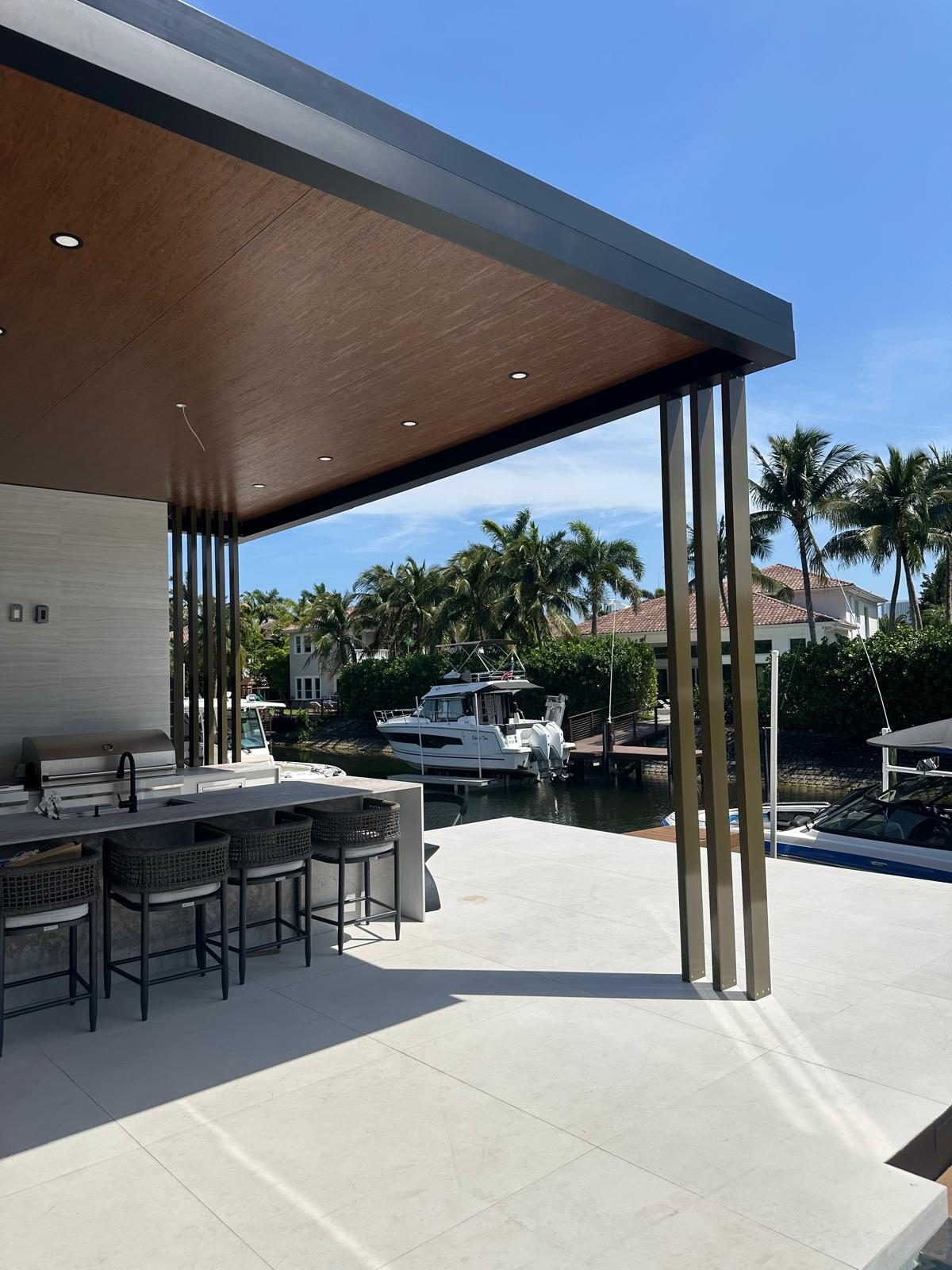
Setting out
Paving is set out from the coping so the cuts fall at the far edge, where they are least visible and least walked on.
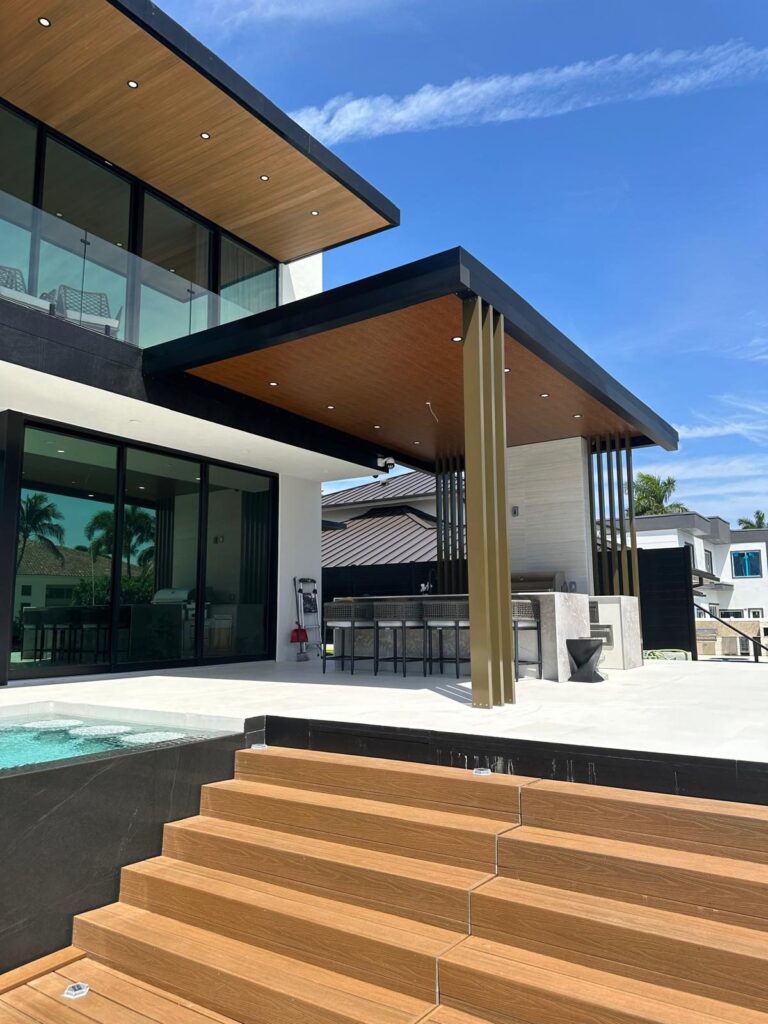
Drainage strips
A pebble strip or a channel at the low edge gives the deck an outfall that does not depend on the lawn accepting it.
Open joints
Grass or gravel joints let a terrace drain through its own surface, which reduces how much fall it needs in the first place.
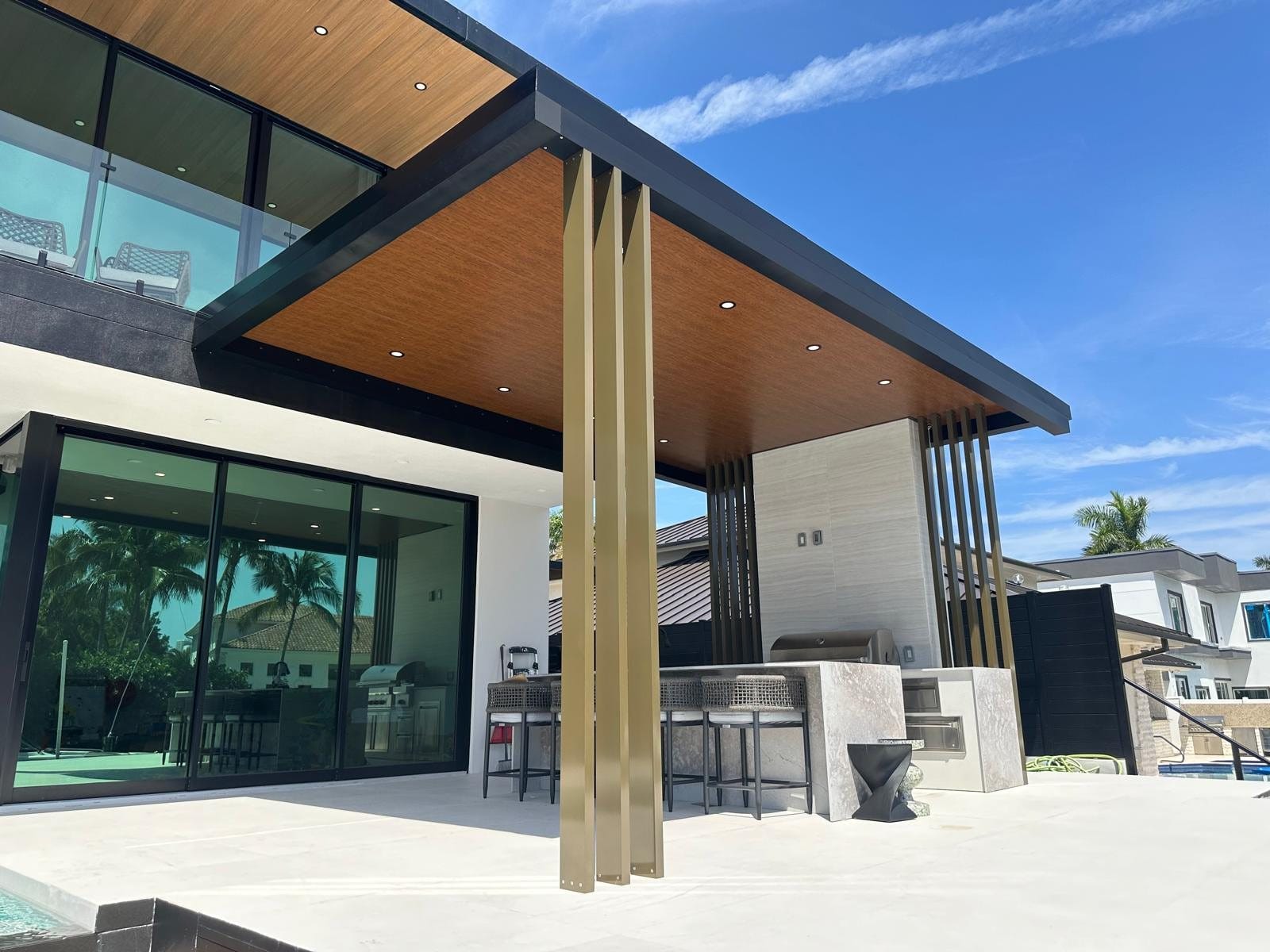
Edge restraint
Unbound paving spreads without a restrained edge. Turf and planting edges get restrained even when the restraint is then buried.
Level changes
A step between terrace and deck is a chance to change the fall, and a risk if the going and rise are not consistent.
Common questions
What South Florida owners ask most often before resurfacing or building a deck.
Pale, porous and textured surfaces run coolest — travertine and shell finishes are the usual answers here, and light large-format porcelain is close. Dark, dense and smooth is the combination to avoid next to a pool.
Sometimes. It depends on whether the existing slab is sound, whether it falls the right way, and whether the cracks in it are cosmetic or structural. Resurfacing over a slab with the wrong falls just buys you the same problem in a new colour.
Often, yes — particularly where the work changes drainage, structure or the pool barrier. It is confirmed with your municipality before work starts rather than assumed either way.
Usually because it has no control joints, or because it was laid tight to a fixed element with nowhere to move. Concrete does not crack because it is bad; it cracks because it has to go somewhere.
Not if the base is compacted properly and the perimeter is restrained. They sink when they are laid on a base that was never compacted, or when the edge lets them spread sideways.
Enough that water leaves it reliably rather than ponding, and always away from the building. The number is set by the surface type and the layout, and we set it out on site — a deck that looks flat and drains is a deck that was surveyed.
It is porous, so sealing helps with staining, particularly around a barbecue or planting. It is maintenance rather than a one-off, and it does not change how the stone performs underfoot.
Yes, where the slab is sound and the extra build-up does not create a threshold or drainage problem at the house. The build-up has to be checked against door thresholds before anything is committed.
A deck should shed water in an ordinary storm without help. In tight sites or where the ground cannot take it, a channel or a strip drain with somewhere to discharge to is designed in rather than added later.
Frequently, and it is usually the better sequence — the falls, the column bases and the surface can all be set out against each other instead of one being worked around the other.
Your details are with the Elbaz Construction team and we will come back to you, usually the same or next working day. If it is urgent, call (754) 236-0675.
Substrate & build · 02
How the work runs
Levels taken across the area, plus thresholds, the pool coping and wherever water currently goes.
High points, falls and outfalls decided, including what happens in heavy rain.
Surface chosen against grip, temperature, movement and the build-up the ground allows.
Confirmed with the municipality; barrier, structural and drainage implications flagged.
Existing surface out, and the ground taken down to the level the new build-up needs.
Compacted base, or a poured and jointed slab where the surface requires one.
Lines established from the pool coping and the principal sightline, so cuts land where they should.
Surface laid to the falls set out, with joints where they were planned rather than where they are convenient.
Restraints, movement joints and the coping junction completed and filled.
Surface cleaned, sealed where the material calls for it, and drainage checked with water.
Whether a deck needs a permit, and which inspections apply, depends on your municipality and on what the work changes. We confirm it for your address before starting rather than working from a general rule.
Materials
Stays notably cooler underfoot than most alternatives and has natural texture, which is why it dominates pool surrounds here. It is porous, so it wants sealing and it will show what gets spilled on it.
Dimensionally stable, low maintenance and available in outdoor-rated textures. Large units mean fewer joints, which also means the substrate has to be flatter and the falls more carefully set.
Individually replaceable, which matters when a tree root or a settlement lifts one area. Laid on a compacted base they tolerate movement better than anything rigid.
The most economical large area, and the most dependent on jointing. Broom, salt and exposed finishes each give a different grip; a smooth trowel finish next to a pool does not.
Textured, cool-toned and forgiving of small movement. Repairs are visible unless the aggregate is matched, so it is worth keeping material back.
Used where a level change or a dock connection makes a framed deck simpler than building up the ground. Composite avoids the maintenance, at a cost.
This is a general comparison of how these materials behave outdoors in this climate. The right choice depends on your substrate, exposure, drainage and how the area is used — we do not recommend a material before seeing the ground it is going on.
Budget
Square footage dominates, and complex shapes cost more per foot because of cutting and setting out around curves and coping.
Between a broom-finished slab and a large-format stone terrace there is a very wide range, on the same substrate.
What is under the existing surface. Poor base or a slab that has to come out is the item most likely to move a number once work starts.
Regrading, channels or a strip drain with a discharge point. Cheap to design in, expensive to add afterwards.
Steps, raised terraces and thresholds each add structure, edges and setting-out time.
Breaking out an existing deck and carting it away, which on a tight site can cost more than the area suggests.
The bars show the relative weight these factors typically carry against one another on outdoor flooring work. They are not prices, percentages of a budget, or a quotation, and the order can change on any individual site.
Google reviews
4.8
Asher was knowledgeable and gave us cool ideas that we didn't even know before. Nice beautiful color and design. We appreciate the price !
Elbaz Construction provided excellent service and outstanding craftsmanship. The team was professional and attentive to our needs. We’re extremely satisfied with the results!
We had a good time dealing with Asher and the crew, he went over and above all our expectations and made every effort to ensure that the end result was up to their high standards. Thank you !!
If you are planning to remodel your kitchen or bathroom or do any other construction project, call Sean from Elbaz Construction . He has a lot of experience and will recommend the best options/ suggestions to your project. He did high quality job !
I give them a five star rating not only for their excellent roofing skills and timelines, but also for their competitive pricing and the honesty and professionalism of the team !! We are very pleased with the outcome
Asher has a lot of experience . We replaced our windows to energy efficient windows. He got down to business right away and did high quality work. His team is very professional! Thanks again
Review text is reproduced verbatim from the connected Google Business Profile, including its original spelling. Nothing is rewritten, shortened or combined. No review schema is emitted on this page.
Proudly serving homeowners across Miami-Dade, Broward and Palm Beach
104 municipalities across three counties — and we hold the licence to build in all of them. Not sure about your address? Ask us.
Keep reading
Cost guide
Where outdoor works sit against the rest of a property budget.
Value
How outdoor living space tends to weigh in a South Florida valuation.
Scope
Resurfacing a deck and rebuilding one are different jobs with different permit paths.
Your details are with the Elbaz Construction team and we will come back to you, usually the same or next working day. If it is urgent, call (754) 236-0675.
Next step
We survey the area, work out where the water has to go, and only then talk about what the deck is finished in.

