


10 service categories · 100 service pages · Miami-Dade, Broward & Palm Beach
View all servicesThe journey
Six stages, from credentials to a closed permit.
Most municipality pages begin with the property. This one begins with the contractor, because Indian Creek Village does: no permit is obtainable until current licences and insurance are on file, and the insurance has to name the Village. Everything downstream — how many applications, which trades, in what order — follows from that single requirement.
Use the stage markers to jump to the part you are stuck on. Nothing here is a promise about your address — the Village decides that — and nothing here is a figure we invented. Where the Village publishes a requirement, it is quoted. Where its documents were not readable, this page says so rather than guessing.
Stage 01 · Standing
Four credentials, and the Village is named on one of them
The Village publishes exactly what a contractor must have on file before a permit can be obtained. It is worth reading as an owner, because it is a checklist you can hold anybody to — including us.
A licence, of one of two kinds
The Village requires either a State of Florida licence or a Miami-Dade County Certificate of Competency and Eligibility. Those are two genuinely different routes into the trade, and the Village accepts either — but it accepts them as filed documents, held by its Building Department, not as claims made on a business card. The distinction matters because it is the first of four things that must be on file before anybody can pull a permit.
- A State of Florida licence, OR a Miami-Dade Certificate of Competency and Eligibility
- Filed with the Building Department, not merely held
- It must be valid and updated, in the Village's own words
- This is the first of four required credentials
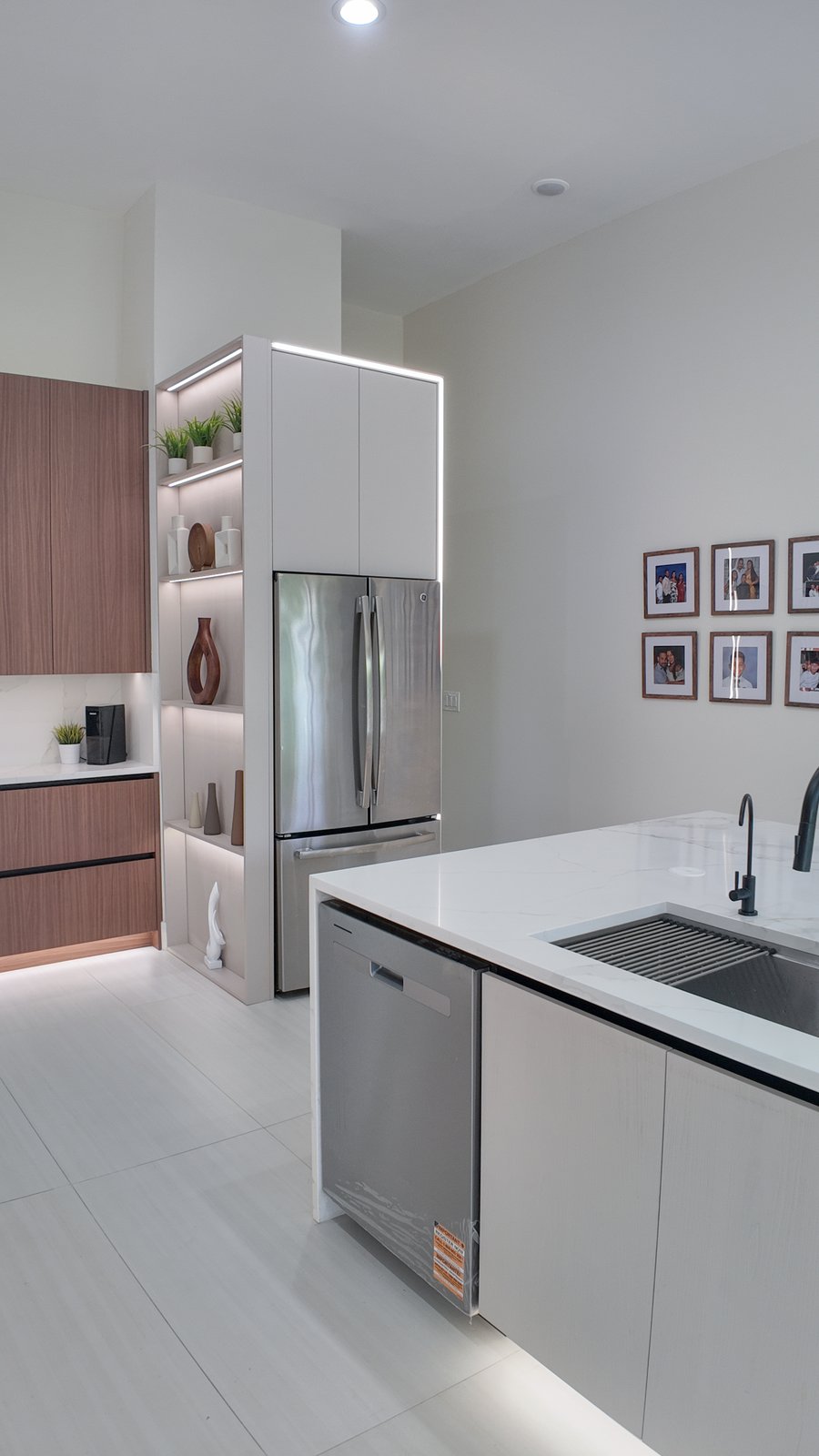
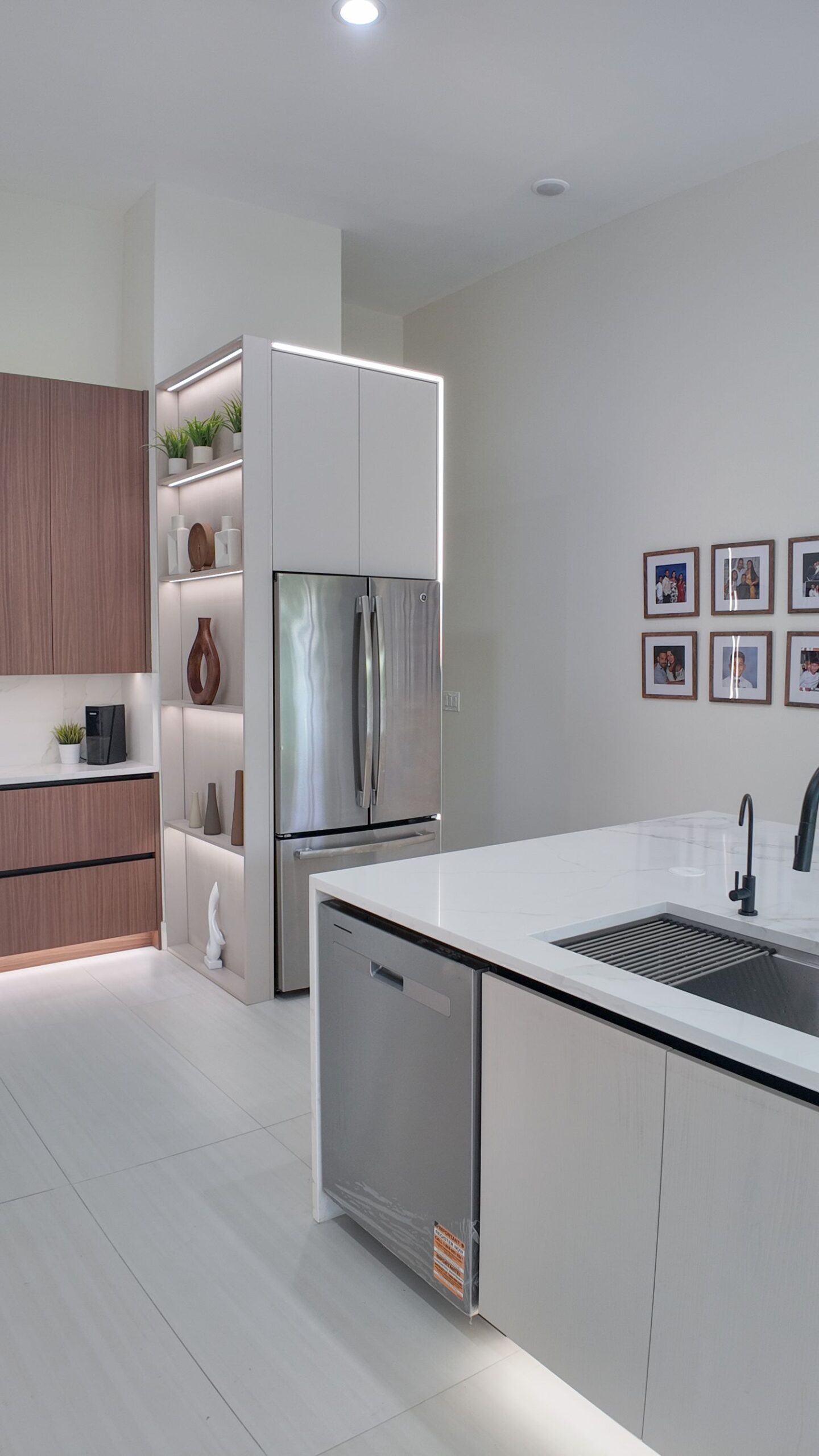
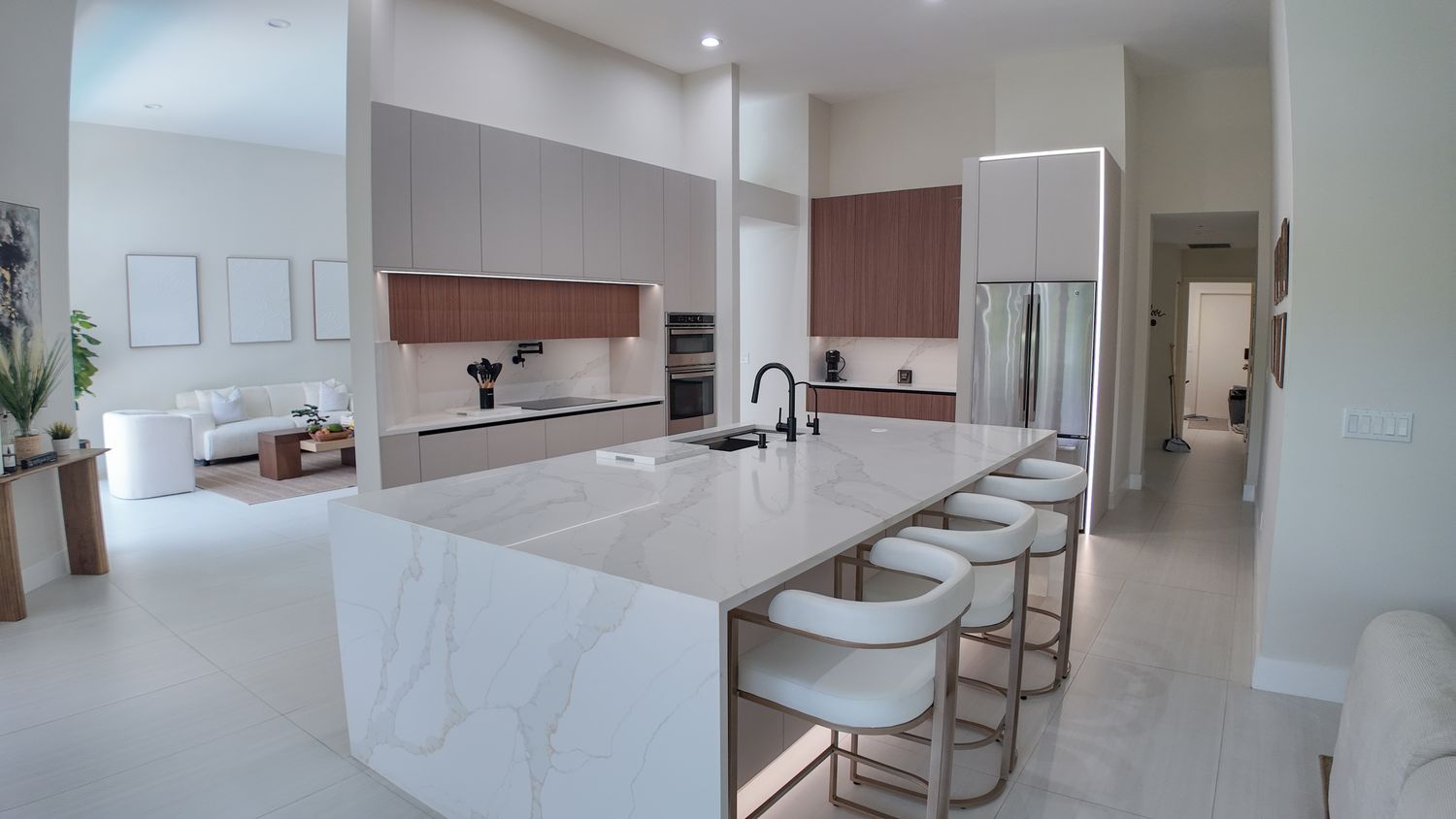
Full-height cabinetry and integrated ovens in a completed Elbaz Construction kitchen. A South Florida project, not an Indian Creek one.
An occupational licence
On top of the trade licence, the Village requires an occupational licence from the county or municipality where the contractor's place of business is located, and separately a Miami-Dade County Municipal Contractor's Licence including state registration. Read together, those two say something specific: the Village wants to know where a company is actually based and that it is registered to work municipally within this county, not merely that somebody holds a trade qualification.
- An occupational licence from the business's home county or municipality
- A Miami-Dade County Municipal Contractor's Licence, including state registration
- Both are separate from the trade licence itself
- The Village is establishing where a company is based, not only what it can do

Wide-plank flooring running through a large open interior on a completed Elbaz Construction project in South Florida.
Insurance naming the Village
This is the requirement that distinguishes Indian Creek Village from its neighbours. The Certificate of Insurance must name Indian Creek Village as Certificate Holder, and must include Commercial General Liability with a minimum limit of $1,000,000 per occurrence and $2,000,000 in the policy aggregate, alongside Worker's Compensation. Being named as certificate holder is not a formality — it means the Village is notified about the policy that stands behind work done inside it, rather than taking anyone's word that cover exists.
- The certificate must NAME Indian Creek Village as Certificate Holder
- Commercial General Liability: $1,000,000 per occurrence
- $2,000,000 in the policy aggregate
- Worker's Compensation is required alongside it
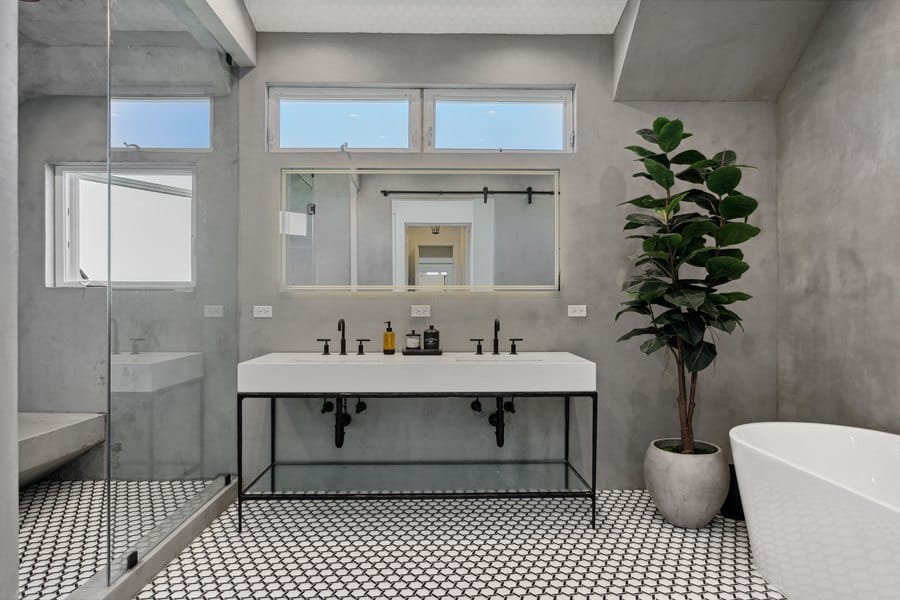
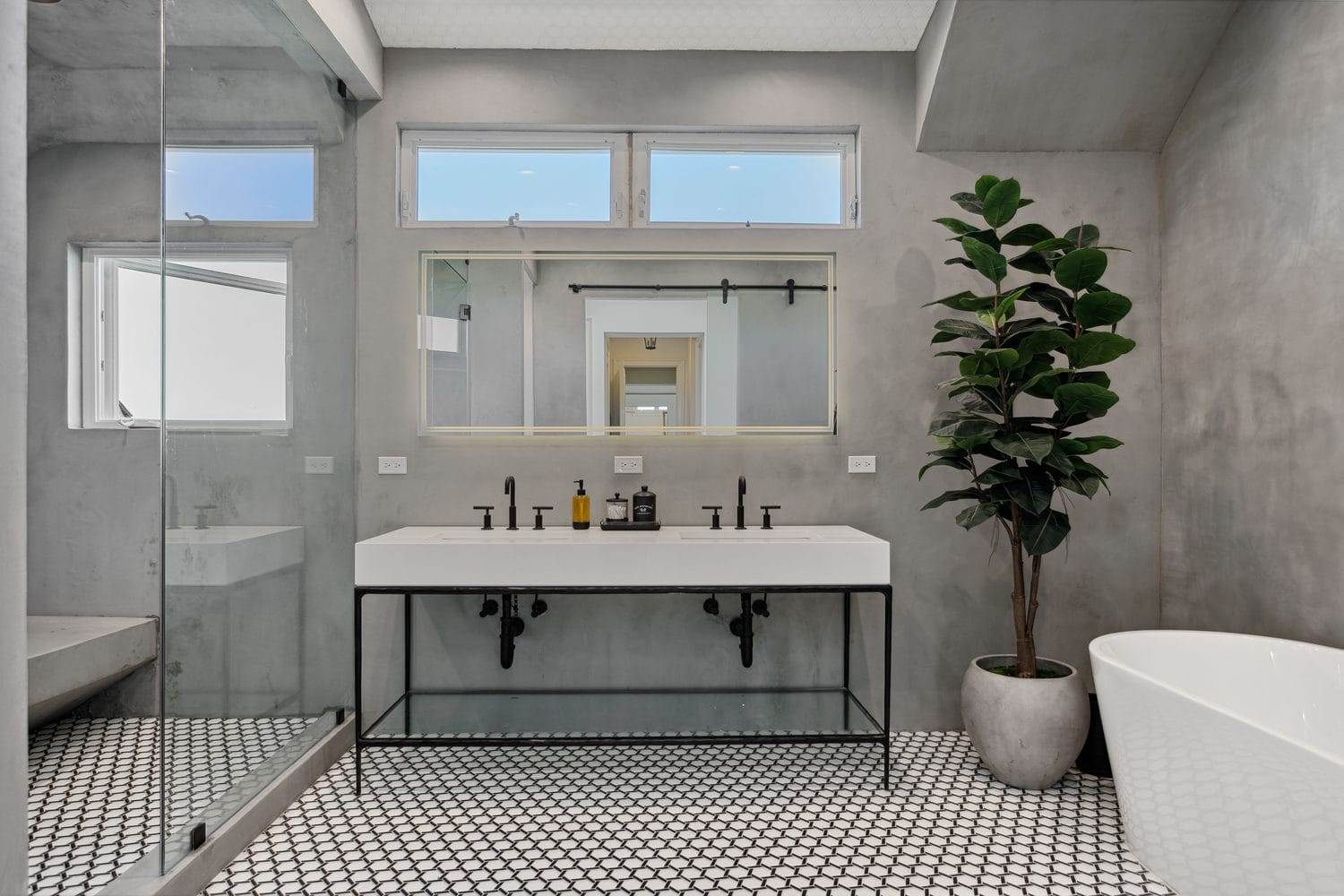
A completed Elbaz Construction primary bathroom in a seamless micro-cement finish with a freestanding tub. A South Florida project.
Miami-Dade, and the HVHZ
The Village is in Miami-Dade County, inside the Florida Building Code's High-Velocity Hurricane Zone — a designation covering Miami-Dade and Broward and nowhere else in the state. It governs roofing, windows, doors and their attachment, and product approval documentation belongs in the submission rather than being produced later. On a waterfront parcel the envelope is the part of the building that does the work, so this is where specification decisions matter most.
- The HVHZ covers Miami-Dade and Broward counties only
- It bites hardest on roof, glazing, openings and their fixings
- Product approval paperwork belongs in the submission
- Roofing is separately permitted here as well as separately inspected
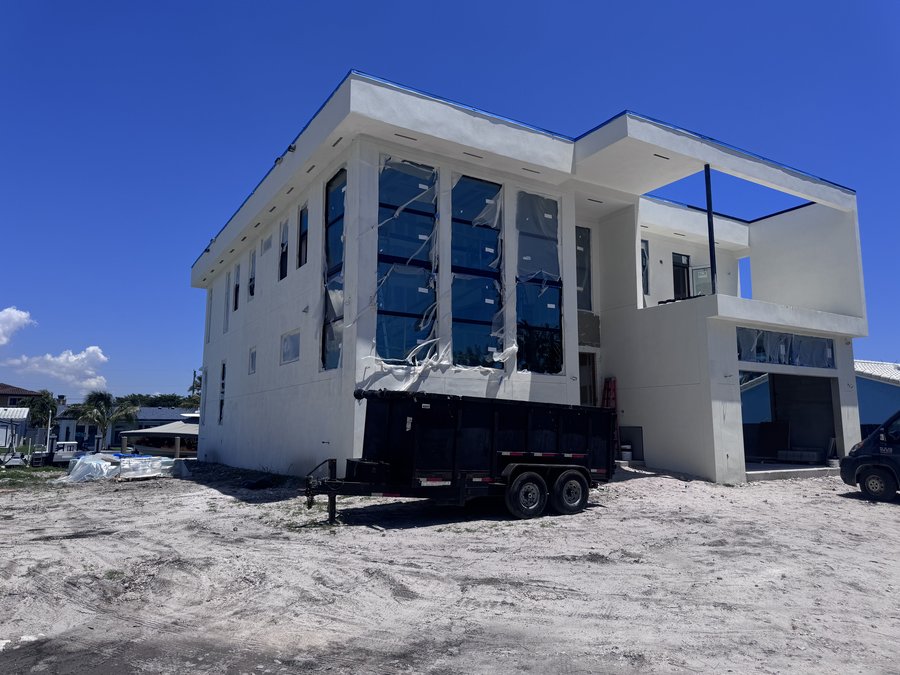
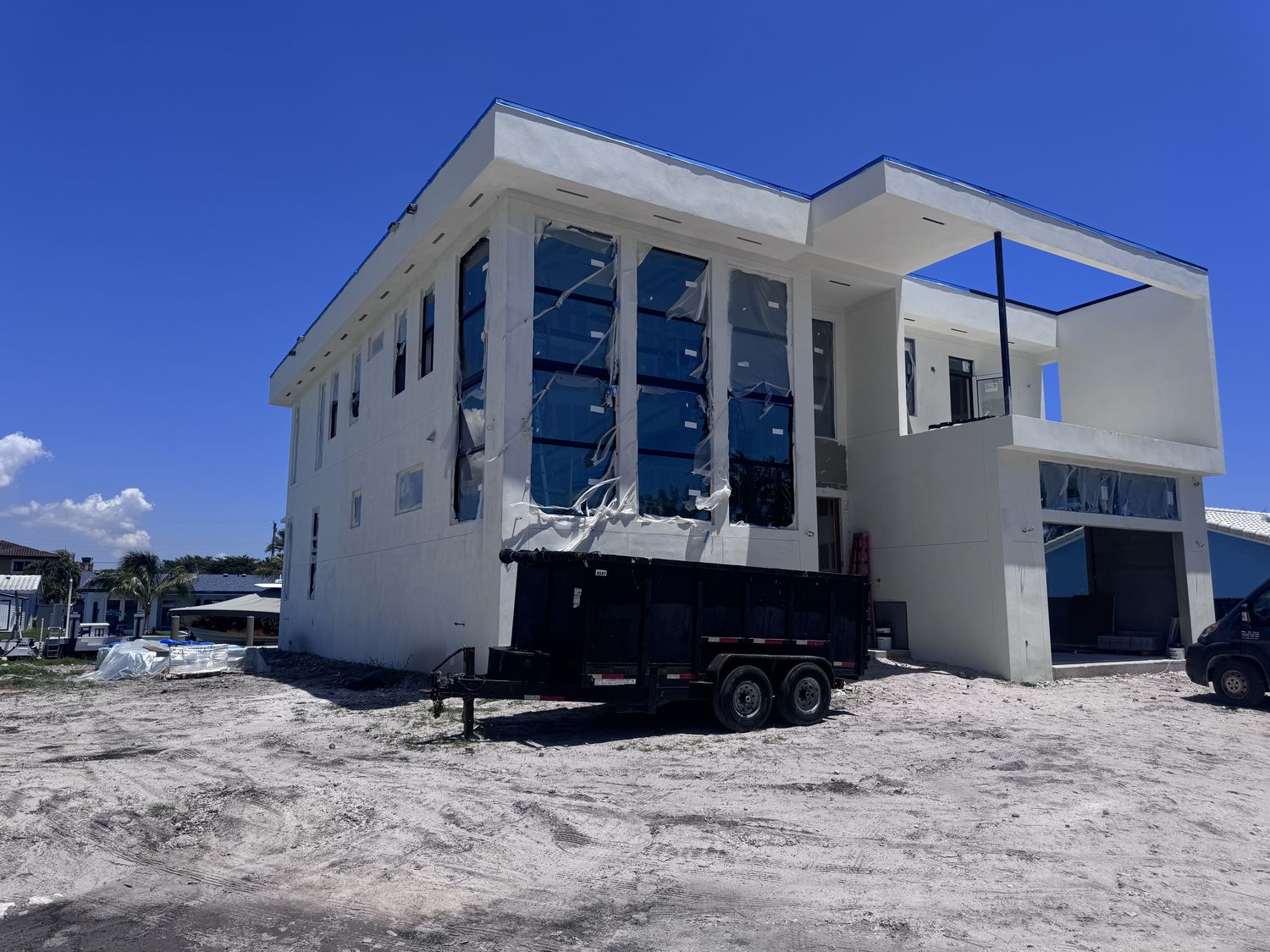
Real Elbaz Construction work: a two-storey ground-up build under construction with structure and glazing in place, seen from the lot. Not an Indian Creek property.
Stage 02 · Permits
Five trades, five separate permits
The Village states it plainly: separate permits are required for electrical, plumbing, pools, roofing and mechanical work. That single sentence reshapes how a project here is planned, priced and sequenced.
Separate, not sub-permits
The Village capitalises the five: ELECTRICAL, PLUMBING, POOLS, ROOFING and MECHANICAL. Each needs its own permit. A bathroom remodel therefore is not one application here — it is at least two, and probably three, each with its own paperwork and its own credentialed trade behind it. That is not a hurdle so much as a planning fact: the count of applications is knowable on day one, and a contractor who has not counted them has not planned your job.
- Electrical, plumbing, pools, roofing and mechanical are each separately permitted
- A bathroom remodel is at least two applications, usually three
- Each carries its own trade credentials on file with the Village
- The count is knowable before anything is drawn
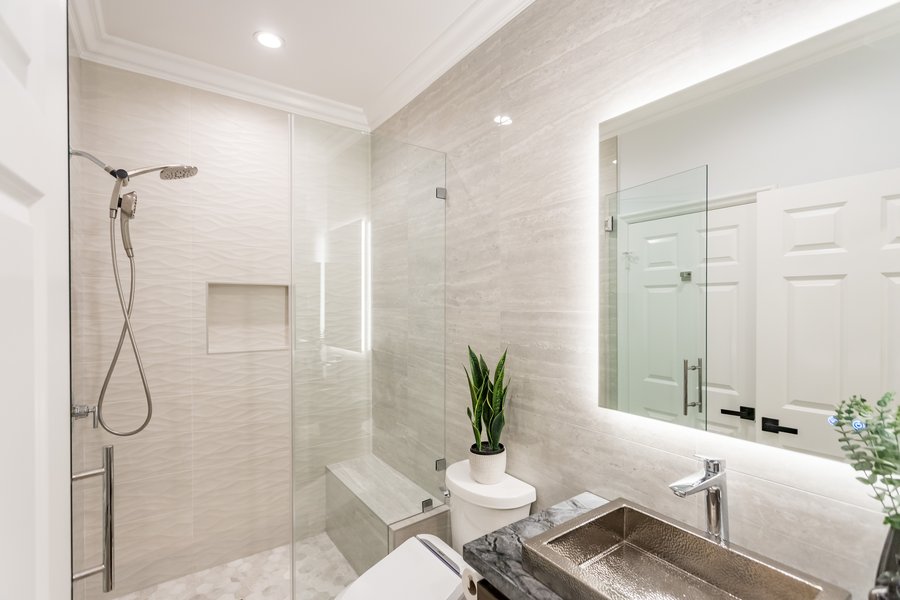
A completed Elbaz Construction walk-in shower behind a frameless glass panel with a recessed niche in large-format tile. A South Florida project.
Credentials come first
The Village's wording is that a contractor "must file valid, updated copies of his/her license(s) and insurance(s) with the Building Department before they can obtain a permit to perform work." Before, not with. So on a job with three trade permits, three sets of credentials have to be current and on file before the first of those permits can issue — and a lapsed certificate on any one of them stops that trade, not the whole job, which is its own kind of scheduling problem.
- Filing precedes obtaining, in the Village's own sequence
- Every trade on the job carries its own filing
- A lapsed certificate stops one trade and strands the ones behind it
- Currency has to be maintained, not achieved once

Illustration, not a photograph: self-levelling compound spread over a prepared concrete subfloor, drawn to show the layer beneath a finished floor. Not a photograph of an Indian Creek property.
Pools, named separately
Pools appear in the Village's list of separately permitted work in their own right, alongside the four trades. On a waterfront parcel that is worth noting early: pool work is not a subset of the general construction permit, it does not ride along with a landscaping scope, and it brings its own barrier and safety requirements under the Code. If a project touches the pool at all, it is another application and another credentialed trade.
- Pools are named in the Village's separate-permit list
- Pool work does not ride along with a general construction permit
- Barrier requirements under the Code apply in their own right
- Touching the pool adds an application, not just a trade
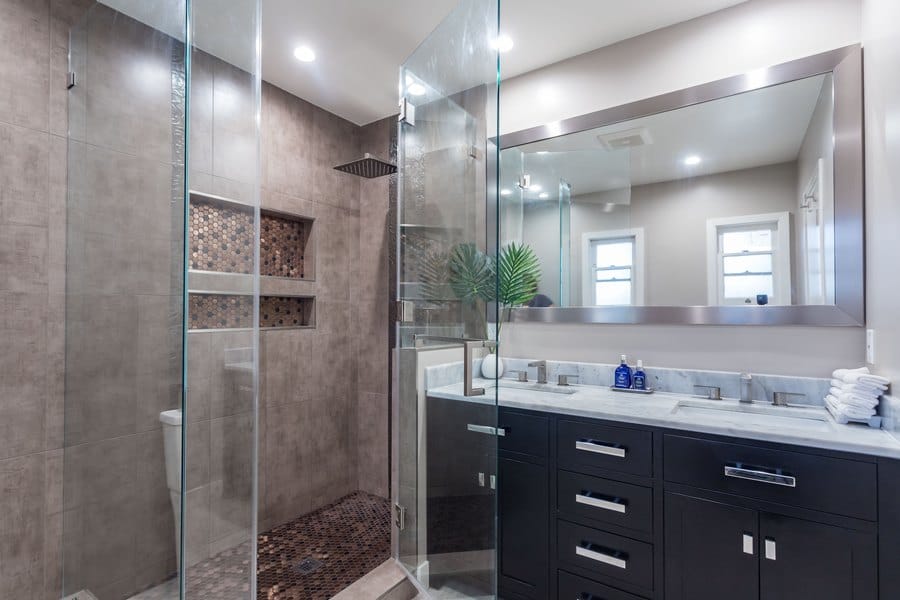
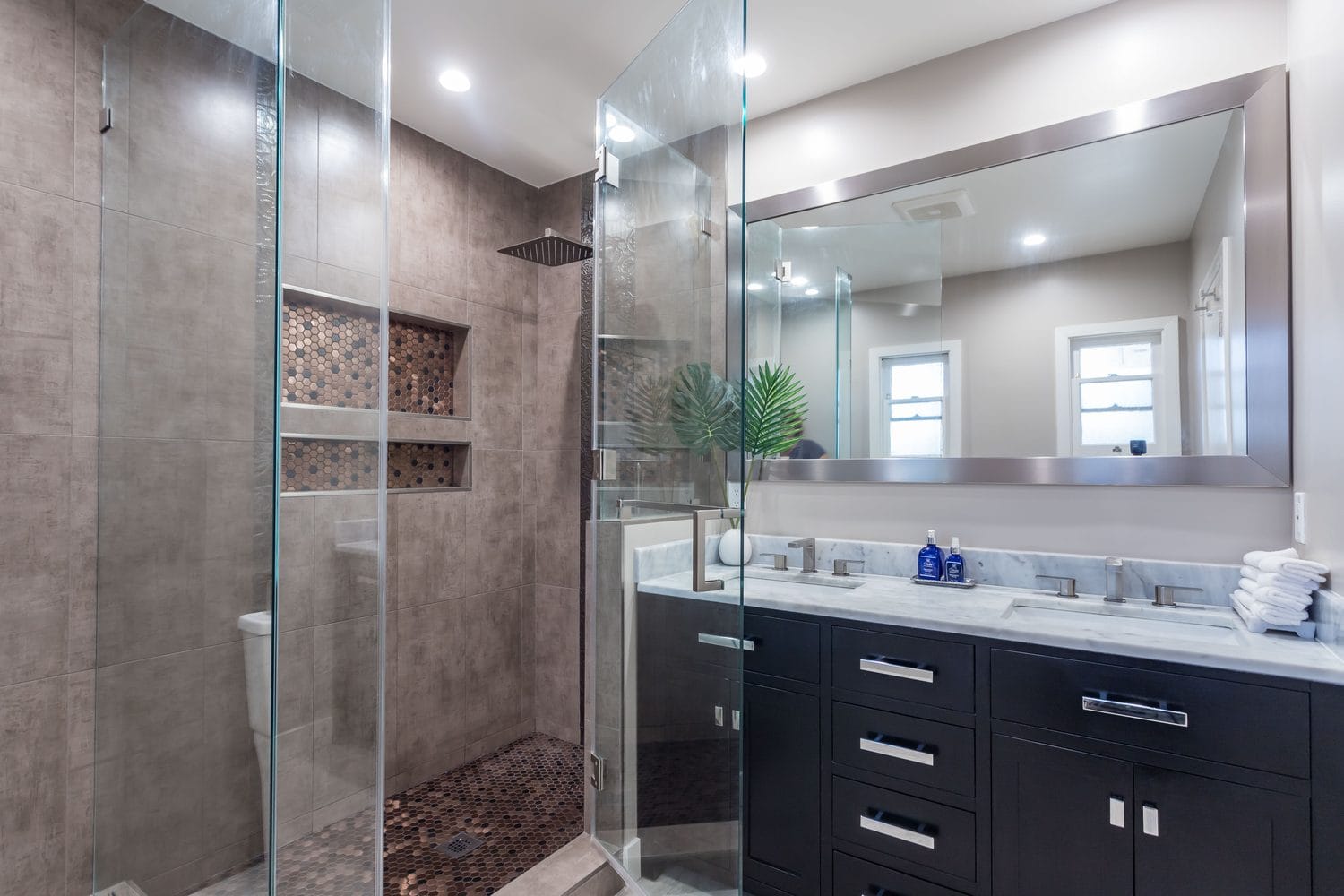
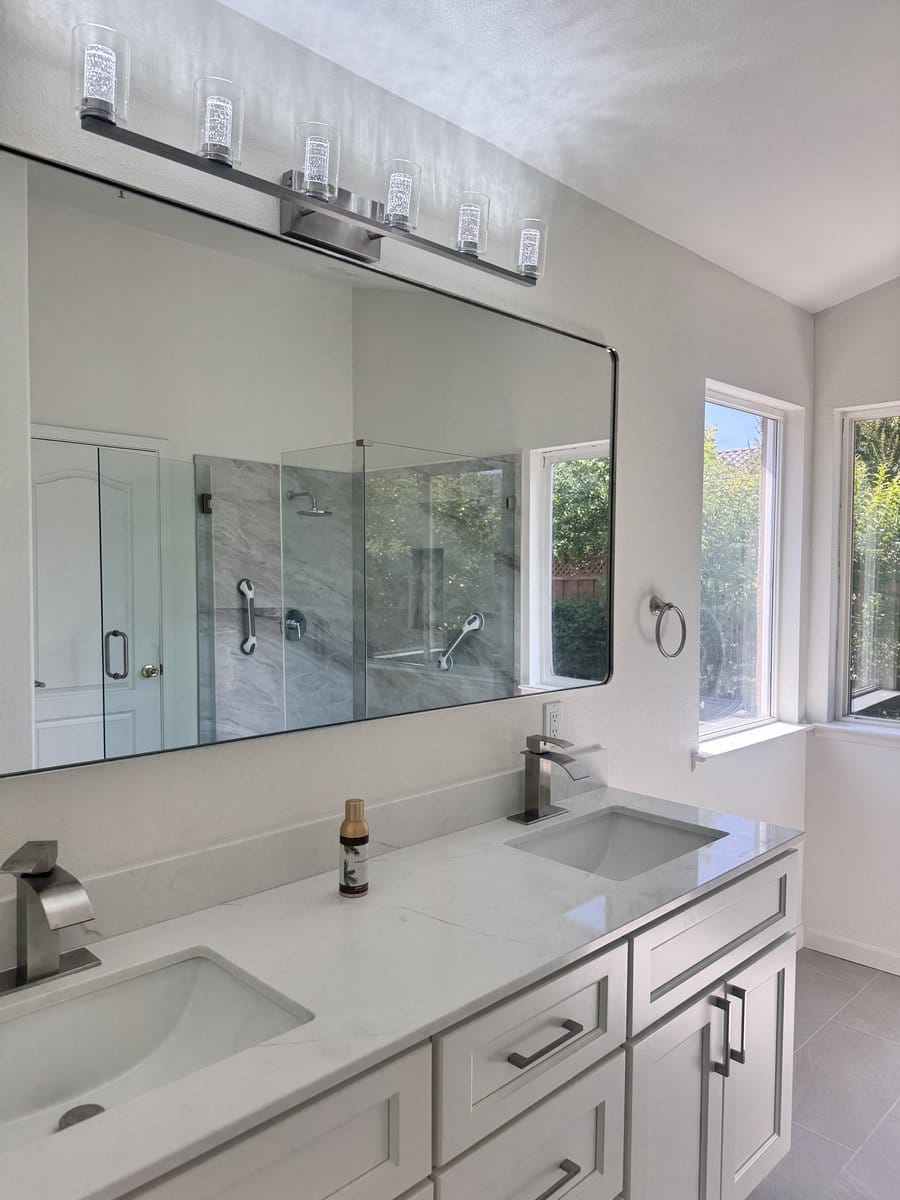
A completed Elbaz Construction curbless walk-in shower with a copper-toned mosaic floor beside an espresso double vanity. A South Florida project.
What we will not tell you
The Village publishes a Building Permit Fee Schedule and Land Development Regulations as documents on its shelf. We did not open them, so this page carries no Indian Creek fee, no setback, no height limit and no floor-area figure. That is deliberate. A number repeated from a document nobody read is worse than no number, because it looks like research — and on a village this size an owner would reasonably plan around it.
- The Village publishes a fee schedule and Land Development Regulations
- Neither was opened, so neither is quoted here
- No setback, height or floor-area figure appears on this page
- Ask the Building Department on (305) 865-4121 for the current documents

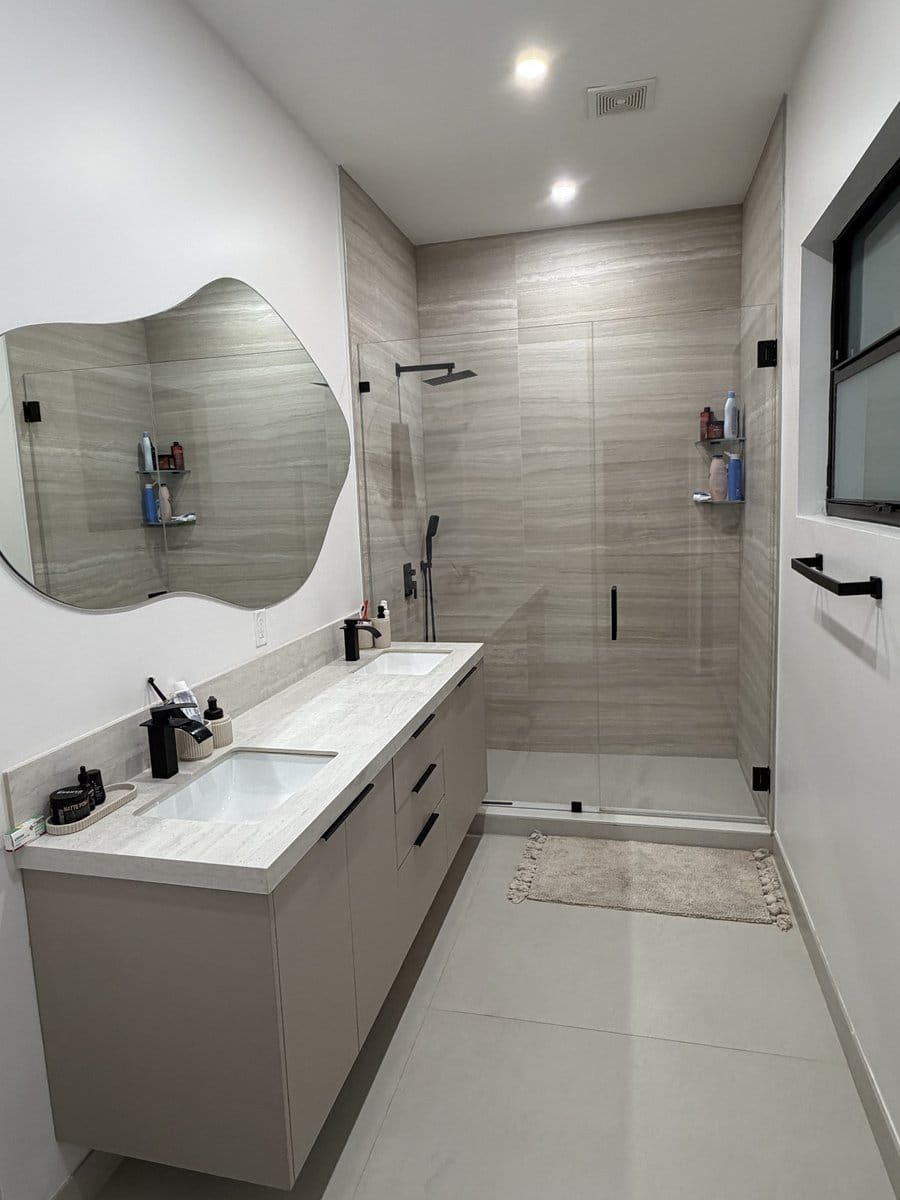
A completed Elbaz Construction walk-in shower lined in grey wood-look plank tile with a hexagon mosaic floor. Not an Indian Creek property.
Every photograph in this section is real Elbaz Construction project photography from completed South Florida work. None of it was taken in Indian Creek and none of it is captioned as though it were. Drawn images are labelled as illustrations.
Project gallery 01
The work the credentials are for
Six frames of completed Elbaz Construction work across South Florida. Different properties, not one project, and not photographed in Indian Creek — each caption says what it actually is.
Project 01, guided tour
Micro-cement, wall to wall
A completed primary bathroom in a seamless micro-cement finish with a freestanding tub and a curbless walk-in shower.
What these show
Six frames from completed Elbaz Construction projects across South Florida, grouped by room rather than by property.
Why they are here
A village page is about a process, and a process is only worth reading if the company at the end of it builds. These are the finished result of the same six stages this page walks.
Where they were taken
South Florida. None is claimed to be in Indian Creek, because none was verified as being in Indian Creek.
What is not claimed
No cost, no address, no client name and no permit history appears anywhere on this page.
Stage 03 · Submit
Submitting it: several applications, one project
Because the Village permits five trades separately, filing here is a set of coordinated applications rather than one. The sequence below is the one that keeps them moving together.
Before anything else can happen
Our licences and insurance — with Indian Creek Village named as certificate holder at $1,000,000 per occurrence and $2,000,000 aggregate, plus Worker's Compensation — are filed and kept current with the Building Department. The Village requires this before a permit can be obtained, so it is the first item on any programme here and it is not one that can be done in parallel.
Which of the five your scope reaches
Before anything is drawn we count how many separate applications your scope produces: electrical, plumbing, pools, roofing, mechanical, plus the construction work itself. That number determines the paperwork, the credentialed trades and much of the programme.
Assembled for each application
The submission carries the drawings and, for anything in the building envelope, the product approval documentation the HVHZ requires. Where trades are separately permitted the drawings still have to describe one coherent building, which is where coordination actually happens.
With the Building Department
The applications go to the Village Building Department at 9080 Bay Drive, which publishes a direct telephone number for permit questions. We ask ours before filing rather than after a comment.
Against the Village's own documents
The applications are reviewed and comments come back. The Village publishes no review timeframe, so we do not quote one — and neither should anybody else. What we can say is which applications are outstanding and what each is waiting on.
Against a schedule we have not read
The Village publishes a Building Permit Fee Schedule. We have not opened it, so we do not reprint figures from it — and we would rather say that than quote a number we cannot stand behind. Whatever your permits come to appears itemised on your proposal.
Then the notice of commencement
Once permits issue the job can start. On work above the statutory threshold a notice of commencement is recorded before the first inspection — ordinary Florida practice, and the step most often forgotten by owners running their own project.
This is the published sequence, not a promise about your project. What any specific address requires, and which of the separately permitted trades your scope reaches, are decided by Indian Creek Village — not by a contractor. We confirm what your address actually requires before anything is filed.
Stage 04 · Admitted
A job built as a sequence of admissions
Everywhere else, the trades arrive in the order the construction needs them. In Indian Creek Village each trade also has to be separately permitted and separately credentialed with the Village before it can start — so the programme is really a sequence of admissions, and these are its phases.
Credential check
Every trade, before any of them start
Before mobilisation we confirm that every trade on the job has current licences and insurance on file with the Village, with Indian Creek Village named as certificate holder. A certificate that expires mid-project stops that trade where it stands, and the trades waiting behind it stop too. Renewal dates go in the programme alongside the construction dates.
Quality check · Every trade's filing confirmed current before mobilisation
Permit set assembled
All of them, before the first one is used
Where a scope reaches several of the separately permitted trades, we would rather have the full set issued than start on one and chase the rest. Starting on the construction permit while a plumbing application is still open is how a job ends up waiting with the walls already open.
Quality check · The separate permits issued as a set, not sequentially
Protecting the approach
A single route, respected
Coverings and the working route go in, and deliveries are consolidated. On a small village parcel the approach to the house is shared with everyone else who lives there, so fewer, better-planned deliveries are worth more than flexibility.
Quality check · Route protected and deliveries consolidated before work begins
Stripping out
And what the record does not show
The scope comes out and the fabric appears. Anything uncovered that does not match the permit record is recorded and put to you before it is concealed again — and in a village that permits five trades separately, previous work is easier to trace than it would be elsewhere, because each trade left its own paper.
Quality check · Everything uncovered photographed and raised before it is concealed
Structure and envelope
The HVHZ pairing
Load-bearing alterations are executed to the approved drawings. Windows, doors, roofing and their fixings go in to the approved products and the approved attachment, with the documentation matched to what is physically installed. Roofing carries its own permit here as well, so the envelope is both separately permitted and separately inspected.
Quality check · Installed products matched to their approval documents
Electrical, on its own permit
Its own trade, its own paper
Electrical rough-in is installed under the electrical permit by the trade credentialed for it, and inspected in its own right. Nothing about the general construction permit covers it.
Quality check · Electrical work executed and inspected under its own permit

Plumbing, on its own permit
Set out before anything closes
Plumbing rough-in is installed under the plumbing permit, set out against the finished setting-out rather than against the demolition, and inspected before anything is covered.
Quality check · Plumbing inspected under its own permit before close-up

Waterproofing
Recorded as it is built
Tanking, backer board and falls go in beneath the tile and are photographed as they are built. It is the only layer of the job that no later inspection can examine, on any permit.
Quality check · Falls and waterproofing recorded photographically before tiling

Setting out and finishes
Walked with you first
Tile, stone and cabinetry are set out and confirmed with you before the field is committed, then the visible work is installed.
Quality check · Setting out walked with you before the first full course
Every permit closed
Not just the main one
Each separate permit is taken to its own final inspection and closed. This is where the five-permit structure has its sting: a job can look finished with the electrical permit still open, and an open permit stays attached to the property.
Quality check · Every separate permit closed, each with its own final passed
Project gallery 02
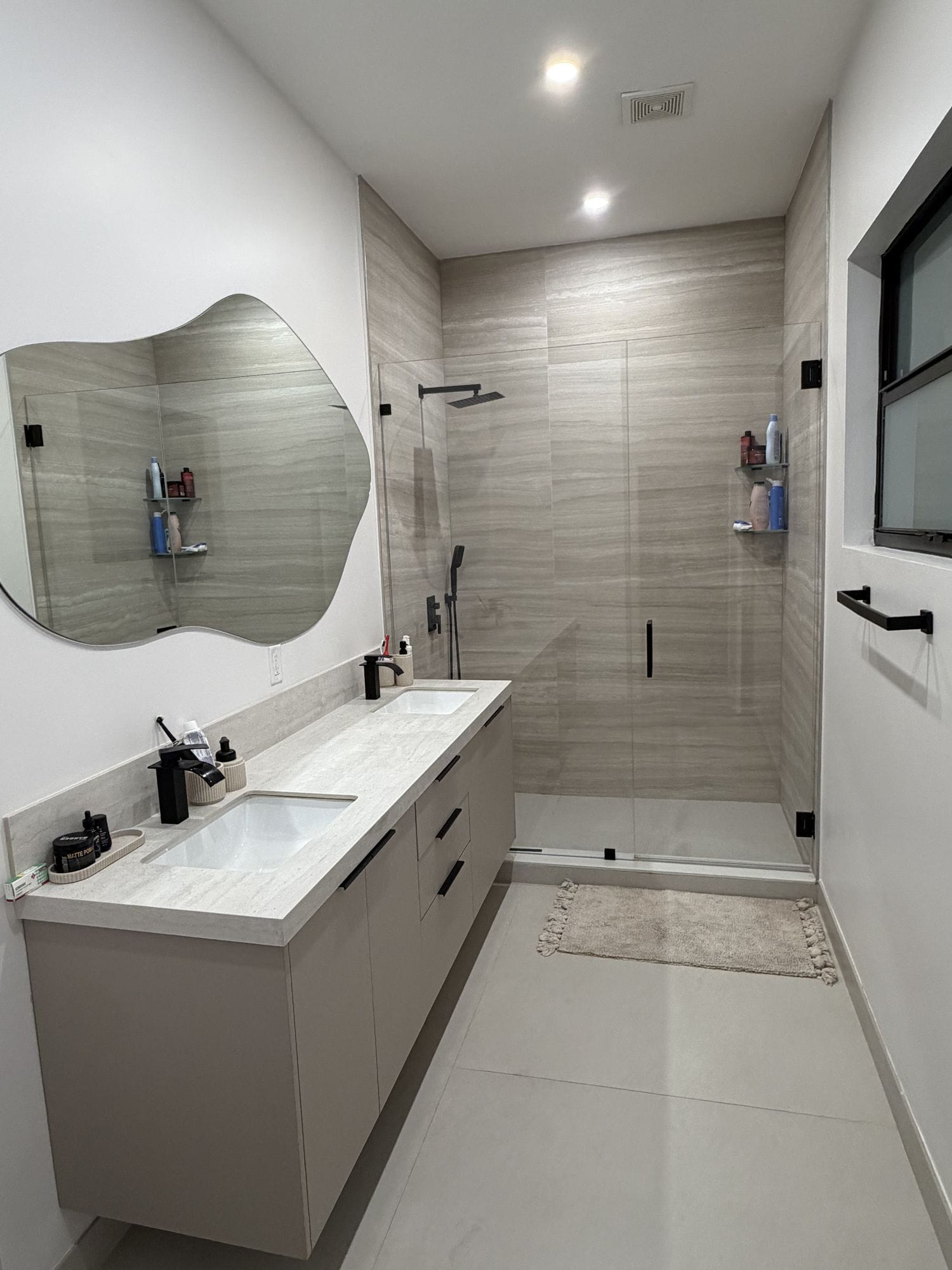
One narrow bathroom, finished
Three frames from real Elbaz Construction work in South Florida — a small room where every trade had to fit around every other one.
These are real photographs of Elbaz Construction work on South Florida projects. A narrow bathroom is the clearest illustration of why separately permitted trades have to be coordinated as one design. None of this work was in Indian Creek and none of it is presented as though it were.
Project 02, during and complete


The room, complete
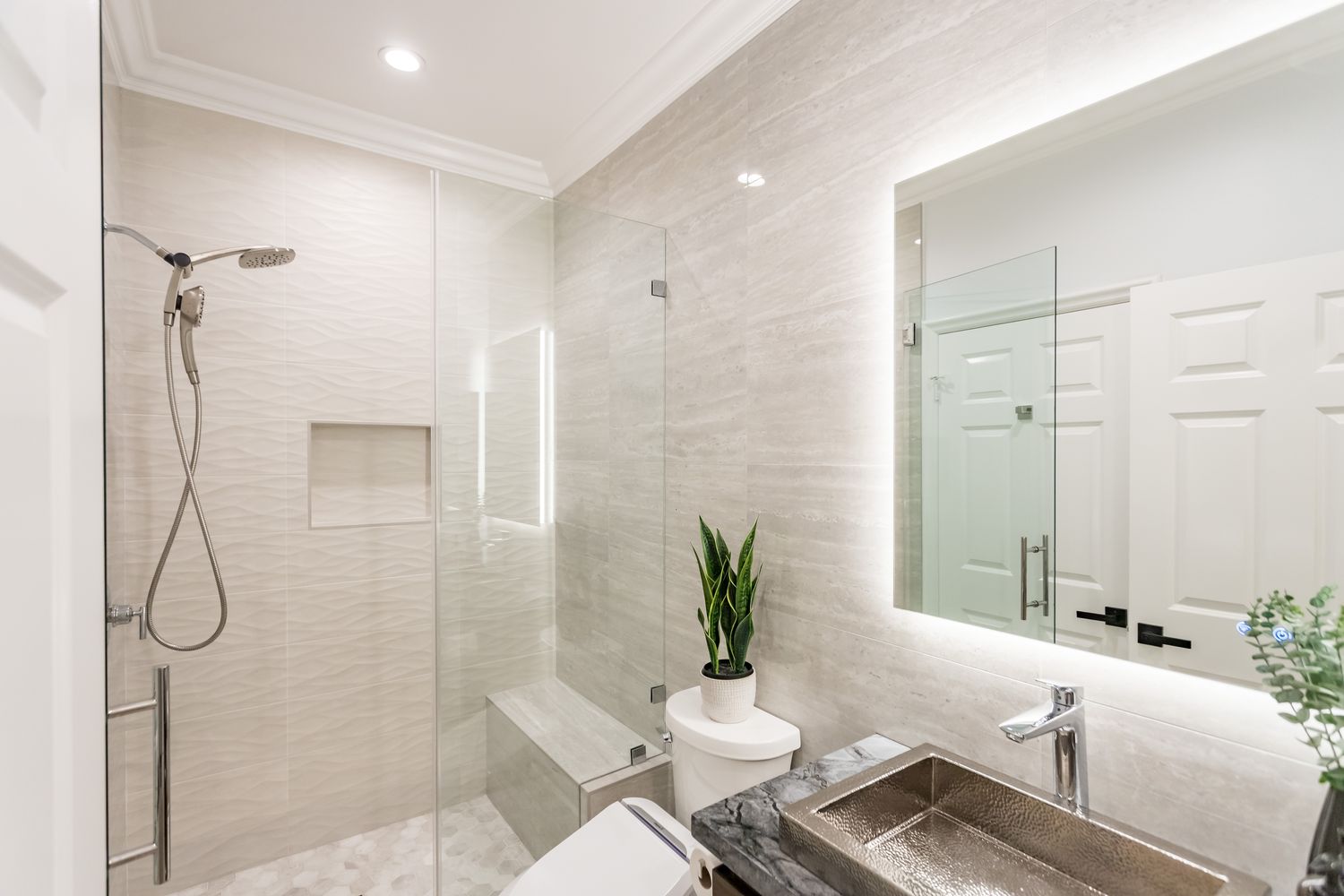
A completed narrow bathroom with a floating vanity, an organic-edge mirror and a curbless walk-in shower.
What this is
Real Elbaz Construction work in South Florida, photographed on completion.
Why it is on a village page
Because a narrow room is where separately permitted trades either coordinate or collide. The fall to that drain, the bench and the vanity were all set out together, before any of them was built.
What it is not
It is not an Indian Creek project, it is not presented as one, and no address, client or cost appears anywhere.
Stage 05 · Judgement
The three decisions Indian Creek owners find hardest
Argued both ways. None of these has a universally right answer — it depends on your scope, how many of the five permitted trades it reaches, and how much of the calendar you control.
Wait for the set
All applications issued first
- What it is
- Holding mobilisation until every separately permitted trade on the job has its permit issued.
- Benefits
- No trade is stranded, and the walls are never open waiting on an application.
- Limits
- The start date is set by the slowest application rather than the fastest.
- Why it matters here
- The Village permits electrical, plumbing, pools, roofing and mechanical separately, so a multi-trade job has several clocks running at once.
- Best for
- Any scope reaching more than one of the five, which is most remodels.
Start on what is issued
Keep momentum
- What it is
- Beginning the construction work as soon as its own permit issues, with trade applications still under review.
- Benefits
- Visible progress sooner, and demolition is rarely the thing waiting on a trade permit.
- Limits
- If a trade permit is delayed, the job stops with the fabric already open, which is the worst place to wait.
- Why it matters here
- Each trade is credentialed as well as permitted, so a delay can come from paperwork that is not even about your project.
- Best for
- Single-trade work, or a scope where the construction permit genuinely stands alone.
Which oneOn a multi-trade remodel, wait for the set. Starting early buys a week of demolition and risks a month of an open wall — and in a village that permits five trades separately, the number of things that can be outstanding is simply higher than it is elsewhere.
Include it now
One mobilisation
- What it is
- Doing pool work as part of the same project, under its own separate permit.
- Benefits
- One mobilisation, one set of protection, and the external works are coordinated with everything else.
- The paperwork
- Pools are named separately by the Village, so it is another application whenever you do it — now or later.
- On the property
- Barrier requirements are engaged either way; doing it alongside other work means the design is settled once.
- Best for
- Any project already touching the outside of the property.
Leave the pool out
Keep this scope contained
- What it is
- Finishing the building work and treating the pool as a separate future project.
- Benefits
- Fewer applications in flight at once, and a shorter list of credentialed trades on site.
- The paperwork
- The same separate permit is required later, so nothing is saved on paperwork — only deferred.
- On the property
- Two mobilisations, and external finishes potentially disturbed twice.
- Best for
- A pool in good condition, or an owner who wants the house finished first.
Which oneThe paperwork is identical whenever you do it, so decide on disruption rather than on process. If the outside of the property is being touched anyway, include it — the mobilisation and the protection are the expensive parts and you are already paying for them.
One contractor coordinating
A single point of responsibility
- What it is
- A general contractor holding the construction permit and coordinating the separately permitted trades.
- Benefits
- One party tracks every credential, every application and every renewal date across the job.
- Why it matters here
- The Village requires each trade to be filed and current before it can obtain a permit; somebody has to be watching all of them.
- Limits
- You are relying on that coordination being done properly, which is a question to ask before signing.
- Best for
- Any multi-trade scope, and any owner who does not want to hold the credential list themselves.
Engage each trade directly
Contract with each one
- What it is
- Contracting separately with each permitted trade and coordinating the sequence yourself.
- Benefits
- Direct pricing from each trade and full visibility of what each is doing.
- Why it matters here
- Each has to be separately credentialed with the Village regardless, so the filings exist either way.
- Limits
- The coordination, the renewal dates and the consequences of a lapsed certificate all become yours.
- Best for
- A single-trade job, or an owner with genuine construction experience and time.
Which oneFor anything multi-trade in this Village, one coordinating contractor — not because the trades cannot be engaged directly, but because the credential requirement makes somebody responsible for watching several filings at once, and that job is invisible until it is not done.
What moves the cost and the calendar in Indian Creek
Tick whatever applies. This will not produce a price — no honest one exists before someone has seen the property — but it will show which parts of your project are carrying the time and the risk.
What this points to
We do not publish figures, and we do not publish permit fees either. The Village publishes a Building Permit Fee Schedule which we have not opened, and we would rather tell you that than quote a number we cannot stand behind. You get a real, itemised number from us in writing after a site visit.
Project gallery 03
A second dwelling, and a ground-up shell
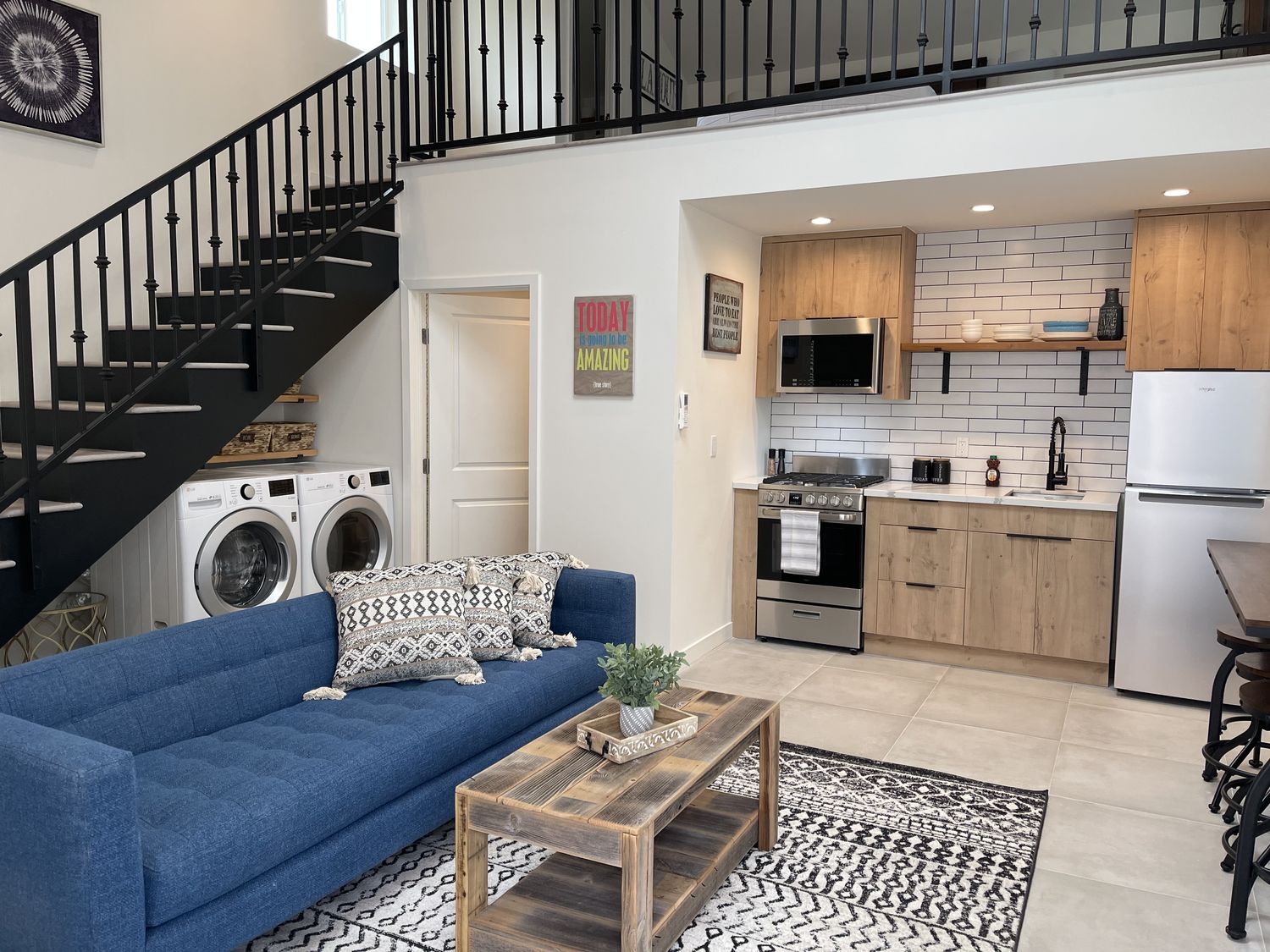
Four frames from completed Elbaz Construction accessory dwelling units and one South Florida build photographed during construction.
Project 03, guided tour

Studio kitchen
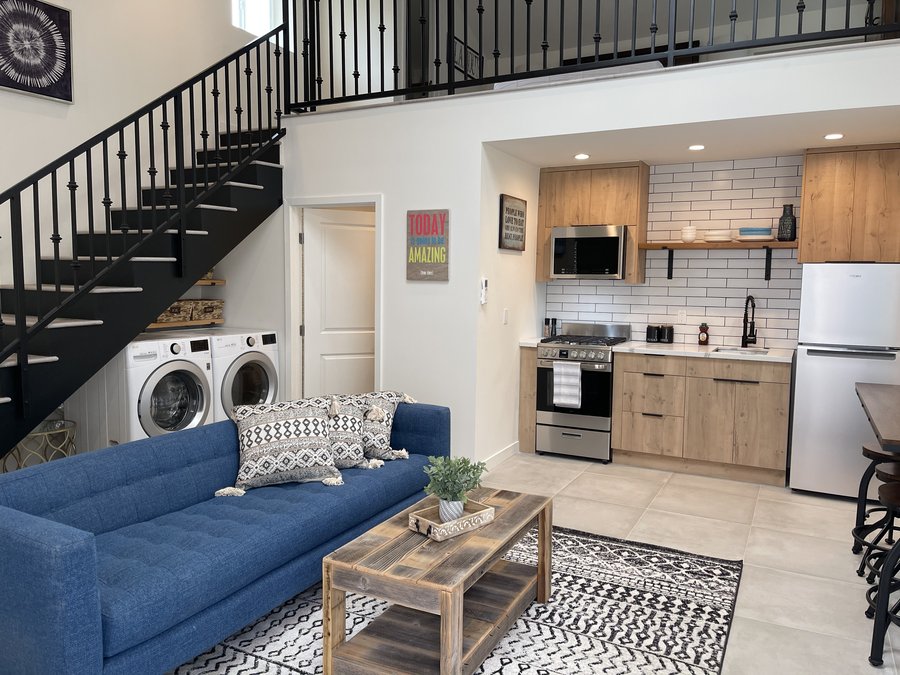
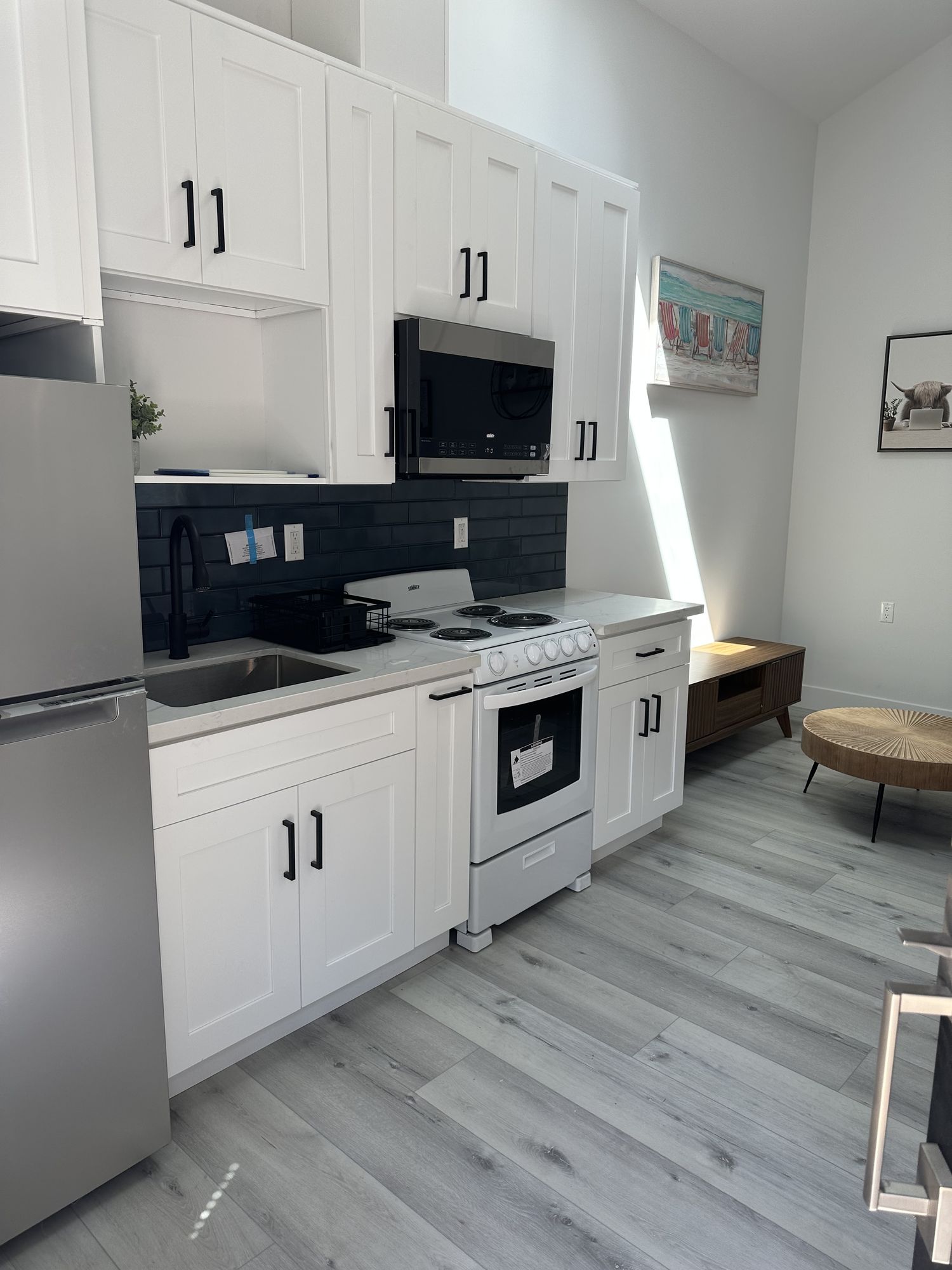
A compact full kitchen in a completed accessory dwelling unit, with white shaker fronts and a dark subway backsplash.
What these show
Completed Elbaz Construction accessory dwelling units in South Florida, and one ground-up build photographed while it was still a site.
Why it matters here
A second dwelling touches every one of the separately permitted trades at once — electrical, plumbing, mechanical, roofing — so it is the clearest case of a project whose paperwork count is set on day one.
Where
South Florida. None of these is claimed to be in Indian Creek.
Stage 06 · Release
What the Village requires, in its own words
Indian Creek Village publishes a short and specific set of requirements. Everything below is quoted from them, and where the Village publishes nothing, this page says so rather than filling the gap.
Filing precedes obtaining
Every contractor "must file valid, updated copies of his/her license(s) and insurance(s) with the Building Department before they can obtain a permit to perform work."
Two acceptable licence routes
A State of Florida licence, or a Miami-Dade County Certificate of Competency and Eligibility.
Plus an occupational licence
From the county or municipality where the contractor's place of business is located.
Plus municipal registration
A Miami-Dade County Municipal Contractor's Licence, including state registration.
The Village must be named
The Certificate of Insurance must name Indian Creek Village as Certificate Holder.
The limits
Commercial General Liability at a minimum of $1,000,000 per occurrence and $2,000,000 in the policy aggregate, with Worker's Compensation alongside.
Five separate permits
"Separate permits are required for ELECTRICAL, PLUMBING, POOLS, ROOFING, and MECHANICAL work."
What is NOT published here
A review timeframe. And although the Village publishes a fee schedule and Land Development Regulations, we did not open them — so no fee, setback, height or floor-area figure appears anywhere on this page.
What we will actually stand behind
Only claims that are either public record or visible in the work on this page. Nothing about awards, nothing about rankings, and no numbers we cannot show you.
Licensed, bonded and insured
Elbaz Construction is a licensed Florida general contractor, CBC1265280. Permits are pulled in the company's name, and the licence is verifiable at the Florida DBPR rather than on our say-so.
Filed with the Village, and current
The Village requires licences and insurance on file before a permit can be obtained, with Indian Creek Village named as certificate holder at $1,000,000 per occurrence and $2,000,000 aggregate. That filing is maintained continuously, not assembled when a job appears.
We watch every trade's renewal date
On a job reaching several of the separately permitted trades, somebody has to be tracking several filings at once. A certificate that lapses mid-project stops that trade and strands the ones behind it, and that is an avoidable failure.
We count the permits before we price
Electrical, plumbing, pools, roofing and mechanical are separate applications here. The count is knowable on day one, and a proposal that has not counted them is a proposal that has not been thought through.
We file it ourselves
Design, the applications and the construction are handled by one company, so a reviewer's comment does not sit waiting on a hand-off between two firms.
We do not quote what we did not read
The Village publishes a fee schedule and Land Development Regulations. We did not open them, so this page carries no figure from them — and we will tell you that rather than produce a plausible number.
Envelope documentation kept straight
In the HVHZ what is inspected is the pairing of installed product and approval paperwork. We keep them matched, because an envelope inspection that fails on documentation costs exactly as much as one that fails on workmanship.
Every permit closed, not just the main one
A job can look finished with a trade permit still open. Each separate permit is taken to its own final and closed, because an open permit follows the property.
Questions, by stage
Filter to the part of the job you are thinking about.
What does my contractor need before they can pull a permit here?Credentials
Four things, all on file with the Building Department before a permit can be obtained: a State of Florida licence or a Miami-Dade County Certificate of Competency and Eligibility; an occupational licence from the county or municipality where their business is located; a Miami-Dade County Municipal Contractor's Licence including state registration; and certificates of insurance for General Liability and Worker's Compensation.
Why does the Village have to be named on the insurance?Credentials
Because it requires it: the Certificate of Insurance must name Indian Creek Village as Certificate Holder, with Commercial General Liability of at least $1,000,000 per occurrence and $2,000,000 in the policy aggregate. Being named as certificate holder means the Village is notified about the policy standing behind work done inside it, rather than relying on an assurance that cover exists.
Can I check that a contractor is properly filed?Credentials
Ask them for it, and ask the Building Department. The Village publishes the requirement precisely so that it is checkable, and a contractor who is genuinely current will have no difficulty showing you. It is a check worth making before signing anything, with anybody.
How many permits will my project need?Which permits
More than you would expect elsewhere. The Village requires separate permits for electrical, plumbing, pools, roofing and mechanical work, on top of the construction work itself. A bathroom remodel is usually at least two applications and often three. The count is knowable before anything is drawn, and we do that count first.
Does pool work really need its own permit?Which permits
Yes. Pools appear in the Village's separate-permit list in their own right. Pool work does not ride along with a general construction permit or with a landscaping scope, and barrier requirements under the Code apply regardless of what else is happening on the property.
Do I need a permit to remodel a kitchen or bathroom?Which permits
Yes, and probably several. A kitchen or bathroom remodel involves electrical and plumbing at minimum, both of which the Village permits separately, and mechanical work adds a third. Each carries its own application and its own credentialed trade.
How long does a permit take in Indian Creek Village?Filing
We do not publish a number, because the Village does not publish one. What we can tell you honestly is how many applications your scope produces, which of them are outstanding at any moment and what each is waiting on. Anyone quoting you an Indian Creek review time is quoting their own average.
What will the permits cost?Filing
The Village publishes a Building Permit Fee Schedule. We have not opened it, so we do not reprint figures from it — quoting a fee from a document nobody read is exactly the kind of plausible-sounding error we work to avoid. Ask the Building Department, and whatever the permits come to appears itemised on your proposal.
Where is the Building Department?Filing
At 9080 Bay Drive, and it publishes a direct telephone number, (305) 865-4121, for permit enquiries. On a village this size, asking before filing is faster than answering a comment afterwards.
What happens if a trade's insurance lapses during the job?On site
That trade stops, and anything sequenced behind it stops with it. It is one of the genuinely avoidable failures on a job here, which is why renewal dates go into the programme alongside the construction dates rather than being left to whoever holds the policy.
What happens if you find unpermitted work from a previous owner?On site
We stop and tell you, before it is covered up. In a village that permits five trades separately, earlier work tends to be easier to trace than elsewhere, because each trade left its own paper — and an absence in that record is itself informative.
Can I live in the property while you work?On site
Often yes, and it changes the programme rather than the price alone. Containment, protection and phasing all cost days. The honest version of this conversation happens at the site visit.
Why won't you publish a price?Cost
Because for a remodel the same square footage can differ several-fold depending on what is behind the wall and how many separately permitted trades are involved. A published rate would be a guess. You get an itemised figure in writing after a site visit, and it says what happens if something is found during demolition.
Does the separate-permit structure make a project more expensive?Cost
It makes it more administrative, which is not quite the same thing. The construction cost is what it is; what changes is the number of applications, the number of credential filings and the amount of coordination. That is real work, and it should appear on a proposal rather than being absorbed silently or discovered later.
How are inspections handled with several permits?Inspections
Each separate permit carries its own inspections and its own final. That is the part owners most often underestimate: a job can be visually complete while a trade permit is still open behind it, and closing them is not automatic.
Is roofing inspected separately too?Inspections
Roofing is separately permitted here, and in the HVHZ it is also the part of the envelope where product approval documentation is inspected against what was actually installed. Both things are true at once, and both have to be satisfied.
What happens to the permits when the job is finished?Afterwards
Every one of them is closed out, not just the construction permit. An open permit — of any trade — stays attached to the property and reappears at sale, when it is somebody else's leverage rather than an administrative detail.
What paperwork should I keep?Afterwards
The record for every separate permit, the approved drawings, the product approval documentation for anything in the envelope, and the closeout for each trade. In the HVHZ the envelope paperwork is the part a future buyer, insurer or inspector will actually ask for.
Do you work anywhere else in Miami-Dade?Afterwards
Yes — across Miami-Dade, Broward and Palm Beach, 104 municipalities in total. The filing routes differ genuinely between them: Indian Creek Village credentials each trade and permits five of them separately, most of its neighbours do neither, and those differences are a working detail for us rather than a surprise.
Nothing in that stage yet — try “All”.
Credentials first, then a building. Let's start properly.
Indian Creek Village asks who is working before it asks what is being built, and it permits five trades separately once it does. The value of a contractor here is having the filings current before the conversation starts, and counting the applications before the drawings.
Or see the rest of what we cover on the Miami-Dade County page if your property is somewhere else in the county.
