


10 service categories · 100 service pages · Miami-Dade, Broward & Palm Beach
View all servicesThe journey
Six stages, from your address to a closed permit.
West Palm Beach publishes more of its own reasoning than any other city on this matrix, and the reasoning is more useful than the rules. It tells you which code a requirement comes from, how long a compliant submission takes, what happens if you build without a permit, and exactly when an old permit stops being your problem. This page walks those in the order they actually arrive.
Use the stage markers to jump to the part you are stuck on. Nothing here is a promise about your address — the Building Division decides that — and nothing here is a timeline we invented. Where the City publishes a number, it is quoted and attributed. Where it does not, this page says so instead of guessing.
Stage 01 · Address
Four things about the property, before anything about the work
In West Palm Beach several of the rules that decide your project attach to the address rather than to the scope. Settle these first, because two of them can remove an exemption you were counting on.
Which code the rule comes from
The City draws a line most municipalities leave implicit. HB 803 amends Chapter 553, the Florida Construction Standards — the building code. But the City's requirement for fence and driveway permits, in its own published words, "is not caused by or derived from the building code but is required based exclusively on the City's Zoning code", which regulates fence height and type, setbacks and driveway location, material and area. Because the statute does not alter the zoning code, those permits survive it. Once you see that, the rest of the City's published positions stop looking arbitrary.
- HB 803 amends FSS Chapter 553, the construction standards
- Fence and driveway permits here come from the ZONING code instead
- The City states the statute "does not alter or amend or nullify" that code
- So fence, pool-barrier and driveway permits are still required
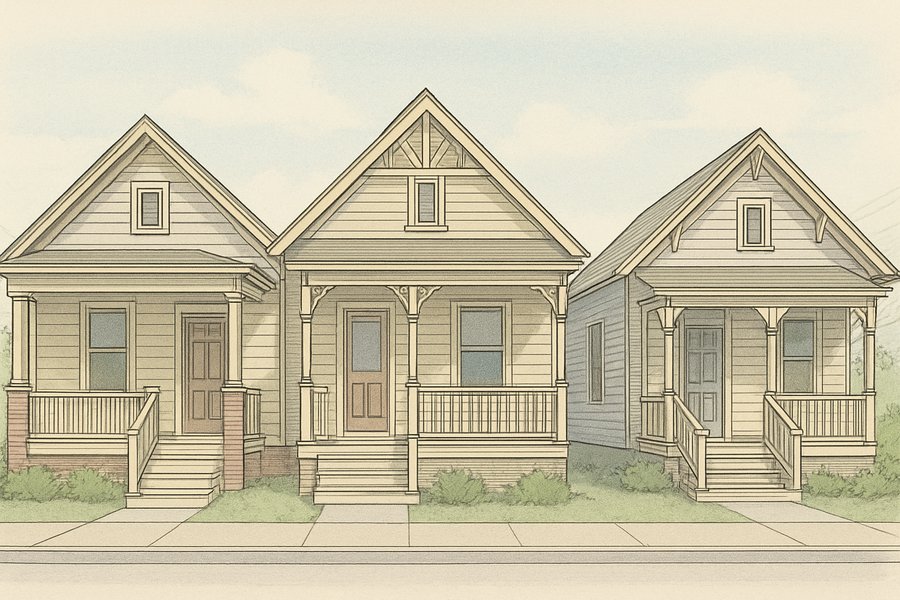
Illustration, not a photograph: a drawn residential streetscape, used to show how an elevation reads from the street. It is not a West Palm Beach street and is not presented as one.
A flood hazard area
The City excludes from Exemption 1 "any work on a property located partially or entirely within a flood hazard area" — note "partially". A lot that is only clipped by the mapping is a lot where the minor-work exemption does not apply. The second exemption, for temporary flood and hurricane barriers, runs the other way and is written for properties where such protection makes sense, but it carries its own five conditions. Flood designation is therefore not background here: it is one of the switches that decides whether you file.
- Exemption 1 excludes work on a property "partially or entirely" in a flood hazard area
- Partial intersection is enough to remove it
- Exemption 2 exists for temporary flood and hurricane protection, with five conditions
- Confirm the designation for the address before assuming any exemption
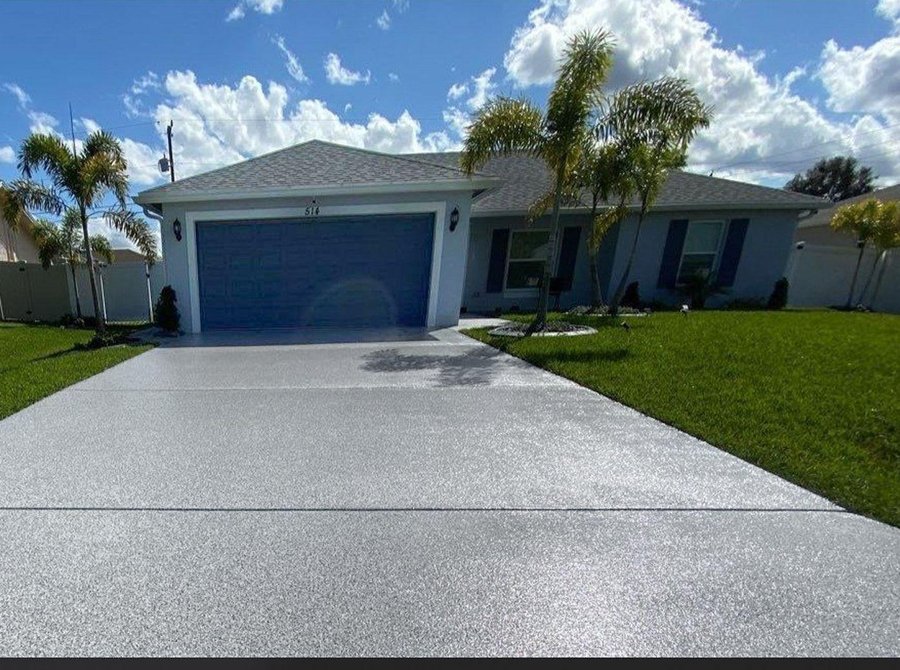
A poured concrete driveway with an exposed-aggregate finish leading to a two-car garage, from completed Elbaz Construction work in South Florida. Not a West Palm Beach property.
House, or apartment and condo
One of the clearest published examples of a rule that follows the building type rather than the work: the City states that replacing flooring in an apartment or condominium does require a permit, while for a house, replacing flooring and painting does not. Identical scope, identical materials, opposite answer, decided by what you live in. If you own a condominium, add your association's own approval on top — that runs on its own calendar, entirely outside the City's.
- Flooring in an apartment or condo: permit required
- Flooring and painting in a house: no permit required
- The distinction is the building type, not the work
- A condominium association approval is separate from, and additional to, the City's
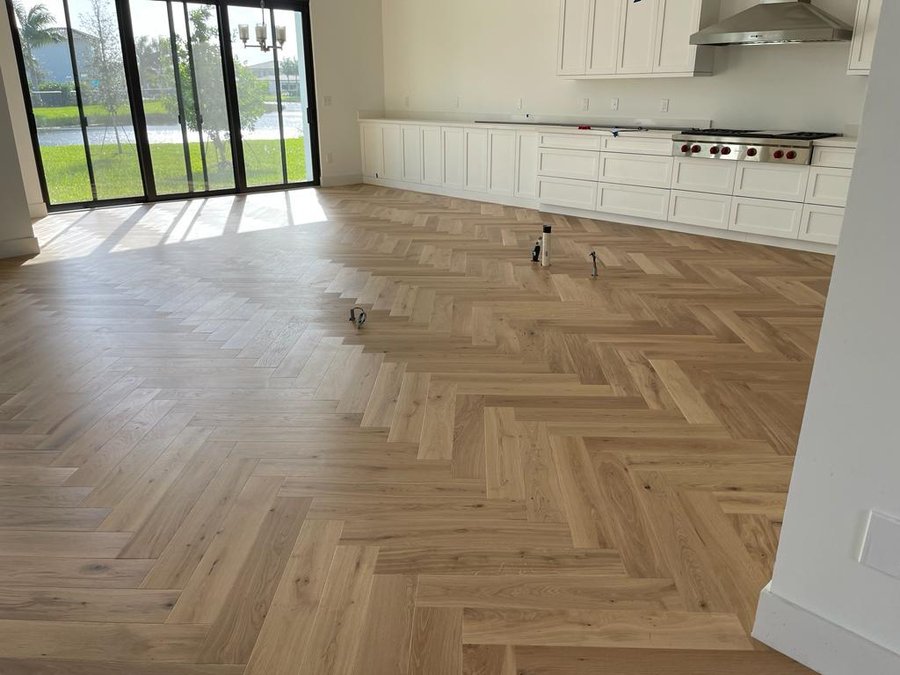
Herringbone timber flooring laid across a large open space beside a glazed wall, from a completed Elbaz Construction project in South Florida.
What is already on the record
West Palm Beach publishes a whole procedure for closing old and expired permits, which tells you how often it comes up. An application that was never issued becomes Abandoned after 180 consecutive days without activity; an issued permit becomes Expired after 180 consecutive days from issue without a passed or partially passed inspection. Both remain attached to the property. Before you plan new work, it is worth knowing what the record already says, because an open permit generally has to be dealt with first.
- Never-issued application: Abandoned after 180 consecutive days of no activity
- Issued permit: Expired after 180 days from issue with no passed inspection
- Both stay attached to the property and surface at sale
- The City runs a dedicated expired-permits mailbox for exactly this
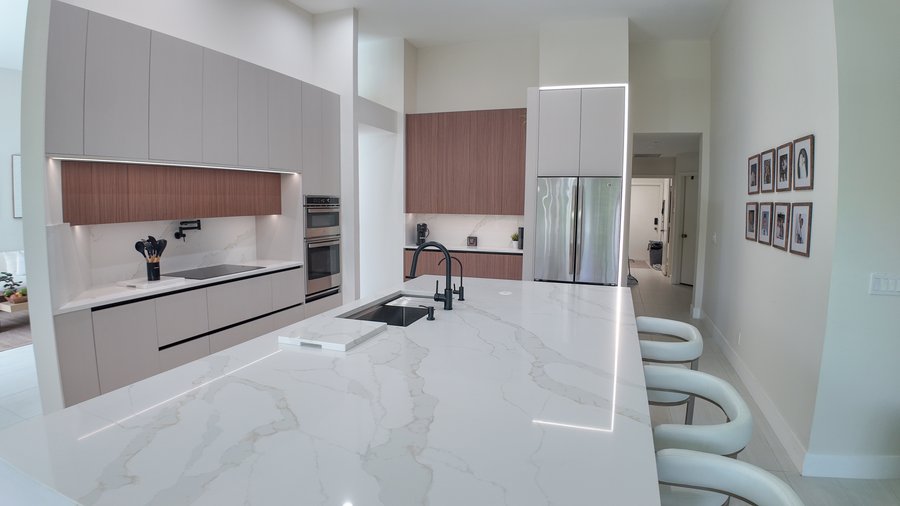
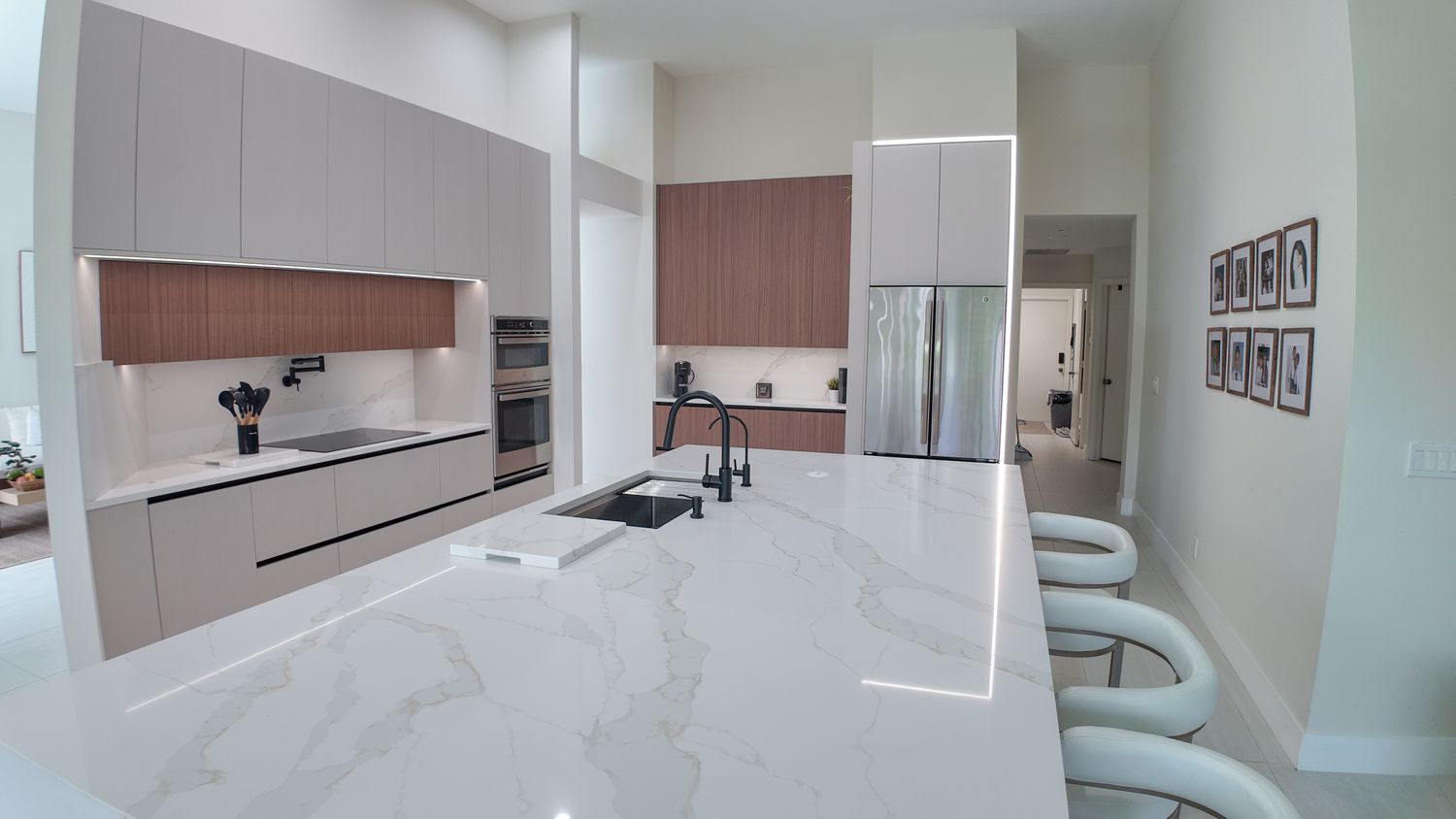
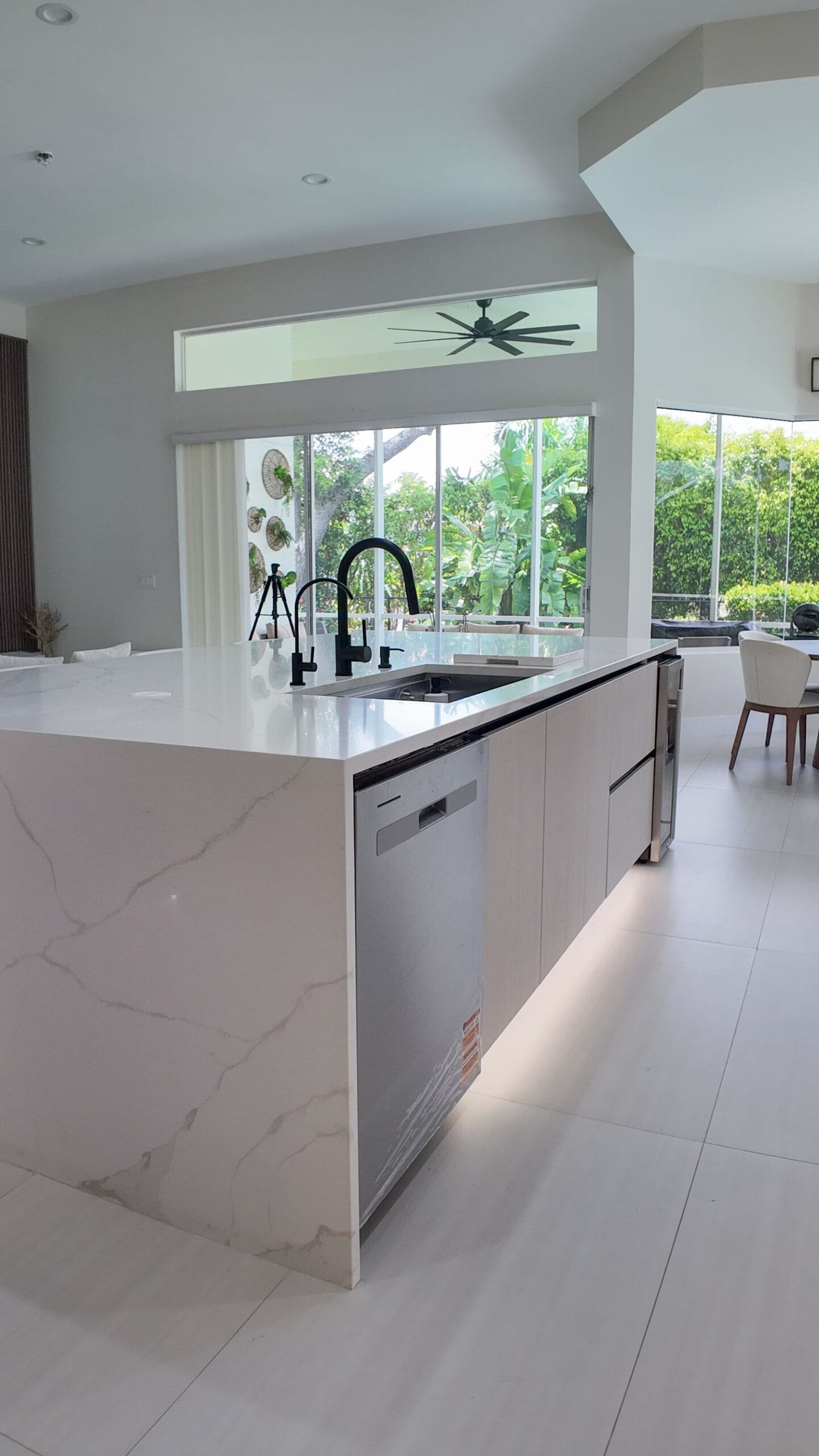
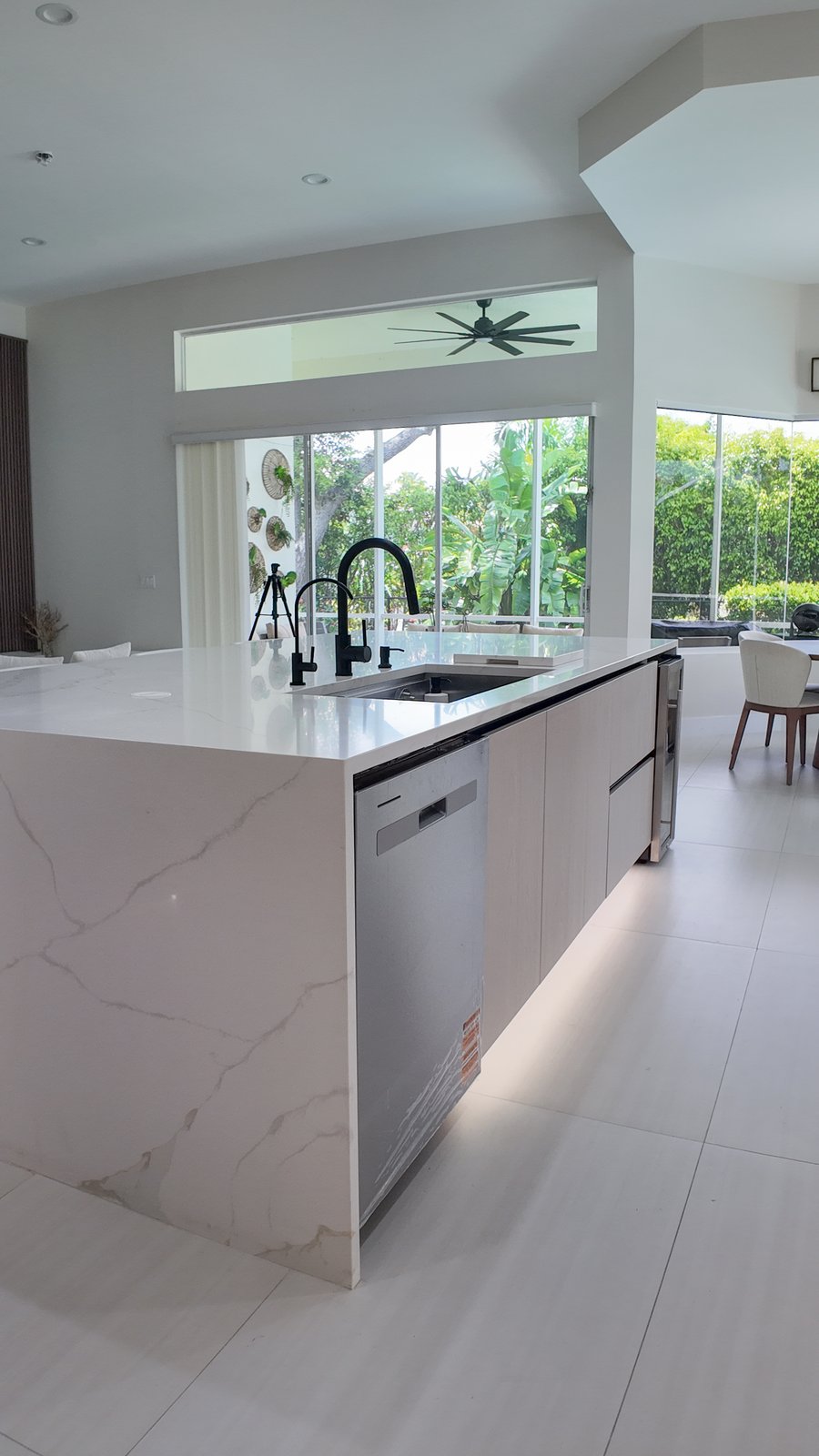
A completed Elbaz Construction contemporary open-plan kitchen with a stone island and full-height cabinetry. A South Florida project, not a West Palm Beach one.
Stage 02 · Exempt?
What HB 803 actually removed here, and what it did not
The exemption is narrower than the headline, and West Palm Beach is unusually precise about the edges. It is also the only city on this matrix that makes you ASK for the exemption in writing.
You have to ask for it
This is the part owners miss. The exemption is not self-executing. The City states that the property owner or the owner's contractor "must submit a written request for exemption", with a copy of the contract or other documentation showing the nature and value of the work. It created a permit type called Permit Exemption in its Civic Access portal and a Permit Exemption Affidavit to go with it. Staff review the request; if approved, the City issues an Exemption Certificate. If it is denied, a permit is required and has to be applied for separately under the correct type.
- The owner or the owner's contractor must request the exemption in writing
- A copy of the contract or equivalent documentation goes with it
- It is filed as a "Permit Exemption" application in Civic Access
- Approval produces an Exemption Certificate; denial means a permit

Illustration, not a photograph: a drawn document wallet beside rolled drawings, used to show what an exemption submission is. Not a photograph of any City record.
Never exempt, whatever it costs
Structural, electrical, mechanical, plumbing and gas work stay permitted work regardless of value — the usual list. Then the City adds fences, fence pool barriers and driveways, and explains why: those requirements come from its zoning code, not the building code, so a statute amending the building code cannot remove them. And any work on a property partially or entirely inside a flood hazard area is out too. For most remodels this means the exemption is irrelevant — a kitchen or bathroom touches at least two of the never-exempt trades before anyone opens a wall.
- Structural, electrical, mechanical, plumbing and gas: always permitted work
- Fences, fence pool barriers and driveways: zoning code, so still required
- Work in a flood hazard area is excluded from the exemption
- A multi-trade remodel is outside the exemption by definition
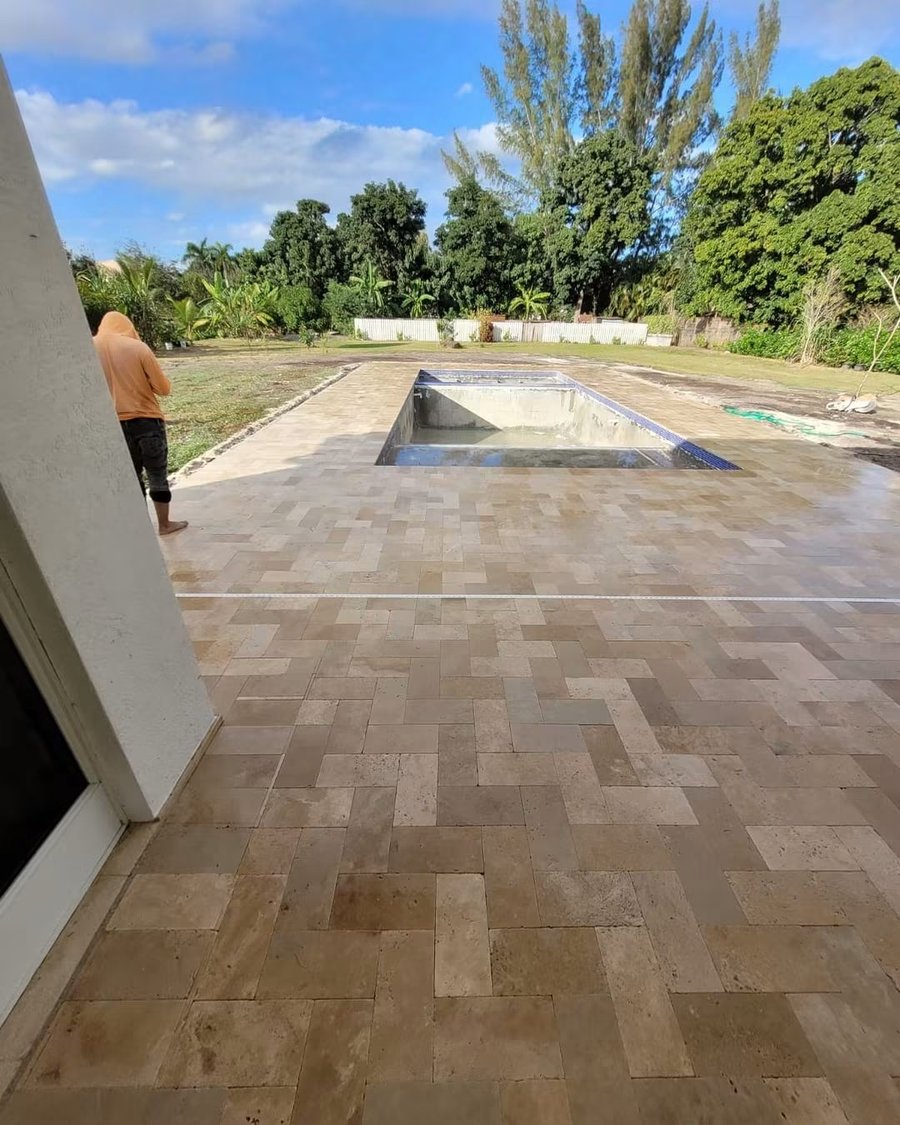
Large-format paving units being laid out on a prepared bed beside a pool, on a completed Elbaz Construction project in South Florida.
No phasing, no splitting
The City gives this its own heading rather than burying it: "A construction project may not be divided into two or more smaller projects for the purpose of staying under the $7,500 threshold to qualify for the exemption." That closes the obvious manoeuvre, and it also tells you how the City will read a sequence of small applications on one address in one year. Phasing for occupancy or budget is ordinary and legitimate; phasing to stay under a number is the thing this sentence exists to prevent.
- Splitting a project to stay under $7,500 does not create an exemption
- The City publishes this as a named rule, not as a footnote
- Phasing for occupancy or budget remains perfectly ordinary
- Several small applications on one address will be read together
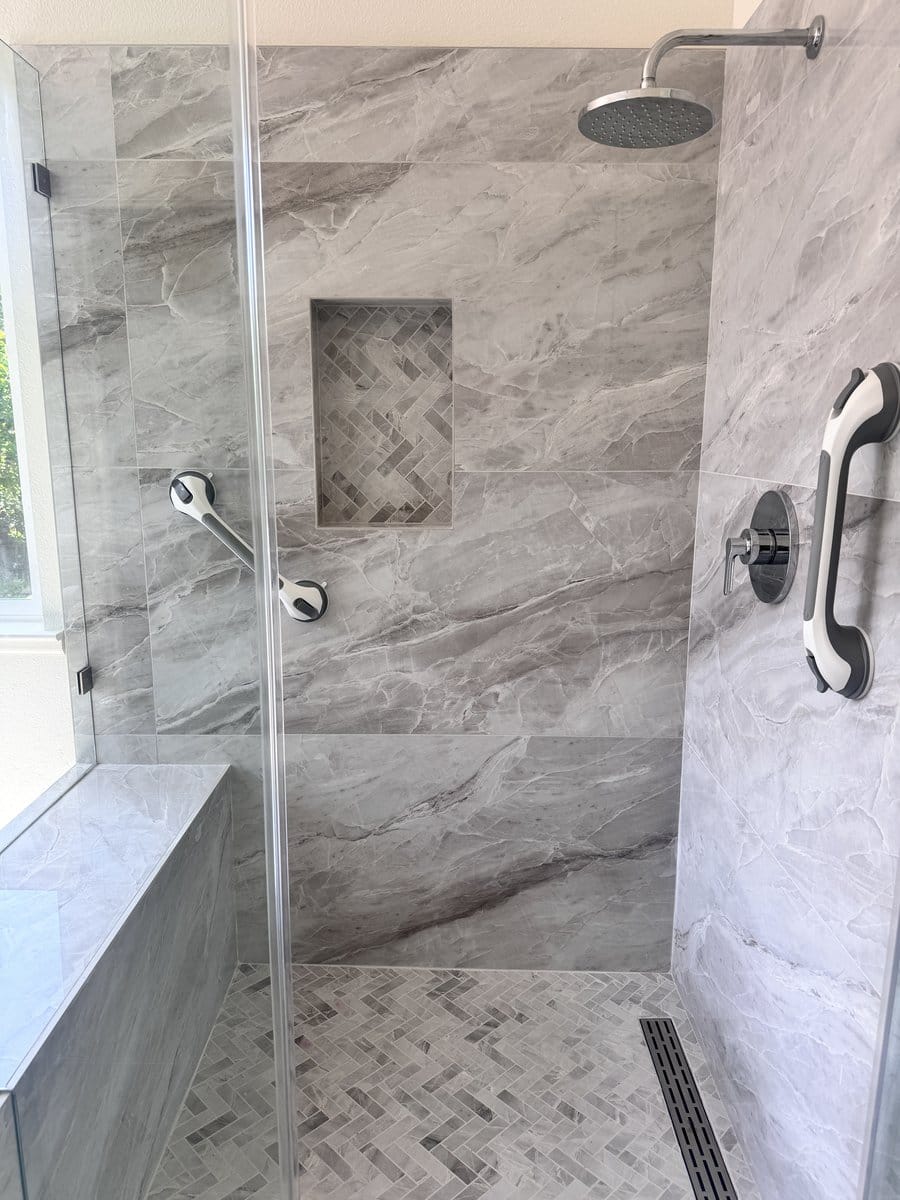
A rain shower head above a recessed niche set into marble-look porcelain wall tile, from completed Elbaz Construction work in South Florida.
The second exemption, and its five conditions
The City publishes all five conditions rather than summarising them. The wall or barrier must be nonhabitable and non-load-bearing; installed on the property of a single-family or two-family dwelling or townhouse; constructed to mitigate or prevent storm surge or floodwaters entering a structure or property; installed by a contractor licensed under Part I of Chapter 489, Florida Statutes; and compliant with applicable local zoning, drainage, easement and setback requirements. All five, not any of them — and the last one puts the zoning code back in the room.
- Nonhabitable and non-load-bearing
- Single-family, two-family or townhouse property only
- Installed by a contractor licensed under Part I of FSS Chapter 489
- Compliant with local zoning, drainage, easement and setback rules
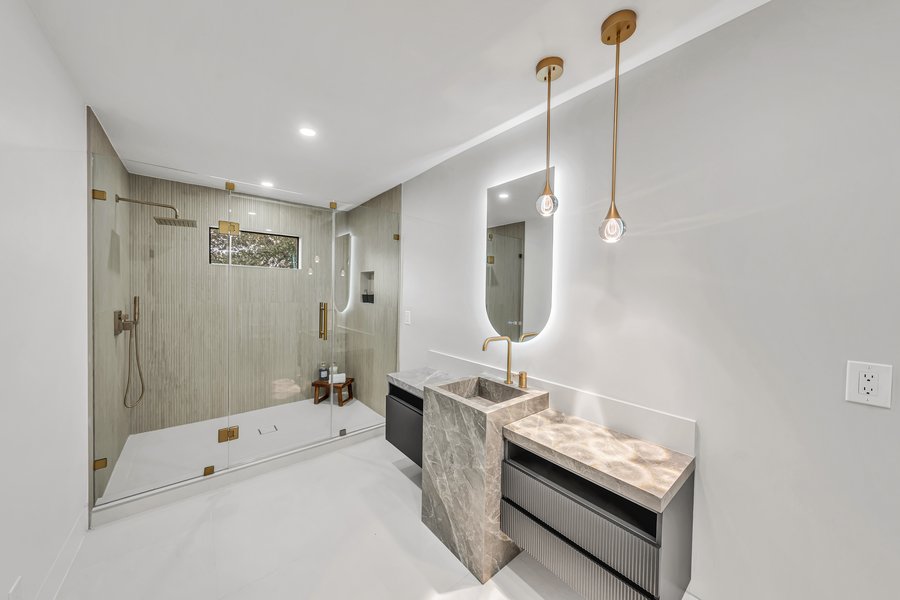
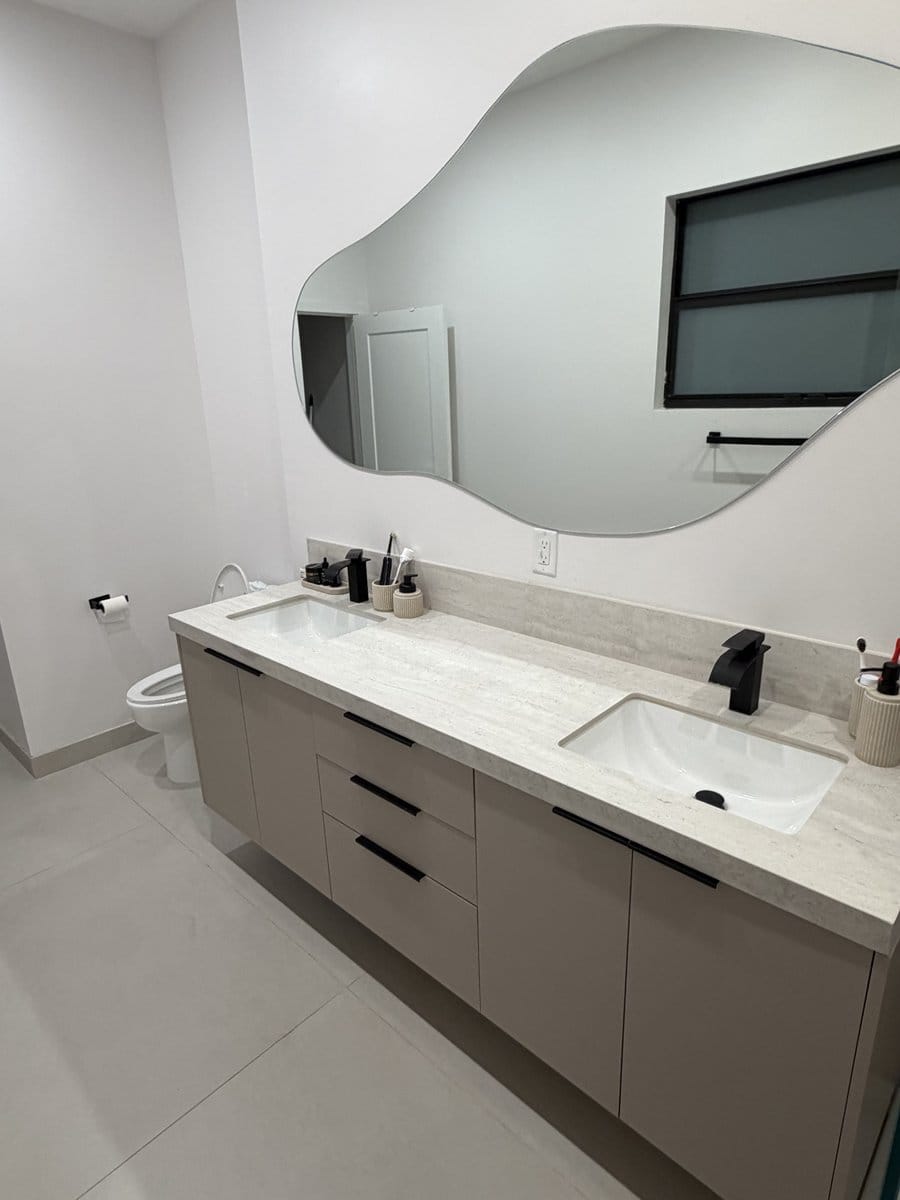
A walk-in shower with brass fittings alongside a stone-topped vanity in a completed Elbaz Construction bathroom. A South Florida project.
Every photograph in this section is real Elbaz Construction project photography from completed South Florida work. None of it was taken in West Palm Beach and none of it is captioned as though it were. Drawn images are labelled as illustrations.
Project gallery 01
The work the paperwork is for
Six frames of completed Elbaz Construction work across South Florida. Different properties, not one project, and not photographed in West Palm Beach — each caption says what it actually is.
Project 01, guided tour
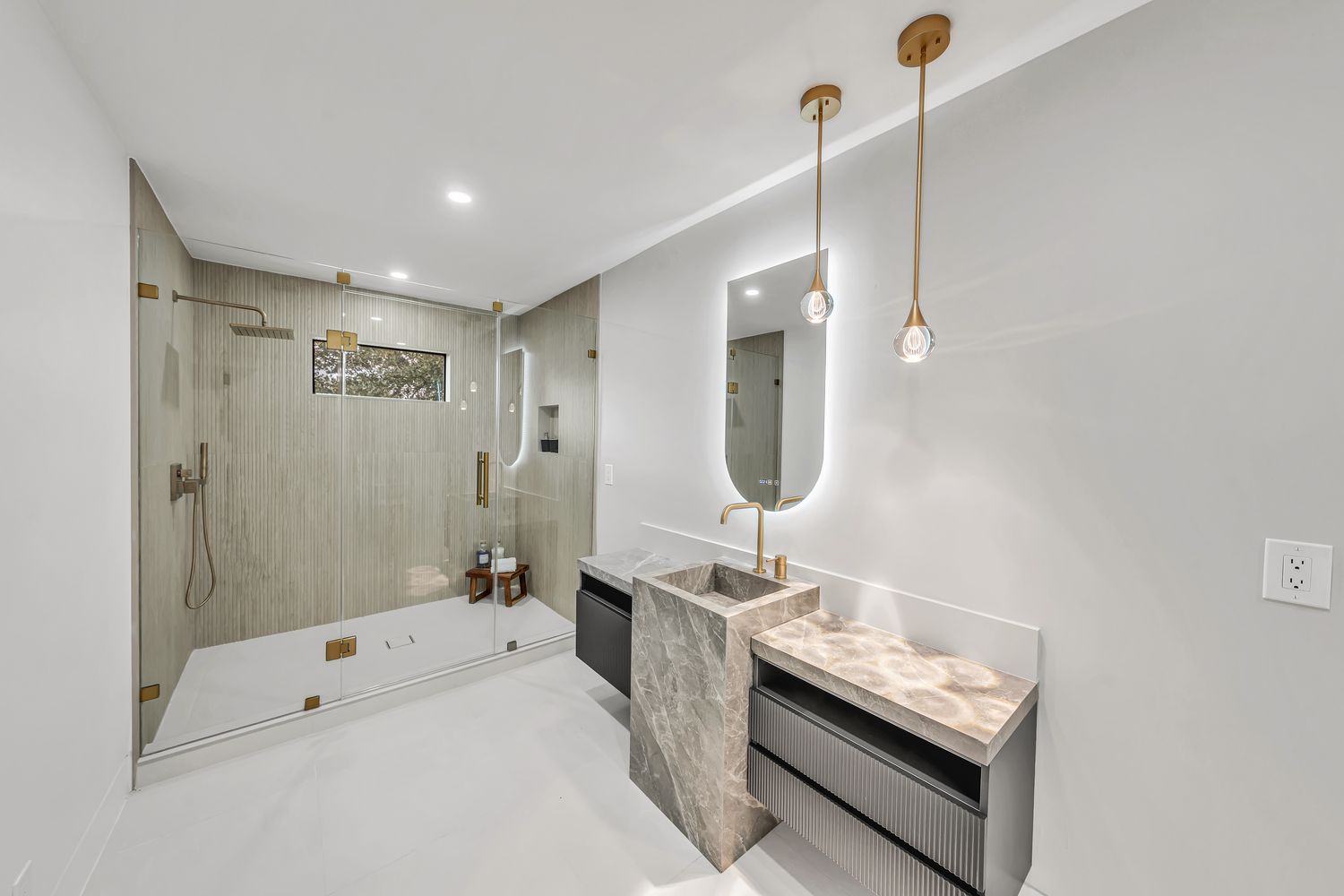
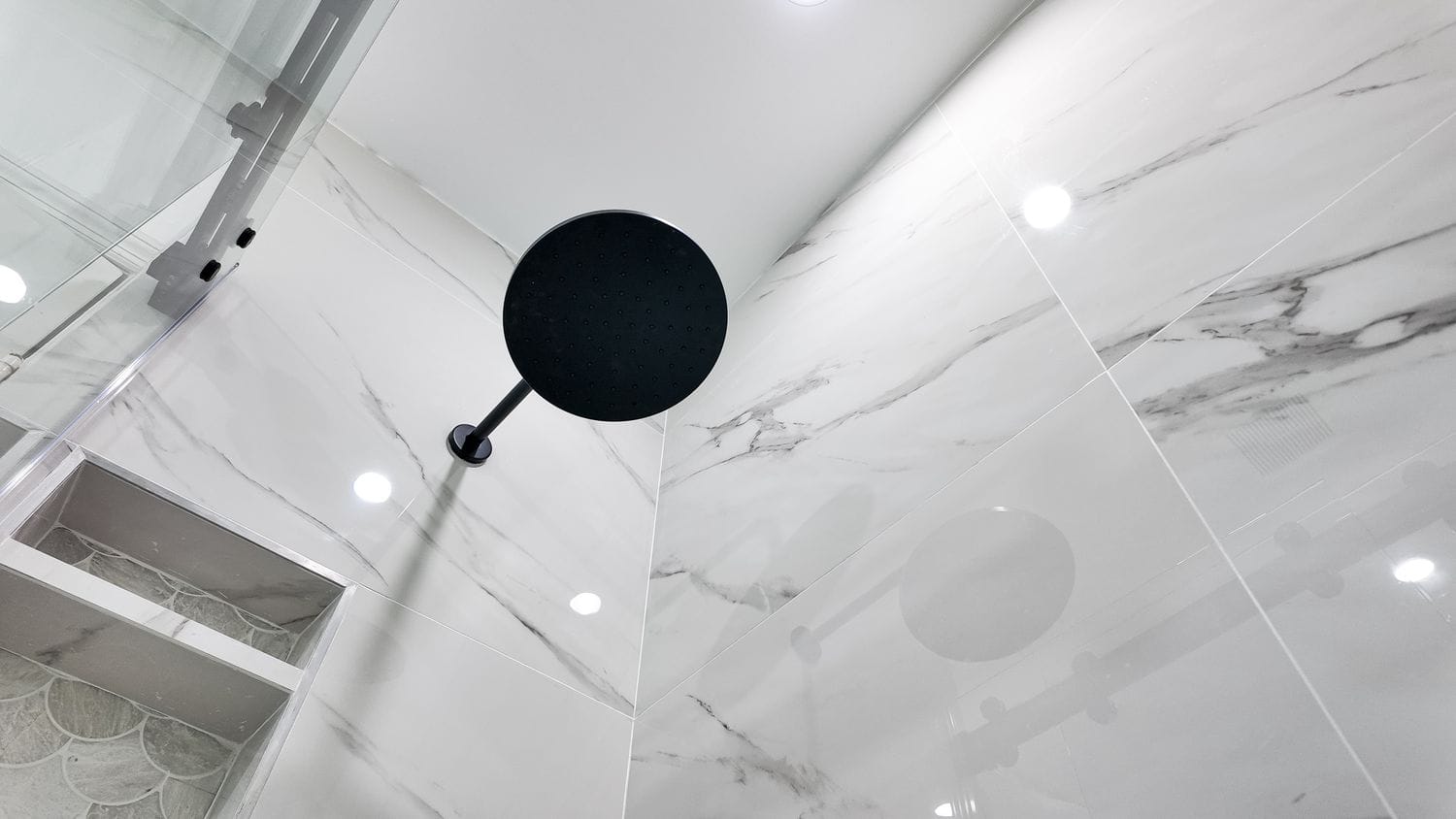
Bathroom, brass fittings
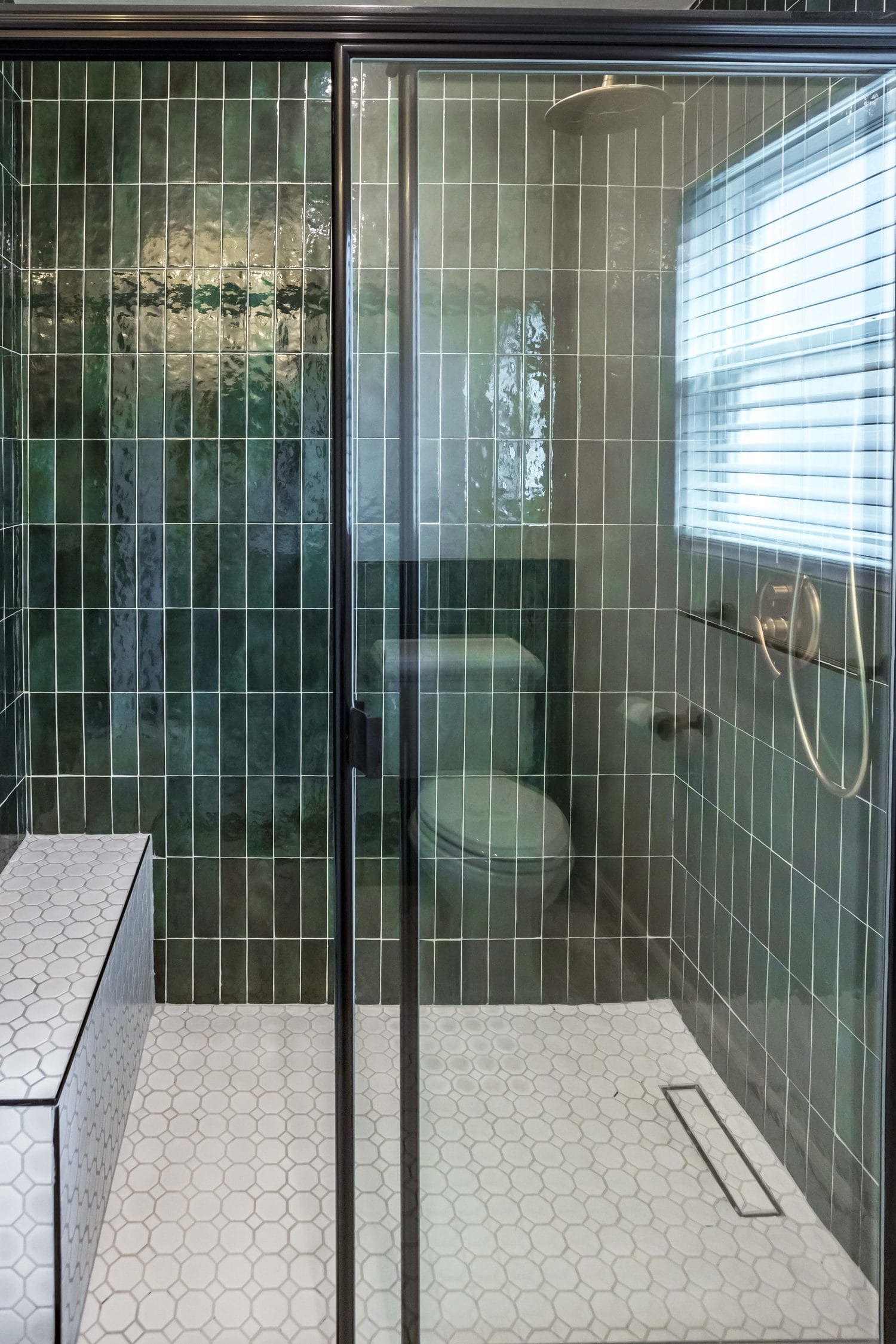
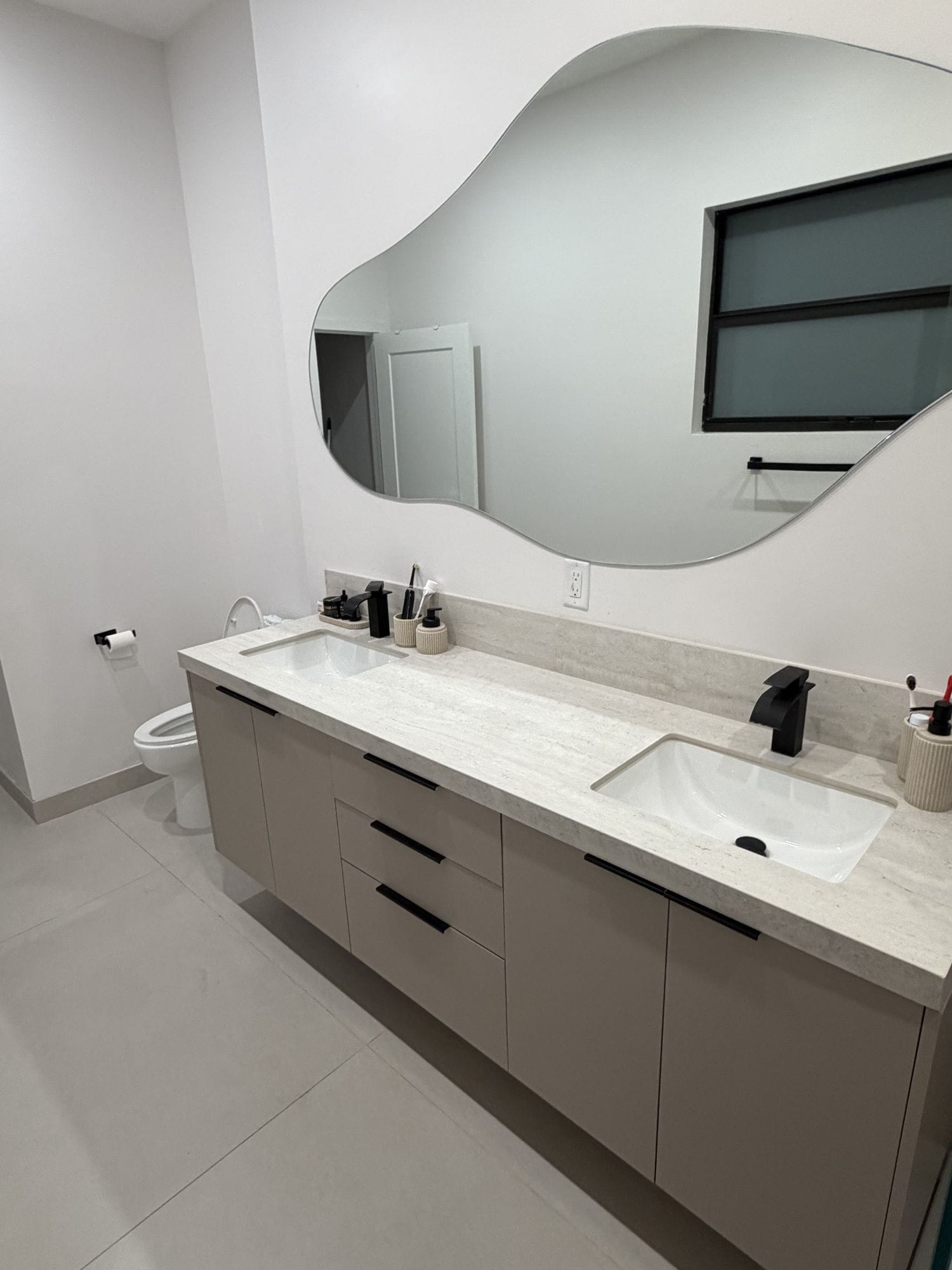
A completed walk-in shower with brass fittings alongside a stone-topped vanity.
What these show
Six frames from completed Elbaz Construction projects across South Florida, grouped by room rather than by property. Bathrooms, a kitchen, and the details that take longest to get right.
Why they are here
A city page is about a process, and a process is only worth reading if the company at the end of it builds. These are the finished result of the same six stages this page walks.
Where they were taken
South Florida. None is claimed to be in West Palm Beach, because none was verified as being in West Palm Beach. Where a caption says "a completed project", that is the whole of the claim.
What is not claimed
No cost, no address, no client name and no permit history appears anywhere on this page.
Stage 03 · File
Filing it: registration first, then Civic Access
West Palm Beach runs its permitting on EPL — Enterprise Permitting & Licensing — through a Civic Access portal, and it publishes a review time, which very few municipalities on this matrix do.
Before the application, not with it
A contractor registers by email with the state licence or county competency licence, a valid local business tax receipt, and certificates of insurance for general liability and workers' compensation naming the City of West Palm Beach as certificate holder at 401 Clematis St. The City asks for 1-2 business days to process it.
Decide this before you file anything
If the work might fall under HB 803, the request goes in as its own Permit Exemption application with the affidavit and a copy of the contract. Staff review it and either issue an Exemption Certificate or refuse it, in which case a permit is applied for separately under the correct type.
What is actually being applied for
The application has to describe a scope the City can review: what is altered, which trades are involved, which need their own sub-permits under a master permit. The City is explicit that its published review time assumes the documents are code-compliant.
One portal, everything against the record
Drawings, product approvals and forms are uploaded against the application in the Civic Access portal, which is also where status, plan review comments and the reviewer's own name and contact details live.
Three weeks, if it is compliant
The City publishes what almost nobody else does: "a residential remodel permit can be issued in approximately 3 weeks and a commercial remodel permit in approximately 5 weeks" — but only if the submitted documents are code-compliant. If they are not, comments are posted and the timeline then depends on how quickly they are answered.
Answered against the same record
Plan review comments appear under the Reviews tab of the permit record, and the City states that the reviewer's name, phone and email should always be left in the comments themselves. Talking to the person who wrote a comment is the fastest way to close it.
Published as minimums
The City publishes a Fee Estimator and, separately, its minimum combined plan review and permit fee: $105 for a project value up to $1,000, $130 up to $2,500, and $580 at a project value of $20,000 — excluding Fire and Zoning fees, which do not apply to every project. Whatever it comes to appears itemised on your proposal.
Recorded at the County, then emailed in
The NOC is recorded in County Official Records at the Palm Beach County Recording Department, and the recorded copy is then emailed to the City with the permit number in the subject line. It is a two-step that owners running their own project routinely collapse into one and then wonder why the first inspection will not book.
This is the published sequence, not a promise about your project. What any specific address requires, whether an exemption applies and how many comment cycles a submission draws are decided by the City of West Palm Beach Building Division — not by a contractor. We confirm what your address actually requires before anything is filed.
Stage 04 · Site
A job that leaves a record, in a city that keeps one
West Palm Beach is unusual on site in two ways. It lets you telephone the individual inspector for a two-hour window, which changes how a week is planned; and it publishes exactly what happens to a permit that is left open, which changes what "finished" has to mean. Both run through every phase below.
Reading the record first
Before a single van arrives
The first thing that happens on a West Palm Beach job is not physical. The City publishes a whole procedure for permits that were abandoned or expired, which tells you how frequently one is already sitting on an address. We look at what the record says before we book anything, because an open permit generally has to be resolved before new work is issued, and finding that out in week three is expensive.
Quality check · Property record checked for open, expired or abandoned permits
Taking it back
With the four-times rule in view
Removing the scope exposes what previous owners actually did. In most municipalities that is an inconvenience; here the City publishes a penalty of four times the regular permit fee for work done without one, a Special Magistrate route and fines that accrue daily. So anything undocumented that appears is raised with you immediately, while the wall is open and the fix is at its cheapest.
Quality check · Undocumented work raised the day it appears, never covered
Load paths
Against the drawings the City stamped
Anything carrying load is built to the reviewed drawings. If a condition on site genuinely differs, it goes back through the portal as a revision rather than being resolved with a decision nobody recorded — in a city this procedural, an undocumented departure from an approved drawing is a problem stored for the final inspection.
Quality check · Nothing structural is concealed before it has been inspected
Openings, and the code behind them
Two rulebooks, one wall
This is where West Palm Beach's published distinction becomes physical. Windows, doors and roofing answer to the building code and their product approvals. But fences, pool barriers and driveways answer to the zoning code — height, type, setback, location, material and area — which is precisely why the City says HB 803 never touched them. On a job that includes both, two separate sets of requirements are live at once.
Quality check · Building-code products and zoning-code dimensions both verified
Services, discipline by discipline
Each one its own booking
Electrical, plumbing and mechanical are installed and each is inspected separately against the same permit. The City customised its permit types so most carry only the inspections they actually need, which makes the list shorter but also makes it important to know which inspection a given scope really requires.
Quality check · Every discipline inspected on its own before anything closes
The 7:30 list
Calling the inspector directly
From 7:30 a.m. the portal shows the day's inspections with the primary inspector and their telephone number, and the City states you can call them for a two-hour time frame. Very few municipalities offer that, and it converts an inspection day from a whole day of waiting into a window a trade can actually be scheduled around.
Quality check · Two-hour window confirmed with the inspector, not assumed
Closing the walls
Only once the record says so
Board and insulation go up after the rough-in inspections have passed — not after they have been booked, and not after somebody is confident they would pass. The City's own definition of an expired permit turns on whether an inspection was actually passed or partially passed, so the record, not the wall, is what marks this phase complete.
Quality check · Walls closed only against passed inspections on the record
Waterproofing, recorded
The part no future inspection can see
Tanking, falls and backer board go in under the tile and then disappear permanently. They are photographed as they are built, because this is the one layer that no later inspection, survey or buyer's report can ever examine directly.
Quality check · Falls and waterproofing recorded photographically before tiling
The visible work
Set out with you before it is committed
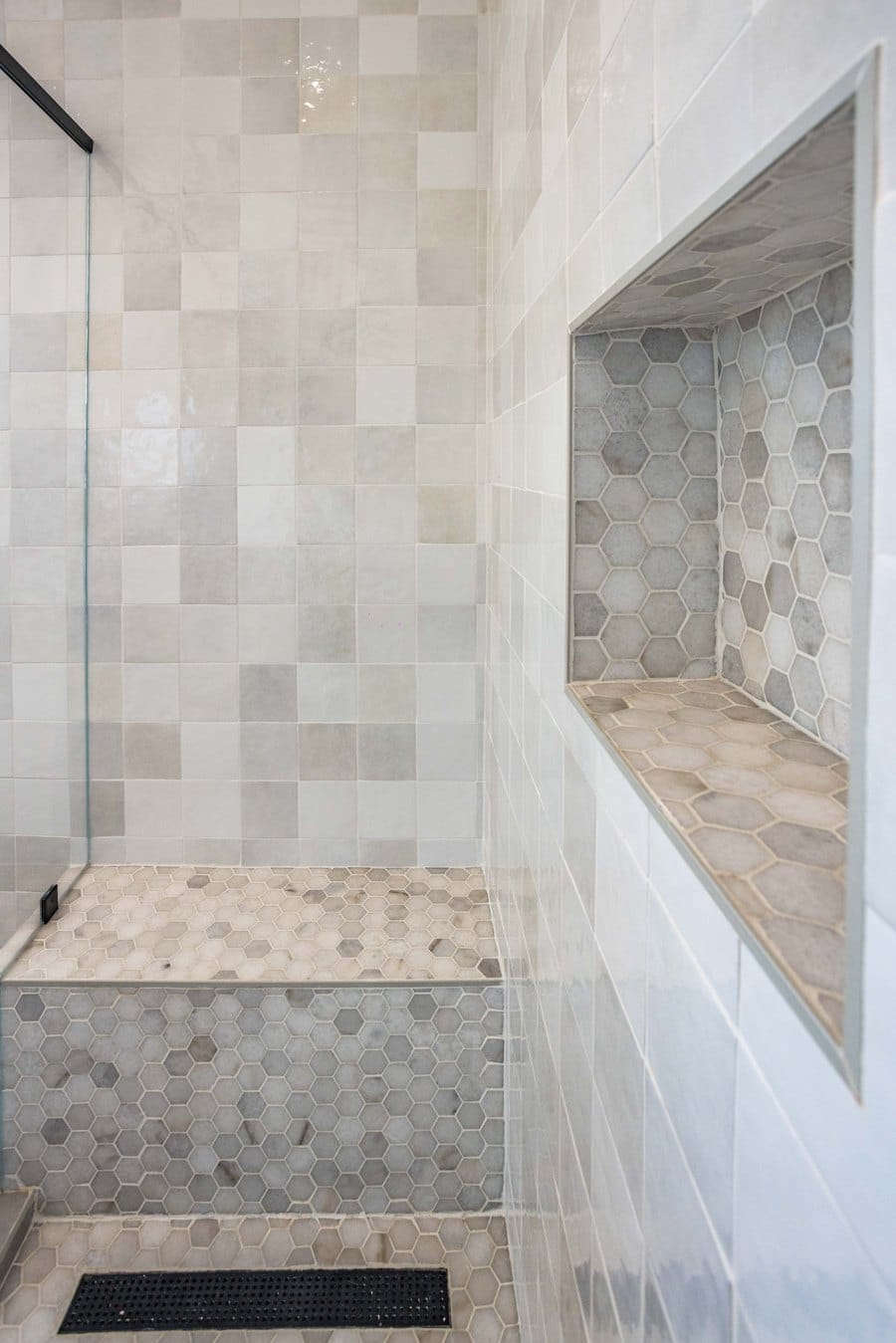
Tile, stone and cabinetry are set out and walked with you before the field is fixed. It is the last point at which a change costs a conversation rather than a rebuild.
Quality check · Setting out walked with you before the first full course
Closing, not abandoning
The 180-day clock stops here
Final inspections are booked and passed, outstanding items are agreed in writing, and the permit is closed. West Palm Beach publishes what happens otherwise in unusual detail — Expired at 180 days without a passed inspection, a $75 renewal, a $100 change of contractor, and a six-year statutory route for the ones nobody ever came back to. All of that is avoidable by finishing properly once.
Quality check · Permit closed as Complete, with every required final passed
Project gallery 02
One bathroom, at rough-in and finished
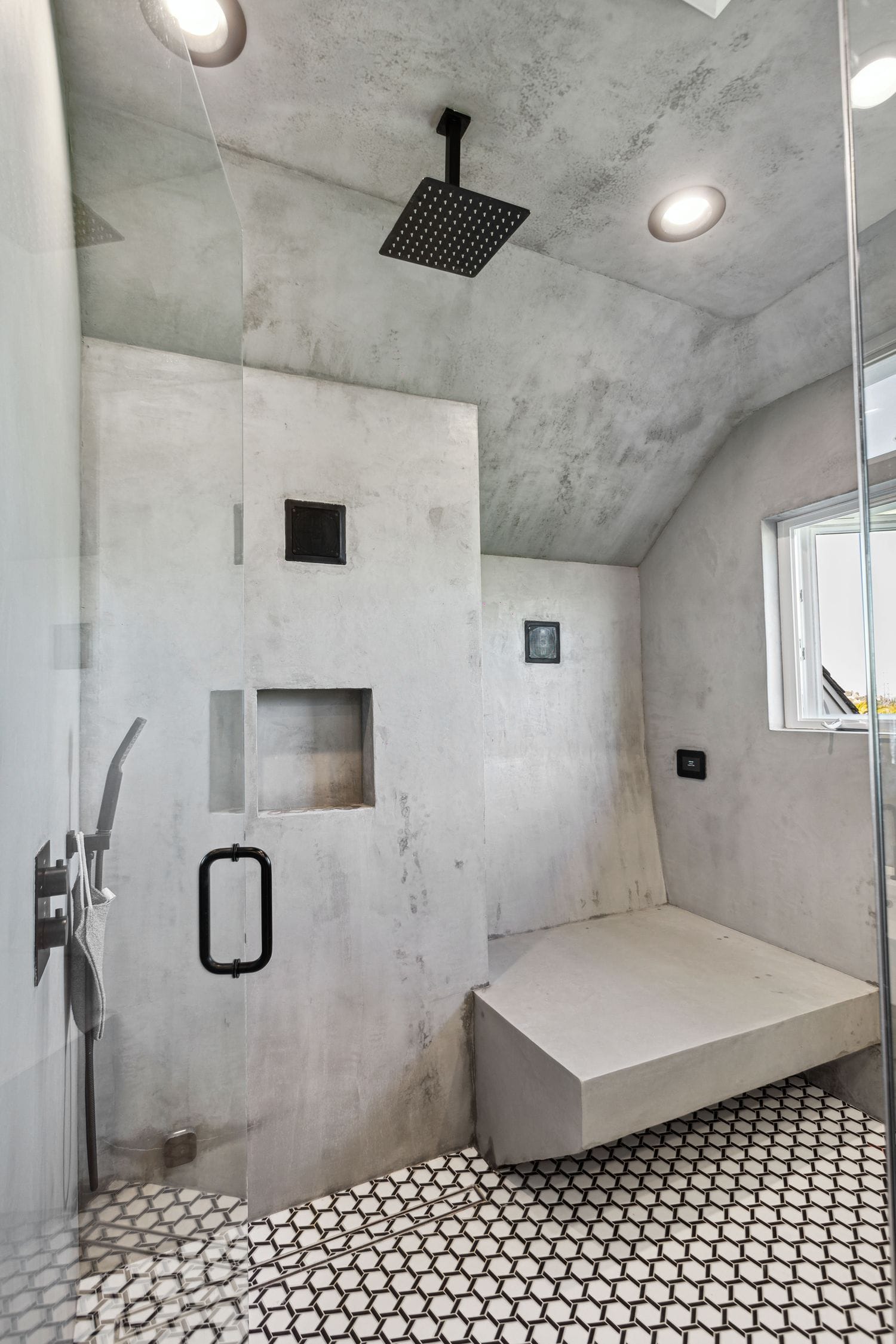
Three frames from real Elbaz Construction work in South Florida — one taken with the plumbing still exposed, two after it was closed and finished.
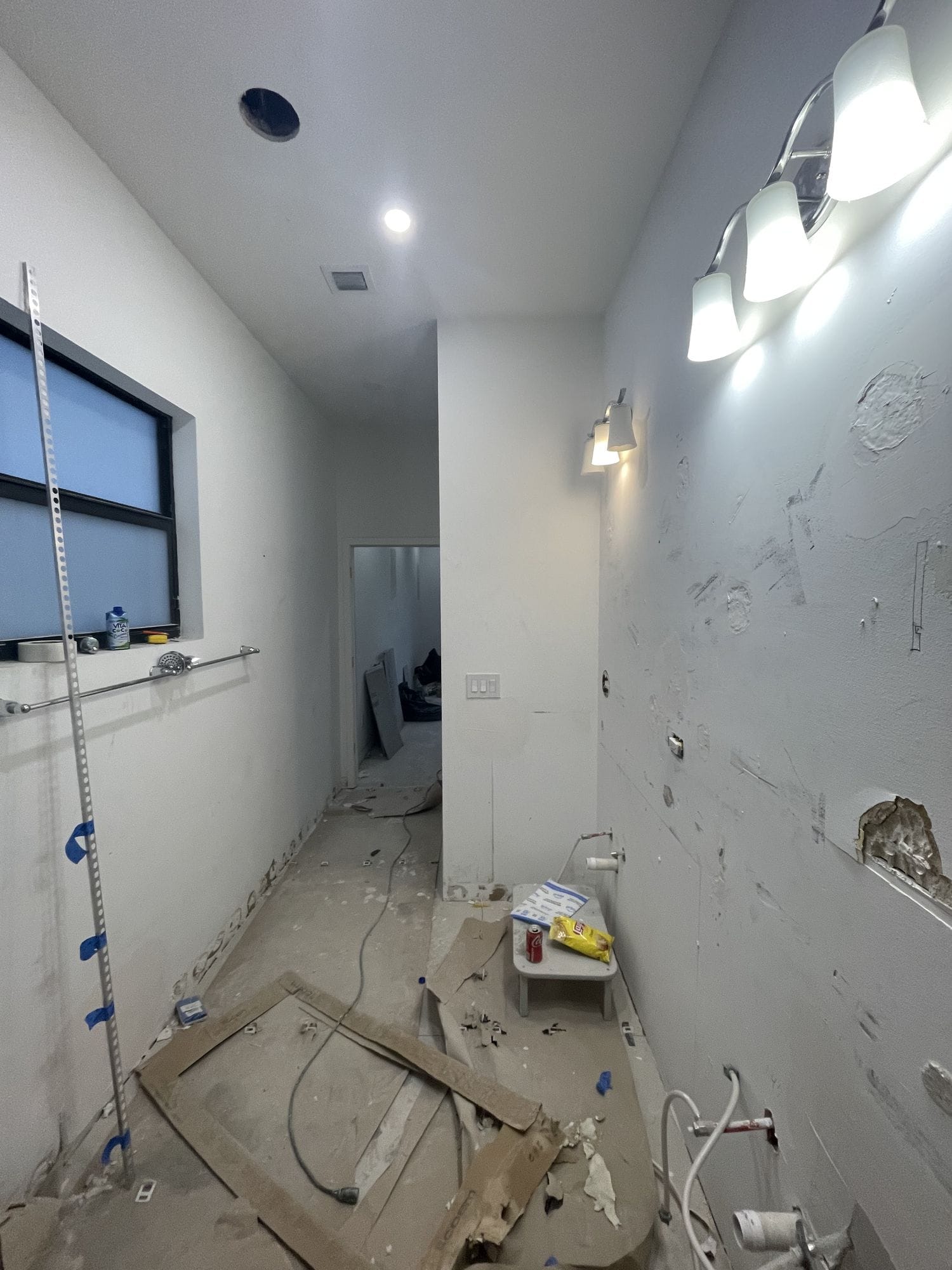
These are real photographs of Elbaz Construction work, taken on a South Florida project. The first is the middle of the job, which is the part an owner actually lives through and the part nobody puts in a brochure. This project was not in West Palm Beach and is not presented as though it were.
Project 02, during and complete
During: rough-in exposed
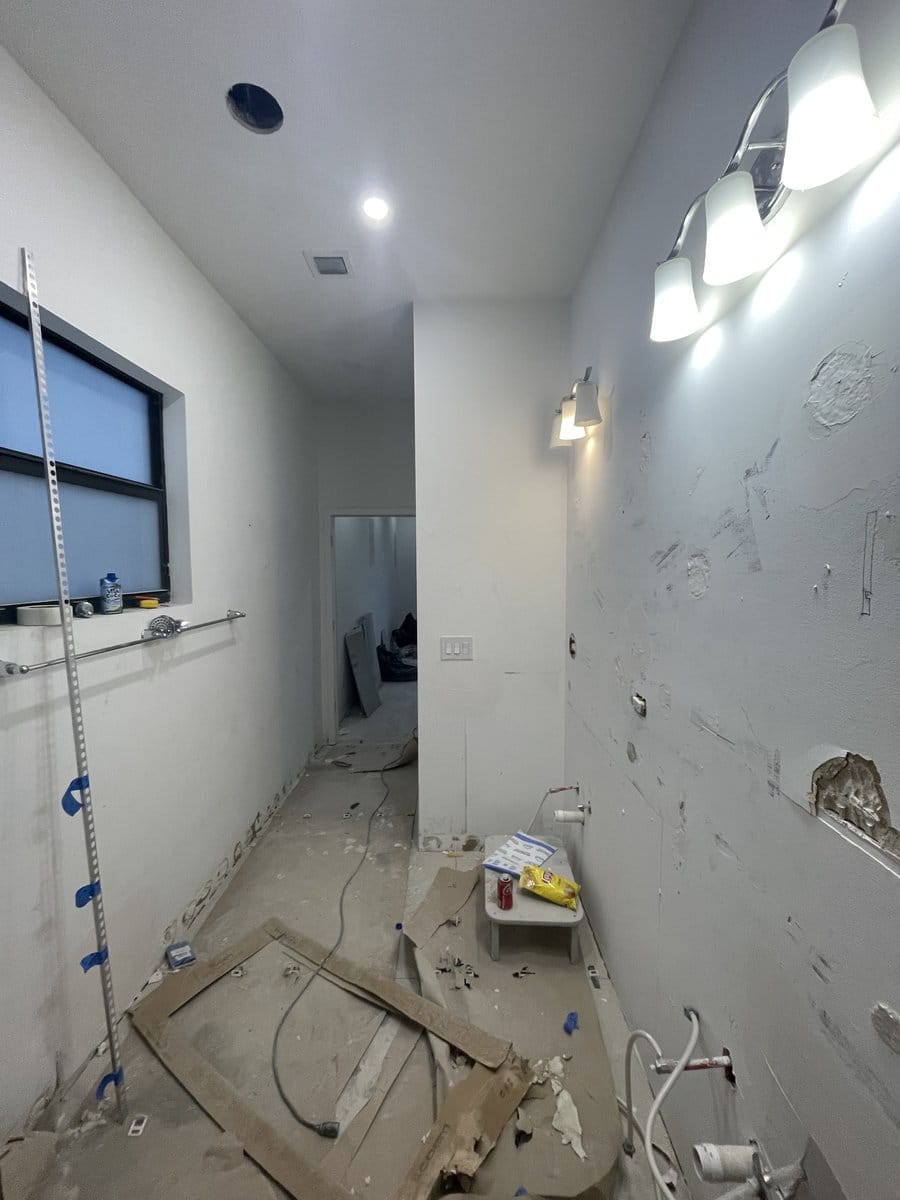
A bathroom mid-construction with the plumbing rough-in exposed and a laser level on the wall.
What this is
Real Elbaz Construction work in South Florida, photographed during construction and again on completion.
Why it is on a city page
Because "each discipline is inspected before anything is closed" is abstract until you have seen the wall it refers to. The first frame is that wall.
What it is not
It is not a West Palm Beach project, it is not presented as one, and no address, client or cost appears anywhere.
Stage 05 · Choose
The three decisions West Palm Beach owners find hardest
Argued both ways. None of these has a universally right answer — it depends on your scope, your building type and how much of the calendar you control.
Request the exemption
Written request, affidavit, contract
- What it is
- A Permit Exemption application in Civic Access with the affidavit and a copy of the contract, for minor residential work under $7,500.
- Benefits
- If approved, an Exemption Certificate and no permit for that scope.
- Limits
- It excludes structural, electrical, mechanical, plumbing and gas work, fences, pool barriers and driveways, and anything on a property partially or entirely in a flood hazard area.
- The risk
- If it is denied you have spent time and still need a permit, applied for separately under the correct type.
- Best for
- A genuinely isolated small repair on a house outside a flood hazard area.
Just permit the work
Skip the question
- What it is
- Applying for the permit the scope actually needs and not testing the exemption at all.
- Benefits
- One route, one record, and a permit history that shows the work was inspected — which is what a buyer, insurer or appraiser looks for later.
- Limits
- A fee and a review you might have avoided on a very small job.
- The risk
- None of consequence. The City publishes a three-week residential review for compliant documents.
- Best for
- Any remodel, because a remodel touches the never-exempt trades by definition.
Which oneFor a remodel the question does not really arise: the moment electrical or plumbing is involved the exemption is gone, and splitting the job to reach it is expressly prohibited. Test the exemption only for a genuinely standalone minor repair — and if you do, request it properly, because the City requires a written request and will not treat silence as approval.
Deal with it now
While the wall is already open
- What it is
- Resolving a previous owner's unpermitted work when demolition uncovers it, rather than building over it.
- Benefits
- It is at its cheapest while the wall is open and a permit is already live on the property.
- Limits
- It adds scope mid-project, which is exactly the thing that lengthens a review.
- What the City publishes
- A penalty fee of four times the regular permit fee for work done without one, or a permit to remove the work.
- Best for
- Almost everyone. The alternative postpones a known cost to a worse moment.
Close it up and move on
Deal with it at sale
- What it is
- Covering the earlier work and leaving the record as it is.
- Benefits
- The current project finishes on its original scope and budget.
- Limits
- You now know about it, and concealing it makes it yours in a way it was not before.
- What the City publishes
- An unpermitted work case goes to Special Magistrate; fines accrue daily and can be recorded as a lien, which the City says may make the property difficult to sell or refinance.
- Best for
- Nothing we would recommend, and not something we will do.
Which oneDeal with it now. This is the comparison on this page with the least genuine balance, and the City's own published consequences are why: four times the fee, a Special Magistrate, daily fines and a possible lien. We stop and tell you before anything is covered, which is the only point at which the choice is still cheap.
Close it out
Renewal, inspections, done
- What it is
- Following the City's published procedure for an old or expired permit: a signed letter saying whether the work was completed, then whatever that scenario requires.
- Benefits
- The record is clean before you sell, refinance or file anything new on the address.
- The cost
- Under six years with the work completed: a $75 renewal fee and the remaining inspections. A change of contractor carries a separate $100 fee.
- Over six years
- The City states that where work was completed more than six years ago and an inspector confirms no apparent safety hazard, the permit is Canceled per s. 553.79(16)(c), Florida Statutes.
- Best for
- Anyone about to sell, refinance, or start new work on the property.
Leave it for now
It has sat this long
- What it is
- Doing nothing about an Abandoned application or an Expired permit already on the address.
- Benefits
- No fee and no inspection today.
- Limits
- It generally has to be dealt with before new work is issued, so "later" often means "in the middle of your renovation".
- On timing
- The six-year rule is a genuine argument for waiting in one narrow case — but only where the work really was completed and really was that long ago.
- Best for
- An owner with no near-term plans for the property and no intention to sell.
Which oneIf you are about to build, close it first — an open permit on the record is the most common reason a straightforward application stalls before it starts. The one honest exception is a genuinely completed job from more than six years ago, where the City's own statutory route is cheaper than a renewal. Check which case you are in before paying anything.
What moves the cost and the calendar in West Palm Beach
Tick whatever applies. This will not produce a price — no honest one exists before someone has seen the property — but it will show which parts of your project are carrying the time and the risk.
What this points to
We do not publish project prices. The City publishes a Fee Estimator in its Civic Access portal and, separately, minimum combined plan review and permit fees of $105 up to a $1,000 project value, $130 up to $2,500 and $580 at $20,000, excluding Fire and Zoning fees. Those are the City's figures, not ours. You get a real, itemised number from us in writing after a site visit.
Project gallery 03
A second dwelling, and the shell it goes into
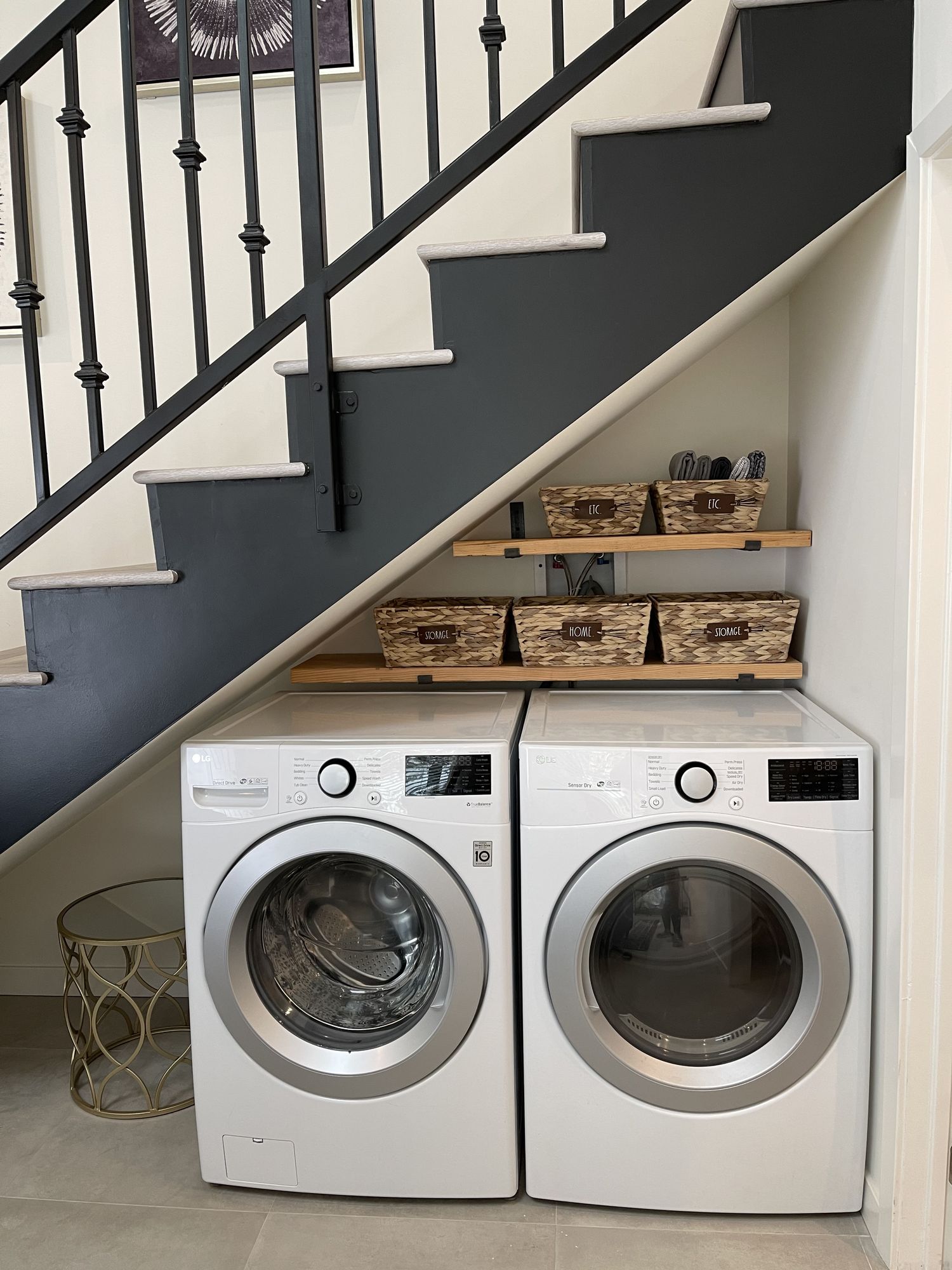
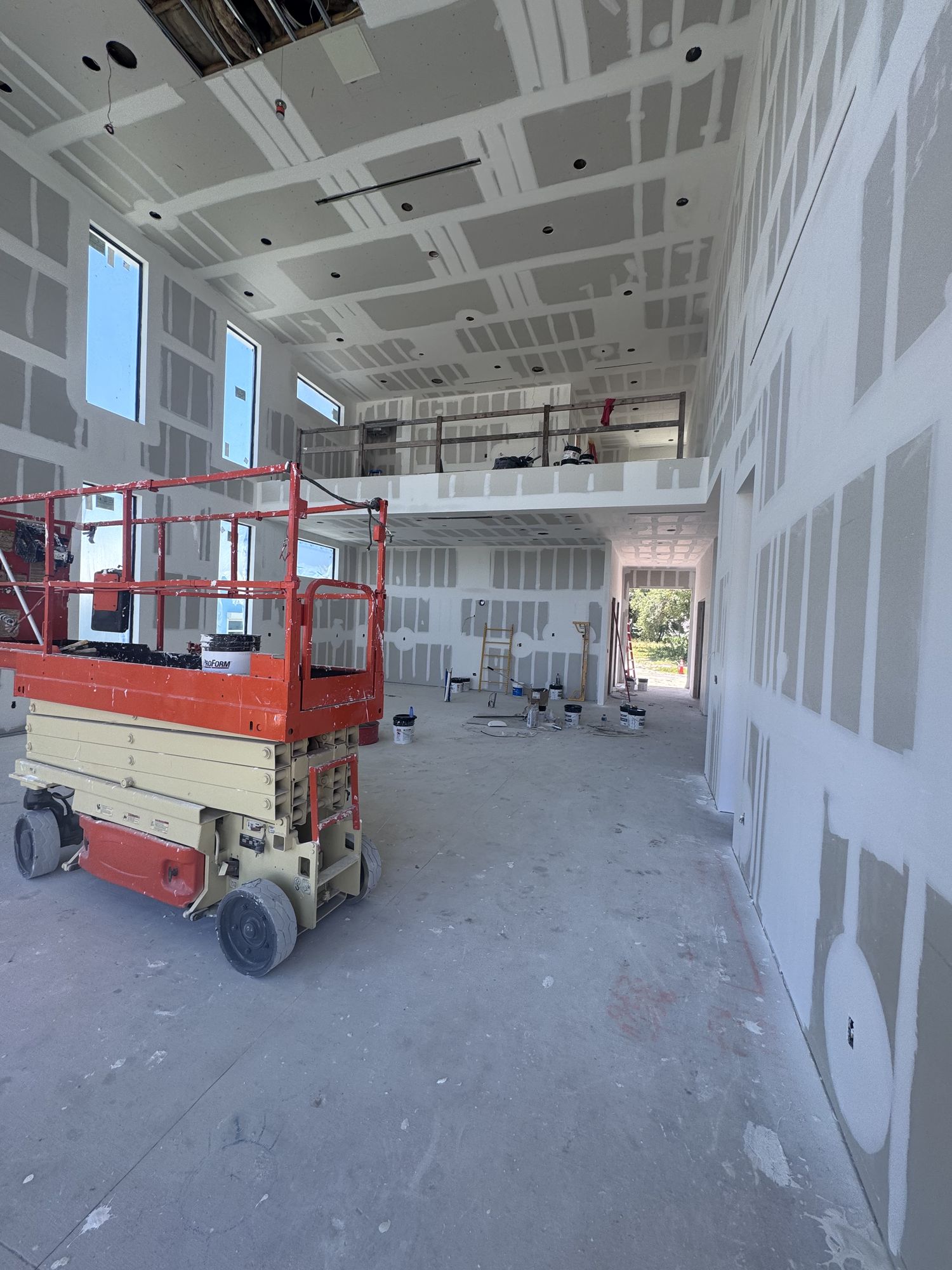
Four frames from completed Elbaz Construction accessory dwelling units and one ground-up South Florida build, photographed during construction.
Project 03, guided tour
Height without footprint
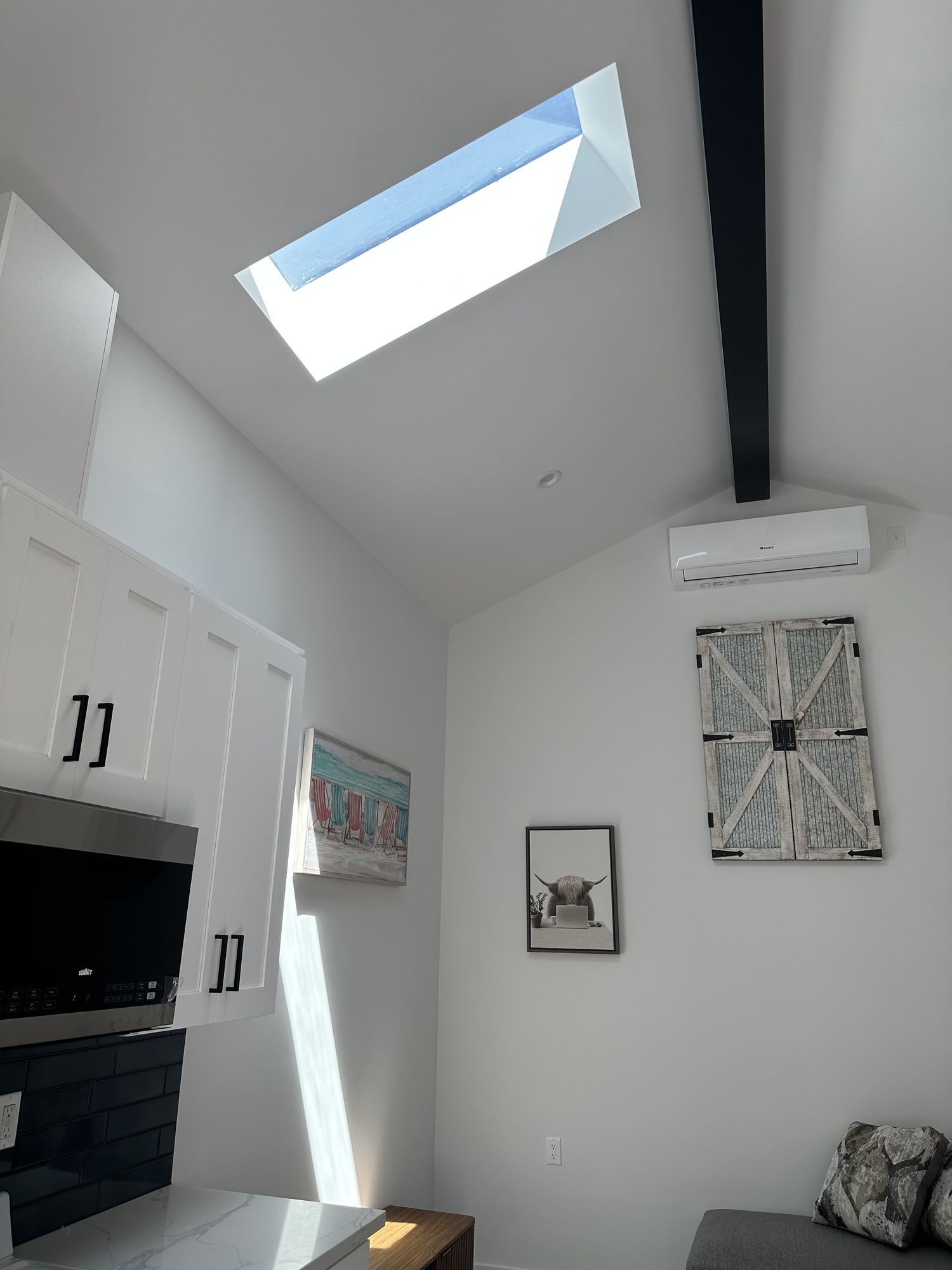
The vaulted ceiling, exposed beam and skylight of a completed studio accessory dwelling unit.
What these show
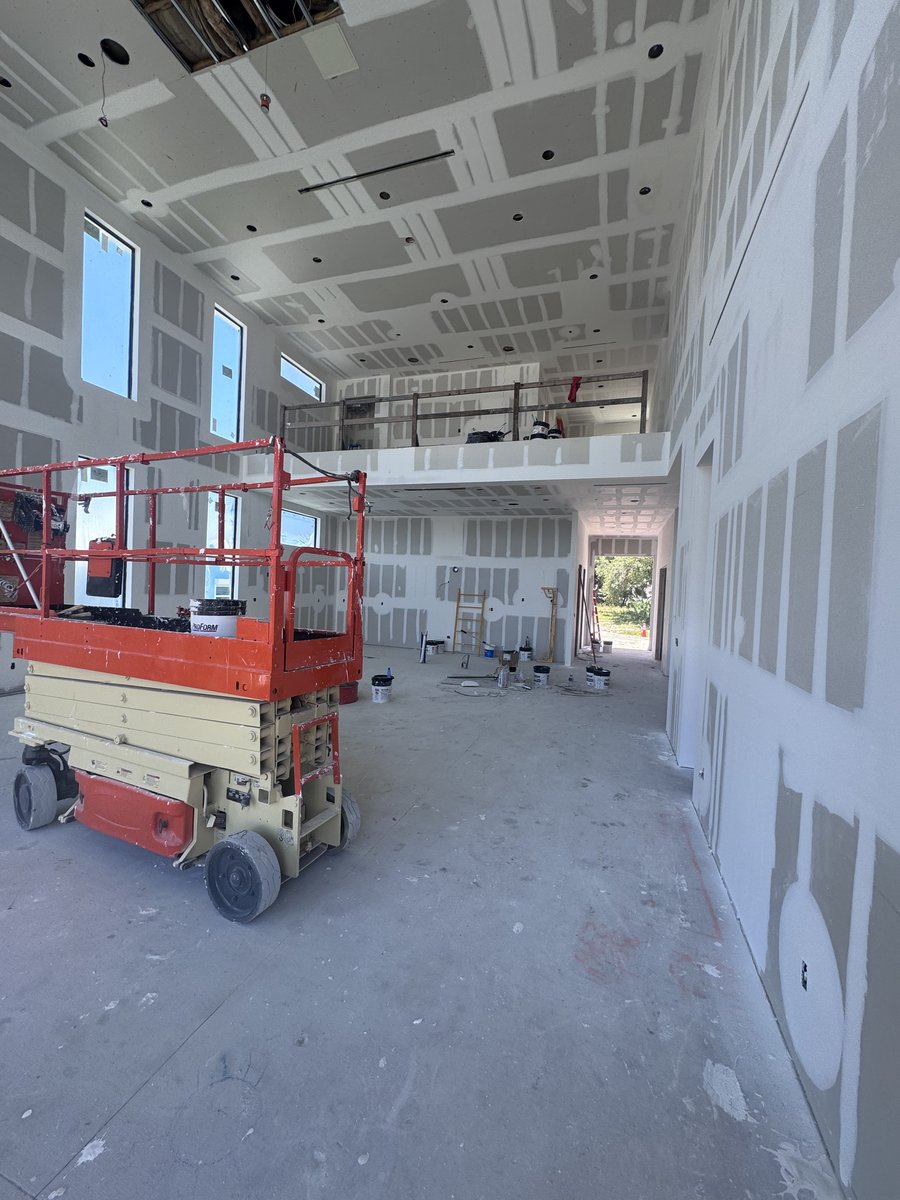
Completed Elbaz Construction accessory dwelling units in South Florida, and one ground-up build photographed while it was still a site.
Why it matters here
A second dwelling is a permitted structure with its own services, its own envelope and its own inspection list. It is the clearest case of a job where the filing route decides the calendar rather than the construction.
Where
South Florida. None of these is claimed to be in West Palm Beach.
Stage 06 · Close
The clock, the penalty and the six-year rule
West Palm Beach publishes more of its own numbers than any other municipality on this matrix. Everything below is quoted from the City's own Permits FAQ.
Three weeks, conditionally
The City states a residential remodel permit can be issued in approximately three weeks, and a commercial remodel in approximately five — if the submitted documents are code-compliant. That condition is the whole sentence.
Four times the fee
For work done without a permit you either permit its removal or pay a penalty fee of four times the regular permit fee. An unpermitted work case goes to Special Magistrate.
Fines that accrue daily
The City states the Special Magistrate can assess fines that accrue daily until the property is brought into compliance, that the fine can be recorded as a lien, and that the case may make the property difficult to sell or refinance.
180 days, twice
A never-issued application becomes Abandoned after 180 consecutive days without activity. An issued permit becomes Expired after 180 consecutive days from issue without a passed or partially passed inspection.
The six-year rule
Where a permit was issued more than six years ago and the work was completed, an inspector confirms there is no apparent safety hazard and the permit is Canceled per s. 553.79(16)(c), Florida Statutes.
$75, and $100
Under six years with the work completed, a $75 renewal fee reopens the permit for its remaining inspections. A change of contractor carries a separate $100 fee.
Your inspector, directly
From 7:30 a.m. the Civic Access portal shows the day's inspections with the primary inspector and their phone number, and the City states you can call them directly for a two-hour time frame.
No roofing affidavit
The City publishes that it has no roofing affidavit or roof package, and publishes the workaround instead: book a Building Miscellaneous inspection before starting and agree the expectations with the inspector.
What we will actually stand behind
Only claims that are either public record or visible in the work on this page. Nothing about awards, nothing about rankings, and no numbers we cannot show you.
Licensed, bonded and insured
Elbaz Construction is a licensed Florida general contractor, CBC1265280. Permits are pulled in the company's name, and our registration with the City carries general liability and workers' compensation certificates naming the City as certificate holder, exactly as it requires.
Registered before we file
The City processes a contractor registration in one to two business days and will not take an application without one. That is maintained continuously here, not started when a job appears.
We file it ourselves
Design, the permit application and the construction are handled by one company, so a plan examiner's comment does not sit waiting on a hand-off between two firms.
We aim at the three-week review, not around it
The City's published residential timeframe assumes code-compliant documents. The way to get it is to submit documents that do not draw comments, which is a drafting discipline rather than a relationship.
Unpermitted work gets raised, not covered
If demolition uncovers a previous owner's work we stop and tell you. In a city publishing a four-times penalty and a Special Magistrate route, concealing it would be expensive advice.
Envelope documentation kept straight
What is inspected is the pairing of installed product and approval paperwork. We keep them matched, because an inspection that fails on documentation costs exactly as much as one that fails on workmanship.
Permits closed out
Every permit we pull is closed out at the end of the job. This City publishes an entire procedure for permits that were not, which is the clearest possible argument for doing it properly the first time.
One point of contact
The same person from the first site visit to the walkthrough, across Palm Beach, Broward and Miami-Dade — 104 municipalities, each with its own filing route.
Questions, by stage
Filter to the part of the job you are thinking about.
Do I need a permit to replace flooring?Your property
It depends what you live in, and the City is explicit about it: "Replacing flooring in an apartment or condo does require a permit. For a house, replacing flooring and painting does not require a permit." Same work, opposite answer, decided by the building type. If you are in a condominium, your association's approval is separate from and additional to the City's.
Does flood zoning change what I can do?Your property
It can remove an exemption outright. The City excludes from the HB 803 minor-work exemption "any work on a property located partially or entirely within a flood hazard area" — and "partially" is doing real work in that sentence. Confirm the designation for the address before assuming any exemption applies.
Is there anything already on my property's record?Your property
There may well be. The City publishes a full procedure for closing old and expired permits, which tells you how often it comes up. An application that was never issued becomes Abandoned after 180 consecutive days of inactivity, and an issued permit becomes Expired after 180 days from issue without a passed or partially passed inspection. Both stay attached to the property.
What did House Bill 803 actually exempt here?HB 803
Minor residential work on a single-family dwelling valued under $7,500, effective 1 July 2026 — but with significant published limits. Structural, electrical, mechanical, plumbing and gas work still need permits regardless of cost, as do fences, fence pool barriers and driveways, and anything on a property partially or entirely within a flood hazard area. There is also a second exemption for temporary flood and hurricane protection barriers, with five conditions.
Why do fences and driveways still need permits if they are under $7,500?HB 803
Because of where the requirement comes from, and West Palm Beach is the only city on our matrix that explains this. In the City's own words, HB 803 "relates to the building code, as it amends FSS Chapter 553" — but the City's fence and driveway permits are "required based exclusively on the City's Zoning code", which governs fence height and type, setbacks and driveway location, material and square footage. Since the statute does not alter the zoning code, those permits survive it.
Is the exemption automatic?HB 803
No, and this is the part most owners miss. The City states that the property owner or the owner's contractor must submit a written request for exemption, with a copy of the contract or other documentation showing the nature and value of the work. It is filed as a "Permit Exemption" application in the Civic Access portal with a Permit Exemption Affidavit. If approved, the City issues an Exemption Certificate; if denied, a permit is required and applied for separately.
Can I split a job into pieces to get under $7,500?HB 803
No. The City gives this its own heading: "A construction project may not be divided into two or more smaller projects for the purpose of staying under the $7,500 threshold to qualify for the exemption." Phasing for occupancy or budget is ordinary; phasing to reach a threshold is the thing that sentence exists to stop.
Do I need a permit to remodel my kitchen or bathroom?HB 803
In practice, yes. A kitchen or bathroom remodel involves at least electrical or plumbing, and the City lists both as requiring a permit regardless of cost. The $7,500 exemption is aimed at genuinely isolated minor work, and it cannot be reached by dividing a larger project into parts.
How long does a permit take in West Palm Beach?Filing
The City publishes a figure, which is rare: a residential remodel permit can be issued in approximately three weeks and a commercial remodel in approximately five — provided the submitted documents are code-compliant. If they are not, plan review comments are posted and the timeline then depends on how quickly they are answered and resubmitted.
How do I register as a contractor, or check that mine is registered?Filing
Registration is by email to the Development Services address with the state or county licence, a valid local business tax receipt for the business's home jurisdiction, and certificates of insurance for general liability and workers' compensation naming the City of West Palm Beach as certificate holder at 401 Clematis St. The City asks for one to two business days to process it.
Can I pull my own permit as the homeowner?Filing
Yes, under the Owner-Builder exemption, if the property is not titled through a company and you are not renting it, and provided you do not sell or rent it for at least a year after the work is complete. Florida Statutes require you to appear in person before the permit is issued, at City Hall, 401 Clematis St, to sign the application and the Owner-Builder affidavit. If you are not doing the work yourself you must still hire appropriately licensed contractors.
Where do I see plan review comments?Filing
In the Civic Access portal, under the Reviews tab of your permit record. The City states that the reviewer's name, phone and email should always be left in the comments themselves, so the person who wrote a comment can be asked about it directly. That is usually the fastest way to close one.
What will the permit itself cost?Cost & fees
The City publishes a Fee Estimator in the Civic Access portal, and separately publishes its minimums: a combined plan review and permit fee of $105 for a project value up to $1,000, $130 up to $2,500, and $580 at a project value of $20,000 — excluding Fire and Zoning fees, which do not apply to every project. Those are the City's figures. Whatever it comes to appears itemised on your proposal.
Why won't you publish a project price?Cost & fees
Because for a remodel the same square footage can differ several-fold depending on what is behind the wall, which disciplines are involved and what the record already says about the property. A published rate would be a guess. You get an itemised figure in writing after a site visit, and it says what happens if something is found during demolition.
What happens if work is done without a permit?Cost & fees
The City is specific. You will be required to get a permit to remove the work, or to pay a penalty fee of four times the regular permit fee to permit it. An unpermitted work case is opened and goes to Special Magistrate hearing if you do not apply for and obtain the permit. The Magistrate can assess fines that accrue daily, the fine can be recorded as a lien, and the City warns the case may make the property difficult to sell or refinance.
What happens if you find unpermitted work from a previous owner?On site
We stop and tell you, before it is covered up. It is more common than people expect in South Florida, and in this City the published consequences — four times the fee, a Special Magistrate, daily fines, a possible lien — make covering it a genuinely expensive decision. It is also at its cheapest to resolve while the wall is already open.
Can I live in the house while you work?On site
Often yes, and it changes the programme rather than the price alone. Containment, protection and phasing all cost days. The honest version of this conversation happens at the site visit, where we can look at where the work is relative to where you sleep and cook.
How do I find out who my inspector is and when they are coming?Inspections
From 7:30 a.m. the Civic Access portal has a "Today's Inspections" view listing the primary inspector and their phone number against each inspection. The City states you can call your inspector directly for a two-hour time frame. Telephones at the department answer from 8:00 a.m.
Is there a roofing affidavit if the weather turns?Inspections
No — the City publishes that it has neither a roofing affidavit nor a roof package. What it publishes instead is a workaround: once the roofing permit is approved and before starting, book a Building Miscellaneous inspection and meet the inspector to agree what will be required, or speak to the Building Chief Inspector. Take photographs throughout, call the inspections in as soon as you can, and be ready to show them. The City is explicit that it remains at the inspector's discretion.
What is a Certificate of Occupancy request?Inspections
A CO, TCO or CC is requested by email to Development Services with the request type in the subject line and the master permit number, address and contact details in the body. The City asks for one to two business days for a response.
How do I close an old or expired permit?Old permits
The City requires a signed letter from either the current property owner or the qualifier of the contractor of record, giving the address, the permit number, the reason for the request and — the question everything turns on — whether the scope of work was completed or not. It then evaluates which of five published scenarios applies. There is a dedicated mailbox for it.
What does it cost to close an old permit?Old permits
It depends on the scenario. If the work was completed and the permit was issued less than six years ago, the City requires a $75 renewal fee and the remaining inspections must be scheduled and passed. If the contractor of record is no longer involved, a Change of Contractor request carries a separate $100 fee and a new notice of commencement has to be recorded.
What is the six-year rule?Old permits
Where a permit was issued more than six years ago and the work was completed but the permit was never closed, the City sends an inspector to confirm there is no apparent safety hazard associated with the work, and then cancels the permit per Section 553.79(16)(c), Florida Statutes. It is the one case where waiting genuinely produced a cheaper route — but only where the work really was completed and really was that long ago.
Do you work anywhere else in Palm Beach County?Old permits
Yes — across Palm Beach, Broward and Miami-Dade, 104 municipalities in total. The filing routes differ genuinely between them: West Palm Beach runs EPL through Civic Access and publishes a three-week residential review, its neighbours publish neither, and those differences are a working detail for us rather than a surprise.
Nothing in that stage yet — try “All”.
The City published its reasoning. Let's build to it.
West Palm Beach tells you which code a rule comes from, how long a compliant submission takes, what an unpermitted job costs and when an old permit stops mattering. The value of a contractor here is knowing which of those applies to your address before the drawings are done, not after.
Or see the rest of what we cover on the Palm Beach County page if your property is somewhere else in the county.
