$162per sq ft: the 2024 national average, before the lot
+1 ftabove base flood elevation in an A zone
175 mphdesign wind speed in Miami-Dade
By Elbaz ConstructionUpdated September 27, 202611 min readSources: NAHB · Florida Building Code · Florida Statutes · county fee schedules
New home construction cost
The short answer
?
Nobody can give you an honest per-square-foot price for building a house in South Florida before seeing the lot and the drawings, and we do not publish one. The best national benchmark is the builders’ survey by the National Association of Home Builders: in 2024 the average construction cost was $428,215 for a 2,647 sq ft house, about $162 per square foot, before the lot. In South Florida, local rules move the number further: how high the flood map says the floor must sit, the wind speed the structure is designed for, the mandatory energy tests, the impact fees and utility connections, and sales tax on materials.
01
Flood elevation
In a flood zone, the lowest floor goes at least 1 ft above the base flood elevation.
02
Wind design
175 mph in Miami-Dade, 170 in Broward, 150–170 in Palm Beach (Risk Category II).
03
Energy tests
Every new house is blower-door tested (7 air changes an hour at most) and duct tested.
04
Fees and hookups
Impact fees, water and sewer connection charges or a septic permit, and permit fees.
The national benchmark
Where the money goes in a new house
The NAHB’s Cost of Constructing a Home survey is still the most detailed public breakdown. Its latest edition (published January 2025, from 2024 builder data) found that construction is 64.4% of a new home’s sales price and the finished lot 13.7%. The rest is financing, overhead, marketing, commission and profit. Inside the $428,215 construction cost, the split looks like this:
Average construction cost of a new single-family house, by stage
United States, 2024; total $428,215 for 2,647 sq ft
Source: NAHB, Cost of Constructing a Home 2024 (Table 3). National averages from 41 builders; NAHB says the sample is too small for a regional breakdown, so this shows proportions, not South Florida prices.
Two things in that chart matter for a South Florida budget. First, interior finishes (24.1%) and systems rough-ins (19.2%) are the largest shares, and they are where your own choices move the number most: cabinetry, flooring, fixtures, the number of bathrooms, and the HVAC and electrical specification. Second, site work (7.6%) already includes permit fees ($7,640 on average), impact fees ($6,367) and water and sewer fees and inspections ($6,260) nationally. Those are the lines that differ most from one South Florida address to the next, and the sections below show why.
For scale, the U.S. Census Bureau reports that the median new single-family house completed in 2025 was 2,142 sq ft, and the median contract price for a contractor-built house started that year was $404,000, not counting the lot.
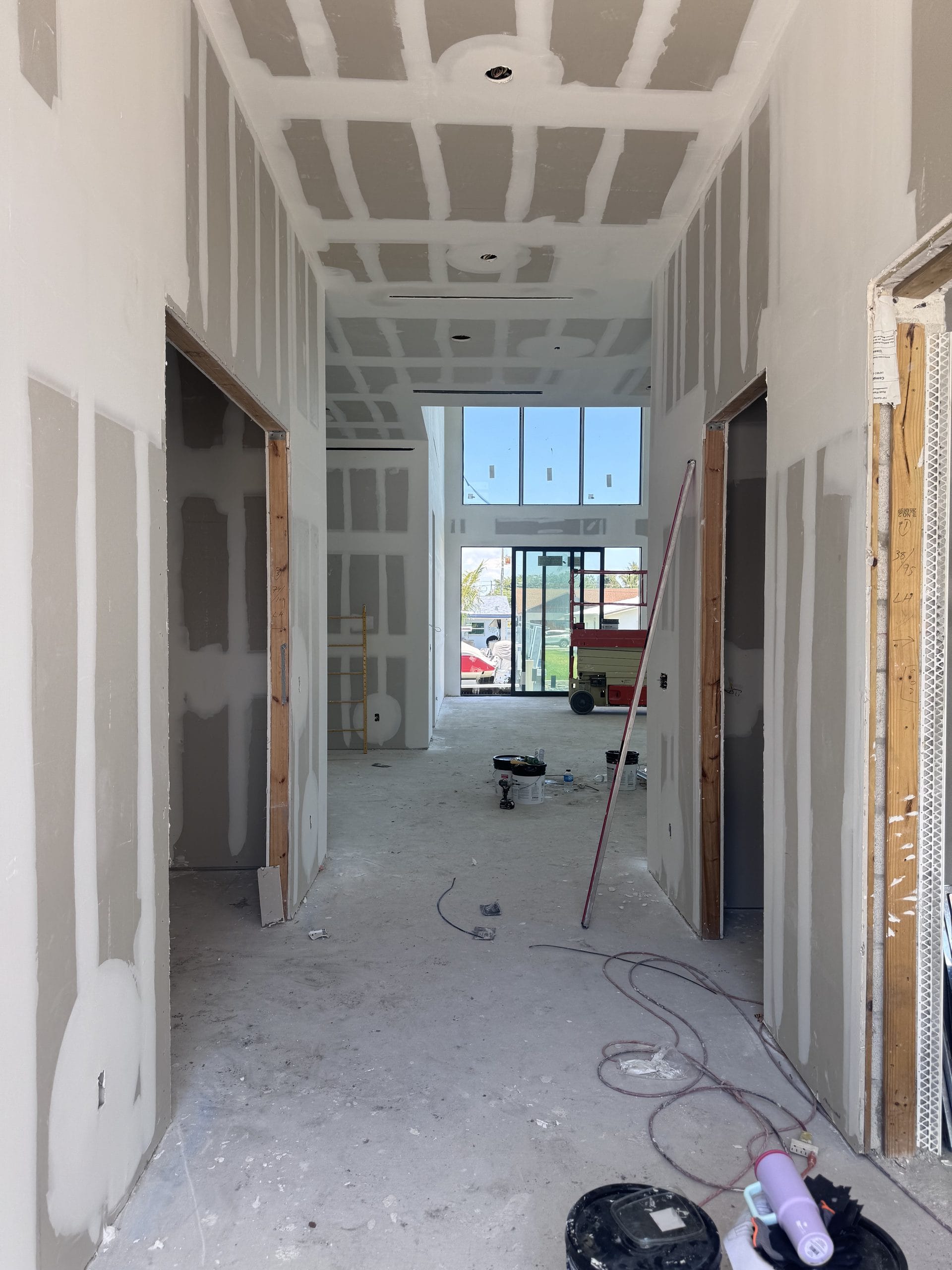
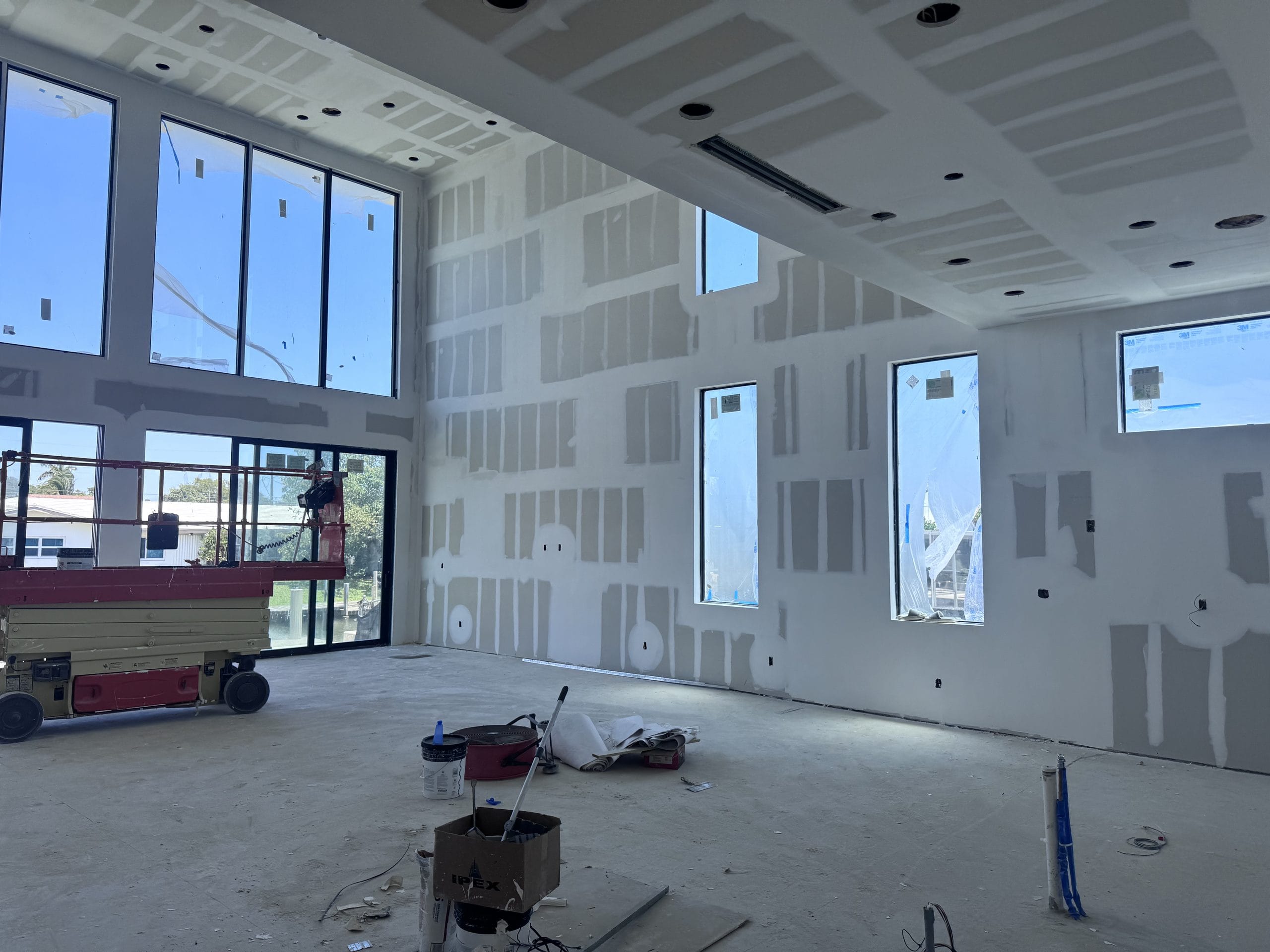
A new house by Elbaz Construction at the drywall stage: board hung and taped, ceilings floated, the rough-ins already behind the walls. Interior finishes are the largest share of a build.
The first South Florida line
Flood zone: how high the floor has to be
If the lot is mapped in a Special Flood Hazard Area, the Florida Building Code sets the height of the house before anything else is designed. In an A zone, section R322.2.1 of the Florida Building Code, Residential requires the lowest floor to be “elevated to or above the base flood elevation plus 1 foot … or the design flood elevation, whichever is higher.” In a V zone or Coastal A zone (R322.3.2), the same line applies to the bottom of the lowest horizontal structural member, so the house stands on piles or columns with the space below left open.
Simplified from sections R322.1.10, R322.2.1 and R322.3.2 of the Florida Building Code, Residential, 8th edition (2023). Your flood zone, base flood elevation and any local design flood elevation come from the flood map and your building department.
What that costs depends on how far the finished floor sits above the natural ground: more fill and taller stem walls, or a pile foundation, stairs and ramps up to the entry, and taller utility risers. It also adds paperwork. A licensed surveyor or design professional must “prepare and seal documentation” of the elevation (R322.1.10), which the building department collects when the lowest floor is placed and again at the final inspection (FBC-Building 110.3). This is where a lot’s flood zone becomes real money, so check it before you buy the land. The same rules decide when an existing house must be raised; our FEMA 50% rule guide covers that side.
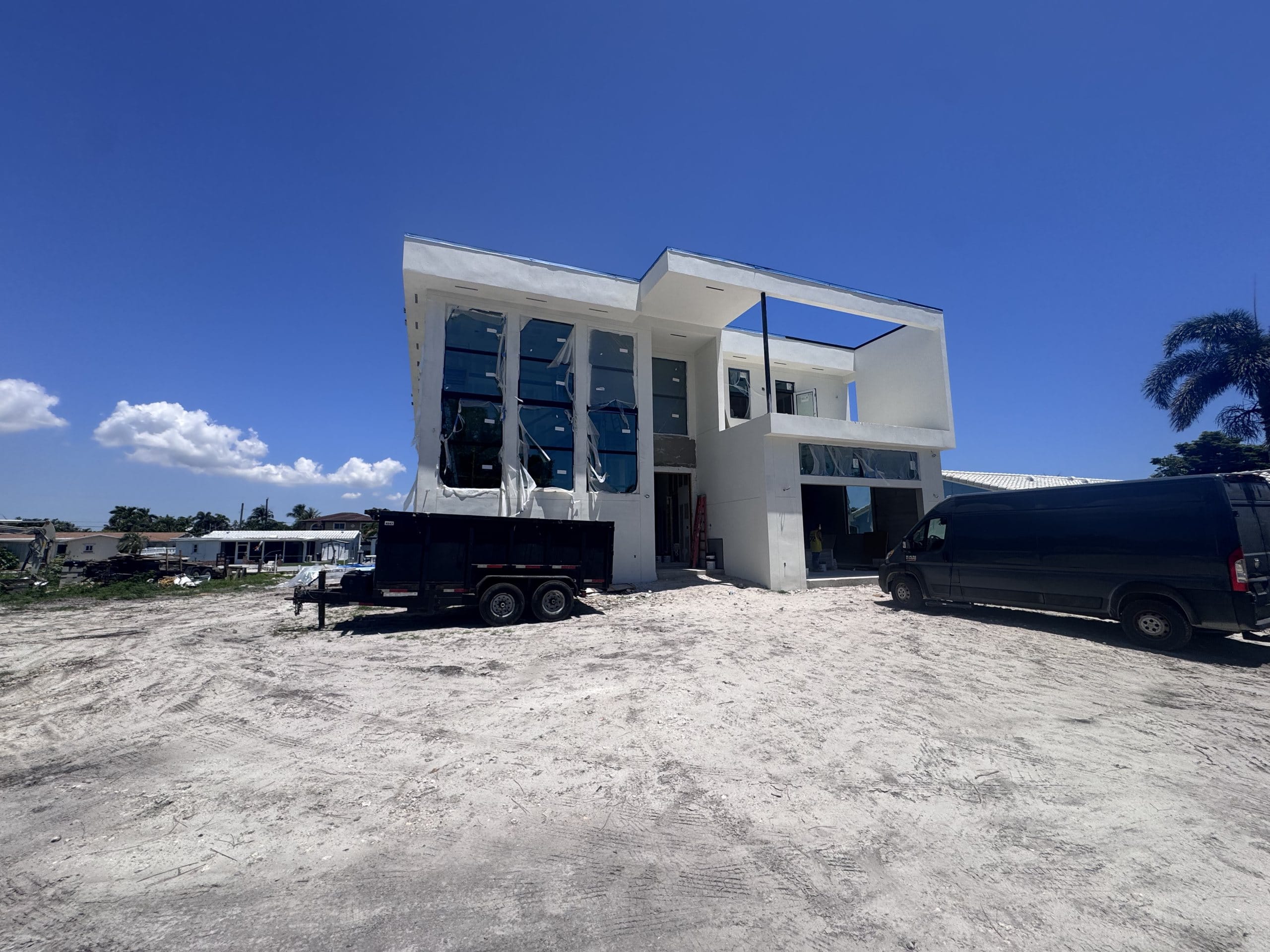
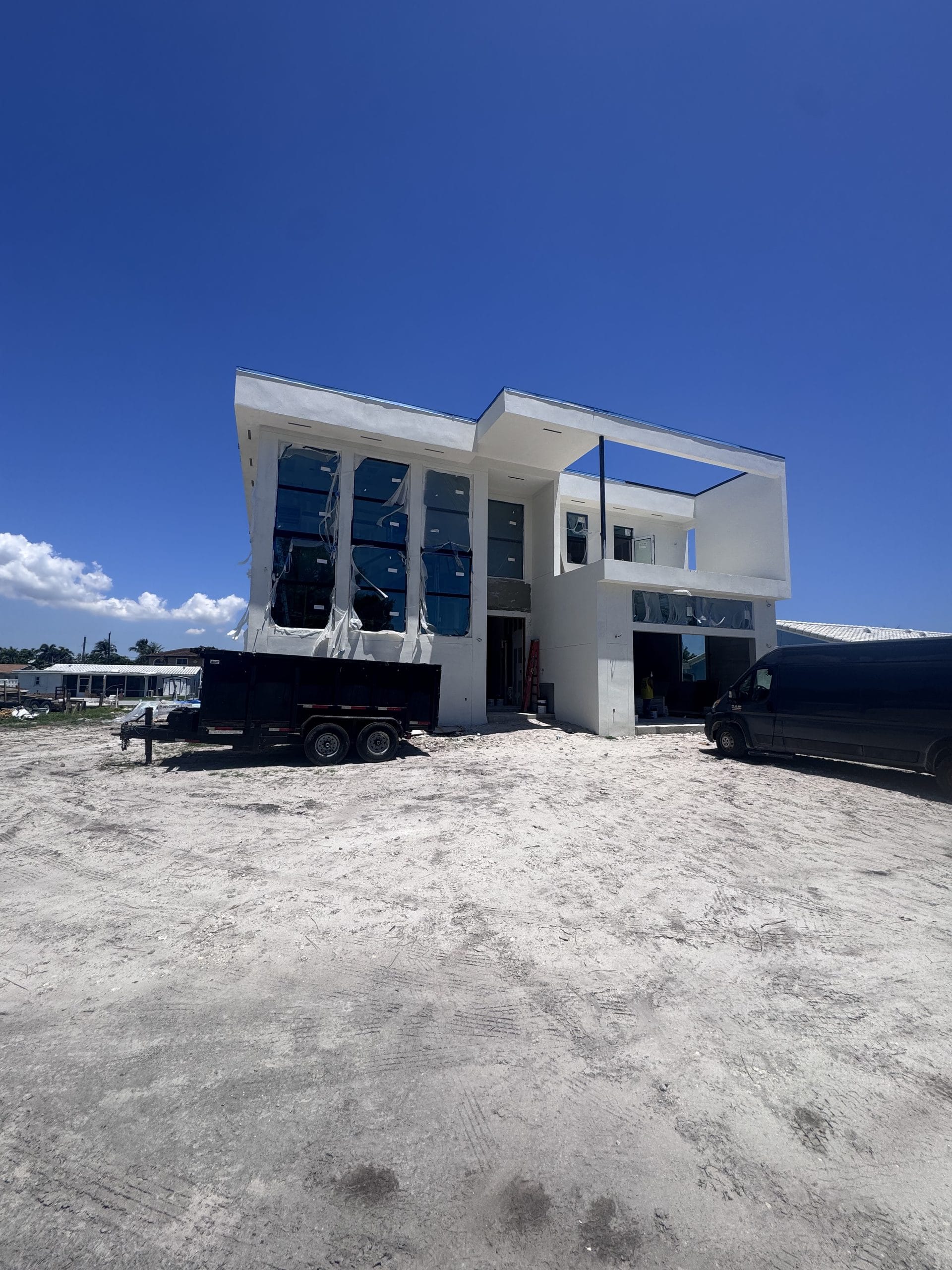
A two-storey house built by Elbaz Construction, at the stucco and glazing stage on a graded sand lot.
Structure and openings
Hurricane design: the wind speed your structure is built for
Every new house in Florida is engineered for wind, but the design speed changes by county. Miami-Dade and Broward make up the High-Velocity Hurricane Zone, and houses there follow the HVHZ sections of the Building volume (R301.1 and 1601.1). Section 1620.2 sets Risk Category II design speeds of 175 mph in Miami-Dade and 170 mph in Broward. Palm Beach County is outside the HVHZ; its own wind-speed map steps from 150 mph near Lake Okeechobee to 160 mph in the centre and 170 mph along the coast.
Design wind speed for a house (Risk Category II)
Florida Building Code, 8th edition (2023)
Miami-Dade County (HVHZ)175 mph
Broward County (HVHZ)170 mph
Palm Beach County, coastal zone170 mph
Palm Beach County, central zone160 mph
Palm Beach County, lake zone150 mph
Sources: FBC-Building 1620.2 (Miami-Dade, Broward); Palm Beach County amendment map, Figure 1609.3(1). Many websites quote “165–170 mph” for Palm Beach; the county’s map uses the three stepped zones shown.
The wind speed flows into the structure (reinforced masonry or concrete, tie beams, roof-to-wall connections, the roof deck and covering) and into every opening. In the HVHZ, exterior walls, the roof, doors, skylights and glazing “shall meet impact test criteria or be protected with an external protection device” (section 1626.1). On a modern design with large window walls and multi-panel sliders, the approved impact glazing is often one of the biggest single packages in the budget. See our hurricane-rated window systems.
A multi-panel sliding glass wall and a two-storey glazed corner installed by Elbaz Construction on a new house, before interior finishes.
Envelope and ducts
Energy code: the two tests every new house must pass
Florida’s Energy Conservation Code (8th edition, 2023) makes testing mandatory for new homes. The house must be “tested and verified as having an air leakage rate not exceeding seven air changes per hour” in climate zones 1 and 2, which include South Florida (R402.4.1.2). That is the blower-door test. The ducts are pressure-tested too (R403.3.3), and leakage may not exceed 4 cubic feet per minute per 100 sq ft of conditioned floor area (R403.3.4).
The tests themselves are a modest line. The cost is in passing them the first time: sealed penetrations, an air barrier that is continuous where the walls meet the roof, and ducts that are sealed and inside the conditioned space where the design allows. A failed test means rework before the final inspection. We plan for it at the drawing stage; see energy-efficient new home construction.
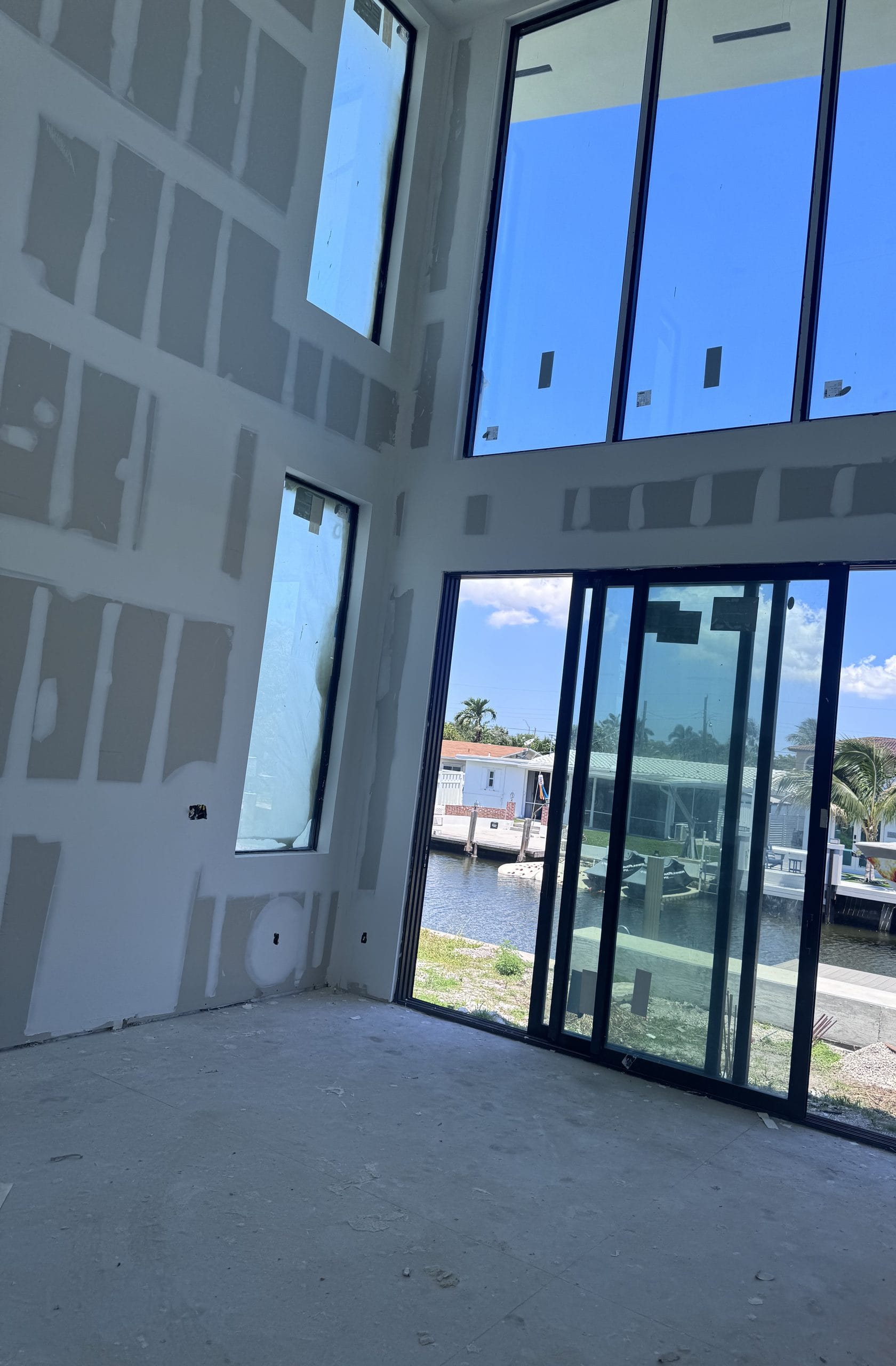
A double-height room in a new Elbaz Construction house: full-height window wall, recessed lighting housings and a linear air diffuser set into the soffit.
Before the first footing
Impact fees, utility connections and permits
Impact fees are charged on new homes because, in the words of section 163.31801, Florida Statutes, they fund “the infrastructure necessitated by new growth.” Each county and many cities set their own schedule, usually by house size. As one published example, unincorporated Palm Beach County charges these fees for a single-family house of 2,000 to 3,599 sq ft:
Impact fees on a new house, unincorporated Palm Beach County
Single-family detached, 2,000–3,599 sq ft; schedule effective January 1, 2026
Schools$7,905.90
Road$5,597.40
Parks$1,225.26
Fire rescue$393.30
Public buildings$317.30
Libraries$295.45
Law enforcement patrol$182.61
Source: Palm Beach County impact fee schedule, unincorporated area. Together about $15,917 (our sum; the county does not print a total). Cities in Palm Beach County, Miami-Dade and Broward publish different amounts, so check the schedule for your address.
Water and sewer. Where public sewer is available, the utility charges to connect. Miami-Dade Water and Sewer, for example, charges $1.39 for water and $5.60 for sewer per average daily gallon (2025–26 schedule), and allocates a single-family house 210 gallons a day under 3,001 sq ft, 310 up to 5,000 and 510 above that. For a house under 3,001 sq ft in its service area, that works out to $1,467.90 in connection charges, before the plumber’s work and the meter. The schedule is revised by fiscal year (from October 1), so check the current one. On a lot without sewer, a septic system needs a permit: the rules are now the Department of Environmental Protection’s, but in these three counties the county health department still issues and inspects it.
Permit and review fees are set by the building department (the NAHB average was $7,640). Florida lets the owner, or the owner’s contractor with written authorization, use a private provider for plan review and inspections; the department “must reduce the permit fee by the amount of cost savings realized” (section 553.791). Our new construction permitting team prepares the package.
Sales tax is built into the contract price, because Florida treats contractors as “the ultimate consumers of materials and supplies they use” (Rule 12A-1.051). The 2026 rate is 7% in Miami-Dade and Broward and 6.5% in Palm Beach (form DR-15DSS).
From lot to certificate
The order the money is spent in
A new house is paid for in stages, and several of the South Florida lines above land before a single wall goes up. This is the usual sequence, with the Florida rules that apply along the way:
Before you buyCheck the lotFlood zone and base flood elevation, the wind zone, whether sewer is available, and any HOA or zoning limits. These decide the foundation and the fees.
DesignDrawings and engineeringArchitecture, structural engineering for the wind speed, the energy calculations and the product approvals for the openings.
ContractDeposit and noticesA deposit over 10% of the contract price obliges the contractor to apply for permits within 30 days and start within 90 days of issue (section 489.126). The contract carries the Recovery Fund notice (section 489.1425).
PermitFees, impact fees, connectionsThe building permit, impact fees as your jurisdiction assesses them, and the utility or septic applications.
StartNotice of commencementRecorded before the first inspection on any direct contract over $5,000 (section 713.135).
Lowest floorElevation certifiedIn a flood zone, the sealed elevation documentation is submitted when the lowest floor is placed.
Before finalTests and final elevationBlower-door and duct tests, the final elevation certification and the final inspections lead to the certificate of occupancy.
Interactive checklist
Before you set a budget: a checklist
0 of 9 done
Our process
How we price a new house
We price new home construction from the lot and the drawings, not from a table. We start with the flood zone and elevation, the wind speed and the utilities, because they fix the foundation, the structure and the fees before any finish is chosen. Then the house itself: size, the number of bathrooms, the glazing and the finish level. On a design-build new home, one team carries the design, the permit package and the build, so the drawings the building department approves are the drawings we price. We also handle lot development and site preparation and custom home construction.
Asher was the best choice I have made. We love the outcome of the ADU . They showed up on time and did a great job, were friendly. No issues at all during the whole process. Very organized team . I would recommend them to everyone I know !
RRobert Bryan
”
Great experience! The team was professional, efficient, and delivered high-quality work on time. They communicated clearly throughout the project and exceeded our expectations. Highly recommend for any construction needs!
AAndrew
”
If you are planning to remodel your kitchen or bathroom or do any other construction project, call Sean from Elbaz Construction . He has a lot of experience and will recommend the best options/ suggestions to your project. He did high quality job !
KKameron Allison
”
Thank you Ashley ! We love the new bathrooms. Good with communication and very clear with explanations . I will definitely use them again in the future
AAndrew Tyupa
”
Asher has a lot of experience . We replaced our windows to energy efficient windows. He got down to business right away and did high quality work. His team is very professional! Thanks again
Jjessica berliner
”
I give them a five star rating not only for their excellent roofing skills and timelines, but also for their competitive pricing and the honesty and professionalism of the team !! We are very pleased with the outcome
ZZachary Gugliotta
Genuine Google reviews of Elbaz Construction, reproduced as written. They describe general work with us, not the specific topic of this article. Read all reviews on Google.
Questions
Quick answers on new home budgets
Rules vary by address and scope. For your property, call 754-236-0675.
There is no reliable per-square-foot figure for South Florida, because the lot decides so much: the flood elevation, the design wind speed, impact fees and utility connections. Nationally, the NAHB found an average construction cost of $428,215 for a 2,647 sq ft house in 2024, about $162 per square foot, before the lot. We price each house from the lot and the drawings.
In an A zone, the Florida Building Code requires the lowest floor to be at or above the base flood elevation plus 1 foot, or the design flood elevation if that is higher (R322.2.1). In a V zone or Coastal A zone, the bottom of the lowest horizontal structural member must meet that line (R322.3.2). A surveyor or design professional certifies the elevation.
Under section 1620.2 of the Florida Building Code, Building, the Risk Category II design wind speed is 175 mph in Miami-Dade County and 170 mph in Broward County, both in the High-Velocity Hurricane Zone. Palm Beach County is outside the HVHZ and uses stepped zones of 150, 160 and 170 mph.
Yes. Counties and many cities charge impact fees on new homes to fund roads, schools, parks and public safety. In unincorporated Palm Beach County, the 2026 schedule adds up to about $15,917 for a single-family house of 2,000 to 3,599 sq ft; other jurisdictions publish their own amounts.
Yes. The Florida Energy Conservation Code (8th edition) requires every new house to be tested and verified at no more than seven air changes per hour, and the ducts to be pressure-tested, with leakage of no more than 4 cubic feet per minute per 100 square feet of conditioned floor area.
Thanks — that came through.
Your details are with the Elbaz Construction team and we will come back to you,
usually the same or next working day. If it is urgent, call (754) 236-0675.
General information about Florida building code, statutes and published fees as of September 2026, not legal, tax or financial advice. National survey figures are averages, not South Florida prices. Fees and rates change; your building department, utility and contract decide how they apply to your project. No figure on this page is an Elbaz Construction price.
Planning a new house?
Start with the lot, not the square footage
We build new homes across Miami-Dade, Broward and Palm Beach with the flood elevation, wind design and permit package settled first.